
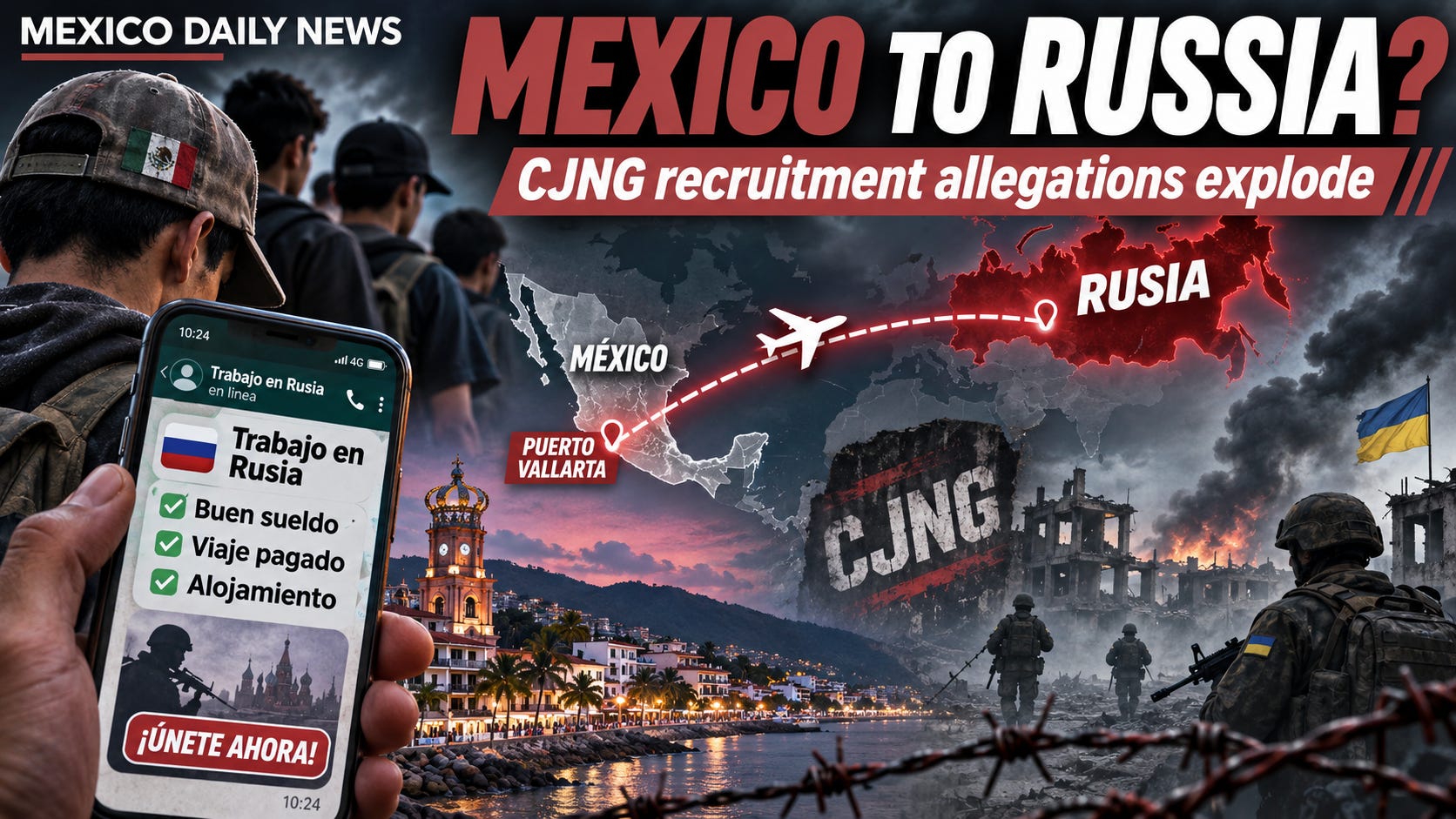
From Mexico to Russia’s Front Lines — Is the CJNG Part of a Recruitment Pipeline?
Mexican men have been offered jobs, salaries, and plane tickets to Russia, only to discover a possible connection to the war in Ukraine. Now a disturbing allegation points toward Puerto Vallarta, raising questions about whether Mexico’s criminal recruitment networks are entering an international market.
Imagine answering a job advertisement promising thousands of dollars a month, free housing, paid airfare, and a chance to make more money than you’ve ever earned in Mexico.
You apply. Someone contacts you through WhatsApp. They arrange your travel, help with the paperwork, and assure you the job is legitimate.
Then you land in Russia.
And suddenly, the security job you thought you accepted has something to do with Vladimir Putin’s war against Ukraine.
That’s not simply a hypothetical scenario. Mexican men have described experiences remarkably similar to this, and Mexico’s embassy in Moscow has acknowledged helping citizens return home after they were lured to Russia through deceptive employment offers.
Now comes another allegation.
Telephone numbers associated with Puerto Vallarta, Jalisco, were reportedly used to recruit Mexican men and arrange their travel to Russia. The claim comes from a columnist who also raises questions about the Cártel Jalisco Nueva Generación, better known as the CJNG.
Yes, that CJNG.
The cartel already linked to forced recruitment scandals, fraudulent job advertisements, and allegations involving young people who disappeared after accepting employment opportunities that turned out to be anything but legitimate.
So here’s the uncomfortable question.
Are we looking at separate criminal schemes that happen to use similar tactics, or could Mexico’s recruitment networks be finding a new business opportunity in Russia’s war?
We don’t have enough evidence to answer that yet.
But there’s more to this story than one sensational newspaper column.
The Phone Numbers That Point Toward Puerto Vallarta
On November 17, the Pepe Grillo Jalisco column in La Crónica de Hoy made a startling allegation.
According to the columnist, telephone numbers associated with Puerto Vallarta were used to contact Mexican men, arrange payments, and coordinate their transportation to flights bound for Russia.
The recruits allegedly believed they were going overseas to work as security guards. They were assured they wouldn’t be involved in the war.
One young man reportedly managed to send a message to his family from the conflict zone, telling them there were many others in the same situation and asking for help getting out.
A day earlier, the same column described two young Mexicans who allegedly arrived near the front lines after signing contracts they couldn’t understand.
According to that account, they were beaten after protesting, given brief weapons instruction, and moved toward the fighting.
Think about that.
A young Mexican man believes he’s boarding a plane for a better-paying job. Days later, according to this account, he’s near one of the deadliest conflicts of the 21st century, possibly facing a situation he never agreed to enter.
The column doesn’t publish the men’s identities, the recruitment messages, or the telephone records. Its claims about those specific men haven’t been independently confirmed.
But the writer raises another question that deserves attention: could the local phone numbers be connected to a larger criminal recruitment operation?
And because we’re talking about Jalisco, the CJNG quickly enters the conversation.
The cartel’s mention is not proof of its involvement. The column doesn’t establish that the organization arranged these trips, knew about them, or received money from the operation.
Still, the possibility is provocative for a reason.
We’ve seen what deceptive job recruitment can look like in Jalisco.
The Job Offer That Turned Into a Russian Military Nightmare
Let’s get away from the speculation for a moment, because there’s a documented case that should alarm anyone who has ever considered taking a job overseas.
In August, La Crónica de Hoy published an investigation involving Daniel Contreras, a 42-year-old Mexican man who accepted what he believed was a private security position in Moscow.
The promised compensation was extraordinary.
A signing bonus equivalent to $28,000. Another $3,000 per month. Housing and meals included.
Recruiters reportedly handled the airfare, hotel arrangements, and visa paperwork.
Contreras traveled to Russia in June, expecting to work in private security. Once he arrived, he said the situation changed.
The men waiting for him explained that his work would involve supporting the Russian military.
He and another Mexican refused to go along with the arrangement. Rather than surrendering their passports or getting into the vehicle that had been sent to collect them, they escaped to Mexico’s embassy.
It took approximately two weeks to arrange their return.
But here’s the detail that makes this more than another story about a job scam.
When La Crónica contacted Mexico’s embassy in Moscow, the diplomatic mission confirmed that it had assisted 14 Mexicans who had been repatriated after accepting deceptive employment offers connected to Russia’s military.
Two additional cases were still open in August.
That’s 16 cases acknowledged at that point, not simply 16 anonymous internet allegations. The figure doesn’t tell us how many total victims may exist today.
And this wasn’t the only warning.
On August 7, UnoTV interviewed another Mexican man who said recruiters offered him more than 500,000 pesos as a signing bonus and around 60,000 pesos a month for security work in Russia.
He received travel arrangements but changed his mind before boarding his flight after learning about suspicious recruitment operations involving other Latin Americans.
According to his testimony, threatening messages followed.
Notice the pattern?
The recruiters don’t necessarily ask desperate workers to join an army.
They offer them a job.
A very good job.
CJNG Already Knows the Business of Fake Job Offers
Here’s where the Mexico connection gets particularly uncomfortable.
The country has already seen how organized crime can turn an employment advertisement into a recruitment trap.
Remember the Rancho Izaguirre scandal in Teuchitlán, Jalisco?
The property became a national symbol of alleged criminal recruitment, with investigations examining how young people were attracted through fraudulent job opportunities.
In September, UnoTV examined how criminal organizations used fake employment advertisements to attract recruits with promises of good salaries and little required experience.
Security work was among the positions advertised.
The similarities with the alleged Russia recruitment operations are difficult to ignore.
Then came another case involving Puerto Vallarta.
In October, El Financiero reported that two young men had been found alive after an investigation into suspected CJNG recruitment through fraudulent employment offers.
They had been missing for months.
The investigation involved authorities in Jalisco and the Secretaría de la Defensa Nacional.
Those men weren’t reported to have been recruited for Russia. Their case was a separate local investigation.
But the similarities in the methods deserve scrutiny.
An attractive job offer. A young person looking for income. An organized group controlling what happens after the applicant agrees.
The CJNG doesn’t need a foreign war to make deceptive recruitment profitable. It’s already been accused of using the practice to obtain people for its own operations.
Which brings us back to Russia.
Could a criminal recruitment network already operating in Jalisco be useful to someone trying to move men overseas?
Of course it could.
Does that mean the CJNG has become a recruiting agency for Vladimir Putin?
No. That conclusion would require evidence we don’t currently have.
But considering Mexico’s documented history with forced recruitment, it’s hardly an unreasonable question for investigators to pursue.
There Is Another Cartel Story Coming Out of Ukraine
As if this weren’t complicated enough, Mexican cartels have also appeared in an entirely different controversy involving Ukraine.
In October, videos circulated showing men wearing Ukrainian military uniforms and making references to the CJNG and the Sinaloa Cartel.
President Claudia Sheinbaum acknowledged that the Mexican government was investigating whether the videos were authentic and who the people involved might be.
Reporting by El País examined the footage and the government’s initial response.
But this is where we need to keep the two stories separate.
The men in those videos allegedly were fighting for Ukraine, against Russia.
The Mexican men described in the deceptive employment cases were being recruited for work connected to Russia’s military.
Opposite sides.
There is another complication: an investigation by Animal Político found that Russian-language media channels had amplified unverified allegations about Mexican cartel members participating in Ukraine’s war effort.
The identities and cartel affiliations of the men in the videos had not been independently established.
That’s an important warning about how quickly an allegation can become a supposed fact when it fits an existing narrative.
One video doesn’t establish an international cartel conspiracy.
Neither does a telephone number associated with Puerto Vallarta.
But the verified cases of deceptive recruitment for Russia-related military work are serious enough without adding an unproven conspiracy.
How Much Is a Mexican Life Worth to a Foreign Recruiter?
There’s something particularly disturbing about the financial side of this story.
A $28,000 signing bonus is a fortune for many Mexican workers.
Even the monthly salaries offered in these recruitment advertisements are far beyond what many applicants could expect to earn in ordinary employment at home.
That’s precisely why such promises can be so effective.
You don’t need to convince somebody that war is glorious when you can persuade them that a job overseas will change their family’s financial situation.
And if the recruiter pays for everything up front, the offer may feel even more legitimate.
A plane ticket. A hotel reservation. A visa. A person waiting at the airport.
All the familiar signs of organized employment.
Until the promised job changes.
Mexico’s Secretaría de Relaciones Exteriores has published an official warning about fraudulent employment offers in Russia.
The advisory identifies risks including deceptive contracts, passport retention, and potential forced labor.
So we are past the point where the entire problem can be dismissed as internet gossip.
Mexican citizens have reported these experiences. The embassy has helped people return. The government has warned others.
What remains unclear is who is coordinating the recruitment, how many people are still involved, and whether criminal organizations in Mexico play any part.
Is Mexico Becoming an Overseas Recruitment Market for Russia’s War?
That’s the bigger question.
Not whether one cartel member might be fighting somewhere in Ukraine. Not whether someone in Puerto Vallarta has a Russian contact on WhatsApp.
The question is whether networks operating inside Mexico are helping move vulnerable workers toward a foreign military conflict under misleading pretenses.
The known cases already provide reason to investigate.
The latest Puerto Vallarta allegations, if supported by records, could identify another connection in that process.
And if investigators eventually discover that organized crime is involved, the consequences would extend well beyond Jalisco.
A criminal organization that recruits workers for a foreign military operation could potentially collect payments, move people across borders, and exploit victims who have little ability to escape once they arrive.
That’s a possibility, not an established description of what’s happening.
For now, we don’t know whether the recruitment contacts associated with Puerto Vallarta belong to cartel members, ordinary intermediaries, independent scammers, or another kind of organization.
But if the telephone records described in La Crónica exist, they are a place to start.
Who owns the numbers? Who paid for the flights? Who collected the passports and personal information? Who received money for bringing recruits into the operation?
Those questions are answerable through evidence.
And they should be answered.
The Most Disturbing Part Isn’t Even the CJNG Allegation
We can spend all day debating whether Mexico’s most notorious criminal organizations have discovered a new international opportunity.
The speculation practically writes its own headlines.
CJNG. Russia. Young Mexican men. War. Missing recruits.
It’s sensational material.
But the part that should bother us most is considerably simpler.
Mexican citizens have already reported being lured overseas with promises of legitimate employment, only to discover that their work was connected to a foreign military. Some needed their government’s help to get home.
Now another report alleges that two young men reached the war zone under similarly deceptive circumstances, and that their recruitment involved contacts associated with Puerto Vallarta.
We don’t know whether those two men have been rescued, whether their families have regained contact, or whether Mexican authorities have opened a specific investigation into the latest allegations.
Nor has the CJNG connection been established.
But suppose investigators do trace the recruitment back to an organized network operating in Mexico.
That would mean the people responsible didn’t have to drag anyone across the border. They only had to offer a salary, buy a plane ticket, and convince someone that a better future was waiting in Moscow.
The cartel connection remains unproven. The deceptive recruitment problem does not.
And somewhere between a WhatsApp job offer in Mexico and a military facility in Russia, somebody needs to explain who is making the arrangements — and what happens to the men who discover the truth too late.