
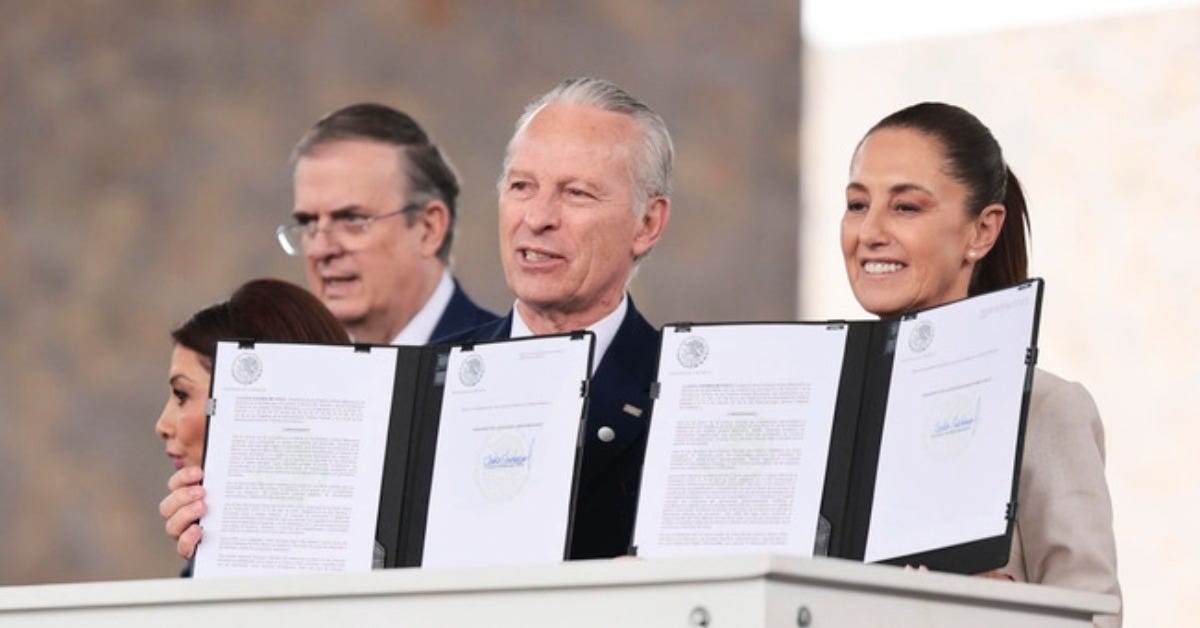
Mexico is trying to answer a difficult economic question: how to attract more private investment without giving up control over national priorities. Plan México is the Sheinbaum administration’s answer. It mixes nearshoring, infrastructure, public procurement, trade policy, faster permits, and state coordination. The May 4 decree adds urgency by promising quick authorization for strategic projects and a 90-day target for other investments. The test is whether the plan reaches beyond large firms and benefits smaller businesses too.
Mexico Wants Investment Without Losing Control. Can Plan México Deliver Both?
Mexico’s government is trying to do two things at once. It wants more private investment, especially from companies looking to move production closer to the United States. It also wants the state to guide where that money goes, which sectors grow, and how much of the value stays inside Mexico.
That is the core idea behind Plan México, the economic strategy now taking shape under President Claudia Sheinbaum. It is not just a slogan for attracting factories. It is an attempt to revive industrial policy, with the government using permits, infrastructure, public procurement, financing, and trade rules to shape the economy.
The latest step came on May 4, when Sheinbaum announced measures to speed up investment approvals. Some projects can move through a fast-track process if they meet strategic conditions. Other private investments are supposed to receive federal permit decisions within 90 days. If the government does not respond within that period, the project may be treated as authorized.
That is a major promise in a country where permitting delays, energy limits, customs rules, and overlapping agencies have often slowed investment. It also raises a larger question. Can Mexico make itself easier for investors while keeping the state in charge of the direction of growth?
Plan México is a shift in economic thinking
For many years, Mexico’s economic model leaned heavily on open trade, foreign investment, and low-cost manufacturing. The country became a key export platform, especially for the U.S. market. But much of that model depended on assembly, imported inputs, and uneven regional development.
Plan México tries to change that balance. The government still wants foreign and domestic investors. It still wants exports. It still wants Mexico to benefit from nearshoring, the relocation of production closer to North American consumers.
But the plan also says growth should be planned. It aims to raise national content, strengthen Mexican suppliers, direct investment into selected sectors, and use public spending as a tool for development.
That is what industrial policy means in practice. The government does not simply wait for the market to decide where investment goes. It picks priorities, sets targets, and creates incentives. In Mexico’s case, those priorities include manufacturing, energy, logistics, pharmaceuticals, semiconductors, technology, infrastructure, agriculture, and strategic supply chains.
This is not a full return to a closed economy. Mexico remains tied to global trade, especially through the T-MEC, known in English as the USMCA. The country’s access to the U.S. market remains one of its strongest advantages.
The difference is that the government wants Mexico to capture more value from that access. It does not want the country to serve only as a low-cost production stop between Asian suppliers and U.S. consumers.
What the May 4 decree changes
The May 4 announcement is important because it moves Plan México from broad goals into administrative action. The government is trying to address one of the complaints investors make most often: slow, fragmented bureaucracy.
Projects can qualify for immediate authorization if they meet at least one of three conditions. They must be located in a Polo de Desarrollo Económico para el Bienestar, involve an investment of at least 2 billion pesos, or belong to a strategic sector.
Those sectors include electronics, technology, textiles, automobiles, energy, and chemicals. Other reports and government materials have also pointed to semiconductors, pharmaceuticals, and related advanced manufacturing as part of the broader strategic map.
For qualifying projects, the government plans to use a simplified digital process. A new presidential investment office and committee would issue an authorization certificate within 30 days.
For other private investments, the government says all federal procedures should be resolved within 90 days. That is one of the clearest benchmarks in the plan. It gives businesses a timeline and gives the federal government a public standard to meet.
The announcement also includes a Ventanilla Única de Trámites de Comercio Exterior, or single window for foreign trade procedures. The idea is to bring trade-related processes from the Economy Ministry, the tax authority, and customs into a single digital channel.
This matters because a factory does not only need land and labor. It needs permits, imported machinery, customs clearance, sanitary approvals, energy connections, transport access, and predictable rules. If one part of that chain stalls, the whole investment can slow down.
The return of state planning
Plan México reflects a wider global shift. Governments are taking a more active role in supply chains, energy security, technology, and manufacturing. The United States has used subsidies and trade rules to rebuild domestic capacity. China has long used state planning. The European Union has moved toward strategic industrial support in key sectors.
Mexico is responding to that environment. It wants to be attractive to investors, leaving or reducing exposure to Asia. But it also wants to avoid becoming only a landing pad for companies seeking cheaper labor and tariff advantages.
That is why Plan México combines private capital with state direction. The government wants investment, but not in any form or place. It wants projects tied to national goals.
The plan’s targets include raising investment as a share of GDP, creating 1.5 million additional jobs in specialized manufacturing and strategic sectors, increasing Mexican content in global value chains, and making public procurement more dependent on domestic production.
The government has also promoted the goal of 50% of public purchases coming from national production. That is a major use of state power. Public procurement can shape markets because government purchases are large, predictable, and tied to infrastructure, health, energy, transport, and public works.
If the government buys more Mexican steel, medicine, equipment, uniforms, trains, vehicles, or technology, it can create demand for local suppliers. But this only works if domestic firms can meet price, quality, and delivery standards.
Public procurement becomes an economic tool
One of the clearest signs of Plan México’s direction is the use of public procurement. The government is not treating public purchases solely as a means of buying goods at the lowest price. It is treating them as a means of building a domestic industry.
This approach can support Mexican companies, especially in sectors where imports have displaced local production. It can also give suppliers the confidence to invest in new machinery, training, and capacity.
But there are risks. If domestic products cost more than imports, public projects can become more expensive. If rules are unclear, procurement can favor politically connected firms. If suppliers are not ready, government agencies may face shortages or delays.
The steel sector shows the logic. Mexico wants more Mexican-made steel used in public projects. That supports the national industry and jobs. It also reduces exposure to imported inputs at a time when tariffs and trade disputes are reshaping global markets.
For readers living in Mexico, this may sound distant. But procurement policy can affect roads, hospitals, schools, energy projects, and public transport. It can also affect prices if higher input costs move through construction and infrastructure budgets.
Infrastructure is the backbone of the plan
Plan México cannot work only through permits and speeches. The country needs enough roads, ports, rail lines, electricity, water, industrial land, and customs capacity to absorb investment.
That is where the broader 5.6 trillion-peso infrastructure plan comes in. The government has described this as a public and mixed investment effort running from 2026 to 2030. It covers strategic sectors, including energy and transport.
Infrastructure is not just a background issue. It is one of the main limits on nearshoring. A company may want to open a plant in Mexico, but it needs reliable electricity, secure transport routes, available industrial land, and fast customs connections.
The May 4 announcement included a road investment package of more than 523 billion pesos, with participation from both the public and private sectors. It covers thousands of kilometers of road projects. The stated goal is to improve logistics, reduce transport costs, and connect regions with higher economic activity.
This points to another part of Sheinbaum’s model. The government wants growth outside the usual industrial corridors. Northern border states and central manufacturing hubs already attract major investment. Plan México also seeks to use development poles to spread investment into other regions.
That goal is difficult. Investors follow infrastructure, suppliers, labor skills, and security conditions. A development pole can help, but only if it solves real business needs.
Nearshoring gives Mexico an opening
Mexico’s biggest advantage is geography. It sits next to the world’s largest consumer market. It also has decades of manufacturing experience, a large workforce, and trade access through the T-MEC.
Nearshoring gives Mexico a chance to attract companies that want shorter supply chains and less dependence on Asia. This is especially important in autos, electronics, medical devices, aerospace, logistics, semiconductors, and advanced manufacturing.
Plan México tries to turn nearshoring from a passive opportunity into a planned development strategy. The government does not want companies to arrive, import most of their inputs, assemble products, and ship them out. It wants more Mexican suppliers inside those production chains.
That is why national content is central. If Mexico increases the share of local inputs in export industries, more of the value stays in the country. That can create more jobs, more tax revenue, and more opportunities for smaller firms.
But building supplier networks takes time. Large manufacturers need reliable parts, certifications, financing, and delivery schedules. Many Mexican small and medium-sized firms cannot meet those requirements without technical support and credit.
That is one of the biggest gaps Plan México must close.
Who benefits first
The fast-track system clearly favors larger projects. A 2 billion-peso investment threshold is not designed for a neighborhood manufacturer, a small logistics company or a family-owned supplier.
The first direct beneficiaries are likely to be large domestic groups, multinational manufacturers, industrial park developers, energy firms, infrastructure companies, and exporters in strategic sectors. These are the companies most able to present complete projects, hire consultants, meet compliance requirements, and navigate federal systems.
That does not mean smaller firms are excluded from the plan. It means their benefits may be indirect.
A small firm could benefit if it becomes a supplier for a larger manufacturer. It could benefit if public procurement rules open doors for domestic providers. It could benefit if Nafin or other financial institutions expand credit. It could benefit if the infrastructure improves logistics in its region.
But those outcomes are not automatic. They depend on whether the government builds a bridge between big investment and smaller business participation.
Without that bridge, small businesses may watch from the sidelines while large companies receive faster approvals, public attention, and access to strategic projects.
The small business question
Plan México includes language about micro, small, and medium-sized businesses. Government materials have set goals, such as expanding access to credit for MiPymes by 2030. Development banking programs are also being used to support financing tied to strategic sectors.
This matters because many small firms in Mexico face the same basic problems. Credit is expensive or unavailable. Informality limits access to contracts. Technology upgrades are hard to finance. Certification costs can be high. Payments from larger clients can be slow.
If Plan México is going to reach beyond headline investments, it needs to help smaller companies become real suppliers. That means financing, training, digital tools, simplified tax compliance, and support for quality standards.
The risk is that industrial policy becomes too top-heavy. Large projects may produce ribbon-cuttings and investment totals, while smaller firms remain disconnected from the value chain.
For retirees and foreign residents who follow Mexico’s economy, this is one of the practical questions. Big investments can lift national statistics, but local benefits depend on whether jobs, contracts, and services spread into surrounding communities.
A new plant can create direct employment. It can also create demand for transport, maintenance, food services, housing, professional services, and local suppliers. But that wider effect requires planning at the local level, not only federal announcements.
Energy remains a pressure point
No industrial plan can succeed without reliable energy. Manufacturing, data centers, logistics hubs, and advanced technology all require stable electricity. Many investors also want cleaner power because their global customers require lower-carbon supply chains.
The government has said it wants to expand generation and increase the share of renewable sources. It also wants the state power company, CFE, to keep a central role.
That creates a balancing act. Mexico wants private investment in sectors that need more electricity. It also wants public control over the energy system. Investors will watch whether the country can provide enough power, at competitive prices, without long connection delays.
Energy is not only about megawatts. It is about location. Industrial parks need grid access. Ports need power. Water systems need power. New rail and logistics corridors need a dependable supply.
If energy bottlenecks continue, fast-track permits may not be enough. A project can receive authorization and still struggle if electricity, transmission, or local infrastructure is not ready.
Trade policy is part of the same strategy
Plan México also connects to trade policy. The government wants to reduce dependence on certain imported goods, especially from countries without free trade agreements with Mexico.
That does not mean Mexico is abandoning global trade. It means the government wants to reshape it. The goal is to import less of what Mexican firms can produce, and to build stronger regional supply chains inside North America.
This approach fits the global moment. Trade is becoming more political. The United States is reviewing supply chains, tariffs, and rules of origin. China remains a major manufacturing power. Companies are trying to reduce risk without losing efficiency.
For Mexico, the T-MEC review is a key test. The country benefits from access to the U.S. and Canadian markets. But that access depends on rules, compliance, and political confidence.
Plan México tries to show that Mexico is serious about regional production. Higher national content, domestic procurement, and strategic sectors all support that message.
The danger is that import substitution can become inefficient if taken too far. Protecting the domestic industry can help firms grow. It can also raise costs if companies are shielded from competition without improving productivity.
The political meaning of control
The phrase investment without losing control captures the political heart of Plan México. Sheinbaum’s government wants private capital, but it does not want private capital to define the country’s development model alone.
That position fits the broader philosophy of the current administration. The state should guide development. Public investment should set direction. Strategic sectors should not be left only to market forces. Growth should be tied to wages, domestic production, and regional balance.
For business groups, the attractive part is faster permits and clearer points of contact. For the government, the attractive part is steering investment toward national priorities.
The tension is obvious. Investors want certainty, speed, and returns. The government wants alignment with public goals. Those aims can work together, but only if rules are clear and applied consistently.
If the fast-track process becomes transparent, it could reduce uncertainty. If it becomes discretionary, it could create a new kind of uncertainty.
That distinction will matter. Investors do not only ask how fast a permit can be approved. They also ask whether the rules are predictable, whether approvals can be challenged, and whether local, state, and federal agencies are coordinated.
The 90-day promise will be tested
The 90-day target is one of the most measurable parts of the May 4 announcement. It is also one of the hardest to deliver.
Mexico’s bureaucracy is complex because investment projects often touch many agencies. A single project may require environmental review, land-use approval, water permits, energy connection, customs registration, sanitary clearance, tax compliance, and local construction authorization.
The federal government can simplify federal procedures. It can also create digital tools and central offices. But many bottlenecks sit at the state or municipal level.
The May 4 plan refers to coordination under the national framework for eliminating bureaucratic procedures and digital simplification. That is important because a federal authorization alone does not always solve local approval problems.
The real test will be whether investors experience a simpler process in practice. It will also matter whether communities see enough transparency around projects that affect land, water, traffic, or the environment.
Speed can help development. But speed without public trust can create conflict.
Environmental and community questions are not secondary
Industrial policy often focuses on factories, investment, and jobs. But large projects also affect land, water, emissions, housing, and public services.
Development poles and industrial corridors can bring employment. They can also increase pressure on local infrastructure. Communities may face higher rents, more traffic, water stress, or changes in land use.
Plan México’s success will depend partly on whether environmental and social review is treated as a serious part of planning, not just as a hurdle to clear.
This is especially important in regions where public services are already stretched. New investment can bring opportunity, but it can also widen local tensions if growth is not matched by housing, water, roads, clinics, and schools.
That is where state planning must prove its value. If the government is going to guide growth, it must also manage its side effects.
What to watch next
The next phase of Plan México will be judged less by announcements and more by execution. The government has now put clear targets on the table. Strategic projects should move quickly. Other private investments should receive federal decisions within 90 days. Foreign trade procedures should become easier through a single window.
Investors will watch whether those timelines hold. Small businesses will watch whether financing and supplier programs become accessible. Workers will watch whether jobs are stable and well-paid. Local communities will watch whether new projects bring services and opportunities, not only pressure.
Mexico has a real opening. Nearshoring, trade tensions, and North American supply-chain changes give the country leverage. But leverage is not the same as results.
Plan México is an attempt to turn a favorable moment into a guided development model. It asks private capital to come in, but on terms shaped by national priorities. It uses the state not only as a regulator, but as a planner, buyer, builder, and coordinator.
The idea is clear. Mexico wants investment, but not at any price. It wants growth, but not growth that leaves the country dependent on imported inputs and low-value assembly.
Whether Plan México can deliver both will depend on the details: permits that move, infrastructure that works, energy that arrives, procurement that is fair, and small businesses that are brought into the chain instead of left outside it.