
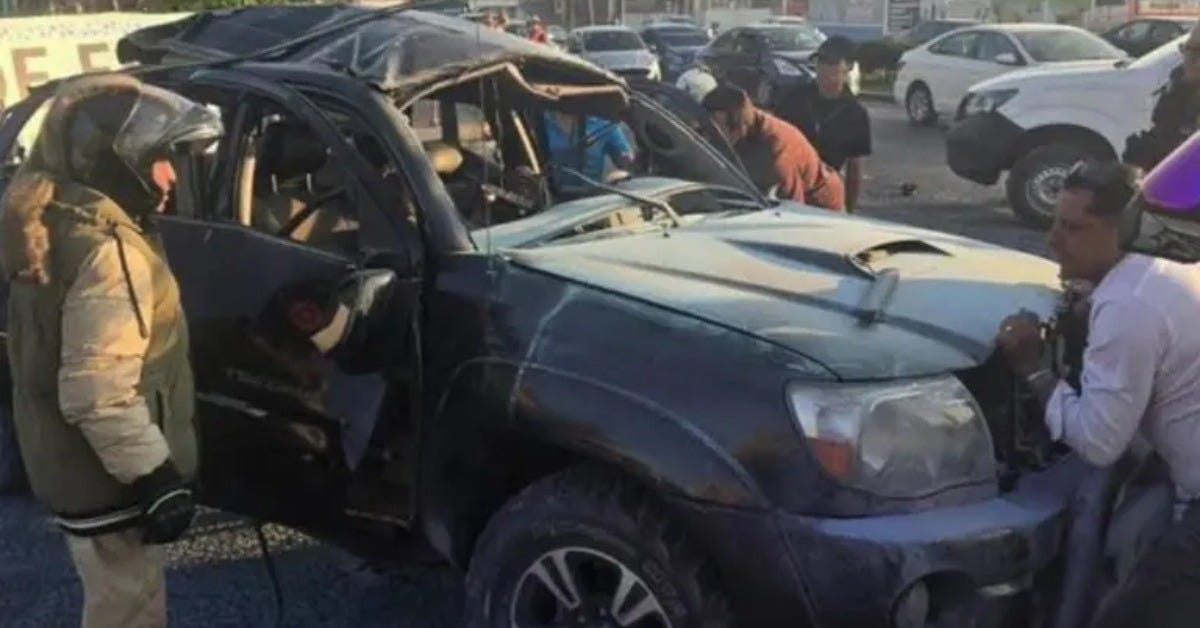
A March vehicle explosion near Mexico City has moved back into the center of a tense debate over sovereignty and security cooperation. The CIA has denied taking part in an alleged attack on Francisco Beltrán, known as “El Payín,” while Mexico’s security secretary rejected any suggestion that foreign agencies can conduct unilateral operations in the country. The dispute comes as Mexico and the United States face growing pressure over cartel violence, intelligence sharing, and the limits of cross-border cooperation.
CIA denies role in alleged cartel attack
The CIA has denied participating in an alleged attack in the State of Mexico that killed Francisco Beltrán, a suspected Sinaloa Cartel operator known as “El Payín.”
Beltrán died in March after the vehicle he was traveling in exploded in Tecámac, near the Felipe Ángeles International Airport and the Mexico-Pachuca highway. Another person in the vehicle also died.
The case first appeared to involve a vehicle explosion under investigation by Mexican authorities. New claims later suggested the incident may have been a targeted attack linked to a covert U.S. intelligence operation.
The CIA rejected that version. Mexico’s federal security secretary, Omar García Harfuch, also denied that foreign agencies carry out lethal or unilateral operations inside Mexico.
Mexico says cooperation has limits
García Harfuch said Mexico works with the United States through intelligence sharing and formal coordination. He also said operational actions inside Mexico belong only to Mexican authorities.
That message fits the position President Claudia Sheinbaum has repeated in recent months. Mexico accepts security cooperation with the United States, but not foreign forces acting independently on Mexican soil.
The issue is sensitive because cartel violence affects both countries. Mexico faces the violence directly, while the United States has increased pressure over fentanyl, weapons trafficking, and organized crime networks.
For Mexico, the concern is sovereignty. For Washington, the concern is whether current cooperation is enough to disrupt cartel operations.
Explosion remains under investigation
The State of Mexico prosecutor’s office has said the Tecámac explosion remains under investigation. Authorities have not issued a final public conclusion on the cause of the blast.
Beltrán had been described as a suspected criminal operator from Sinaloa. Earlier accounts said authorities were reviewing whether the explosion came from an accidental detonation or a direct attack.
That uncertainty has made the case politically larger than the explosion itself. The question is no longer only what happened in Tecámac. It is also whether U.S. agencies are acting beyond agreed channels in Mexico.
A tense moment for U.S. Mexico security ties
The denial comes during a strained period in U.S.-Mexico security relations. Recent disputes have involved U.S. personnel, anti-cartel operations, and public pressure from Washington for stronger action against organized crime.
For foreigners living in Mexico, the story is not about immediate personal risk. It is about the direction of national security policy and how Mexico handles pressure from its northern neighbor.
The government’s response shows that Mexico wants to keep cooperation open while drawing a clear line. Intelligence can be shared. Joint objectives can be discussed. But Mexico says enforcement actions inside the country must remain under Mexican authority.
The Tecámac case is still unresolved in public terms. What is clear is that the allegation has added new tension to a relationship already shaped by drugs, guns, migration, trade, and election-year politics.