
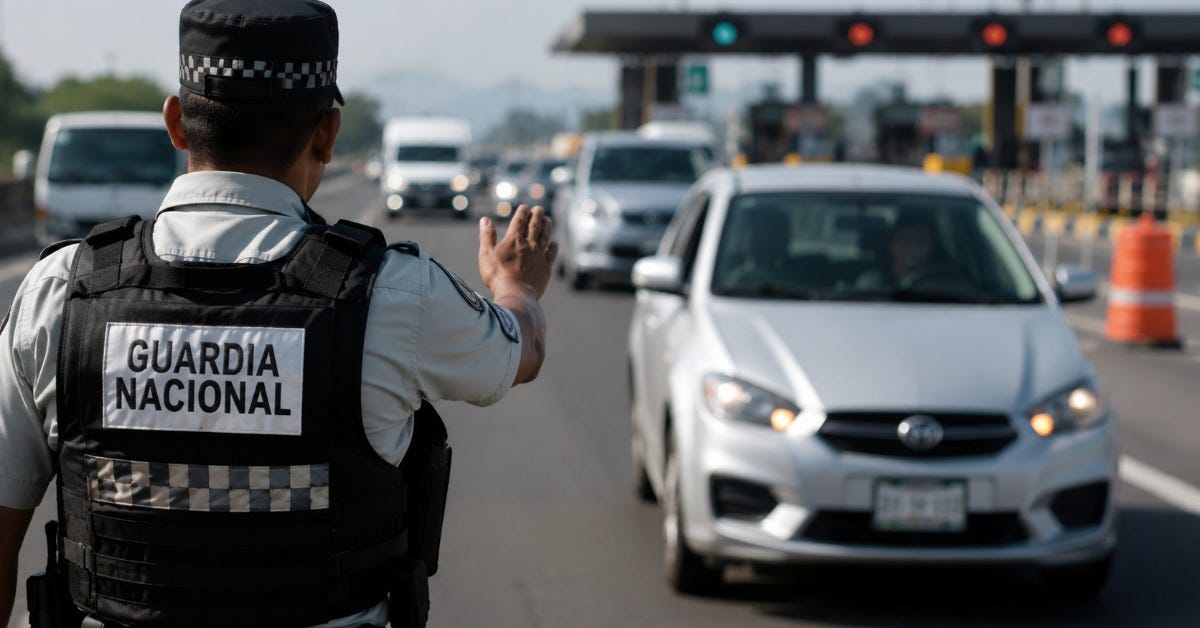
Drivers on Mexico’s federal highways now face a more formal role for the National Guard at checkpoints, crash scenes, and roadside stops. A new federal decree grants agents authority to inspect vehicles, verify documents, impose sanctions, and detain individuals in limited cases. For Puerto Vallarta residents and visitors who use Highway 200, toll roads, or long-distance routes, the change is small enough to miss but noticeable before the next drive out of town.
National Guard Gets Broader Federal Highway Powers
Mexico’s National Guard can now inspect vehicles, issue traffic sanctions, and detain people in specific cases on federal highways. The change comes from a federal decree that rewrites parts of Mexico’s road-traffic rules.
Published by the Diario Oficial de la Federación decree on May 25, the decree reforms the Reglamento de Tránsito en Carreteras y Puentes de Jurisdicción Federal. It took effect the next day. The Guard now has a larger formal role in traffic control on federal roads and bridges.
The reach is national, but the local angle is plain enough. Puerto Vallarta drivers use federal routes such as Highway 200 for airport runs, coastal trips, deliveries, and weekend travel. Vallarta Daily has also covered past emergency closures on Highway 200, including a fuel-truck response in Cabo Corrientes.
What the Guard can do at the roadside
Revised language defines Guard personnel as authorities with inspection, security, and surveillance powers in federal traffic matters. It also allows them to determine sanctions for violations committed on federal roads.
Roadside stops may now involve more than a warning and a glance at plates. The decree lets Guard agents direct traffic, request a driver’s license and vehicle registration card, verify documents, prepare infraction tickets, and issue sanctions. In traffic incidents, they may prepare technical reports. For property-damage cases, when drivers agree, they may also draw up an Acta-Convenio.
Vehicle condition gets a new weight in the rules. Authorities may verify physical and mechanical conditions in federal road traffic. The text also mentions brake-system checks in cases tied to federal transport rules. In plain highway Spanish, bad brakes and bad paperwork can now become official business much faster.
The Guard’s instructions can outweigh signs
One sharper line says National Guard instructions prevail over traffic-control devices and other applicable rules on federal roads. Ignoring those instructions or traffic-control devices can result in a fine of 40 to 50 times the daily quota set by the regulation.
That daily quota equals one Unidad de Medida y Actualización, under the same regulation. Some fines may be reduced when the driver recognizes the violation on the ticket. Another reduction applies when payment is made within the stated period.
When detention can enter the stop
The decree does not describe detention as a routine part of every stop. Its language ties detention to conduct such as resisting Guard instructions, refusing to provide a license or registration card, or making threats, insults, or acts of aggression toward Guard personnel, other authorities, or emergency workers.
In those cases, the Guard may detain the person and present them to the Ministerio Público. The stated federal offense is disobedience and resistance by private individuals. Separate language says Guard personnel must detain drivers involved in traffic incidents when they are drunk or under the effects of narcotics or psychotropic substances.
Procedure matters here. Once a vehicle is stopped, the regulation states that the Guard may direct the driver, passengers, and companions to remain inside until otherwise directed. The agent then requests documents, verifies them, and, when a fine applies, fills out the ticket.
For residents and visitors, carry proper vehicle documents. Follow direct roadside instructions. Treat a federal highway stop as a formal process. Mexico’s roads already had enough surprises. This one now comes with a printed ticket.