
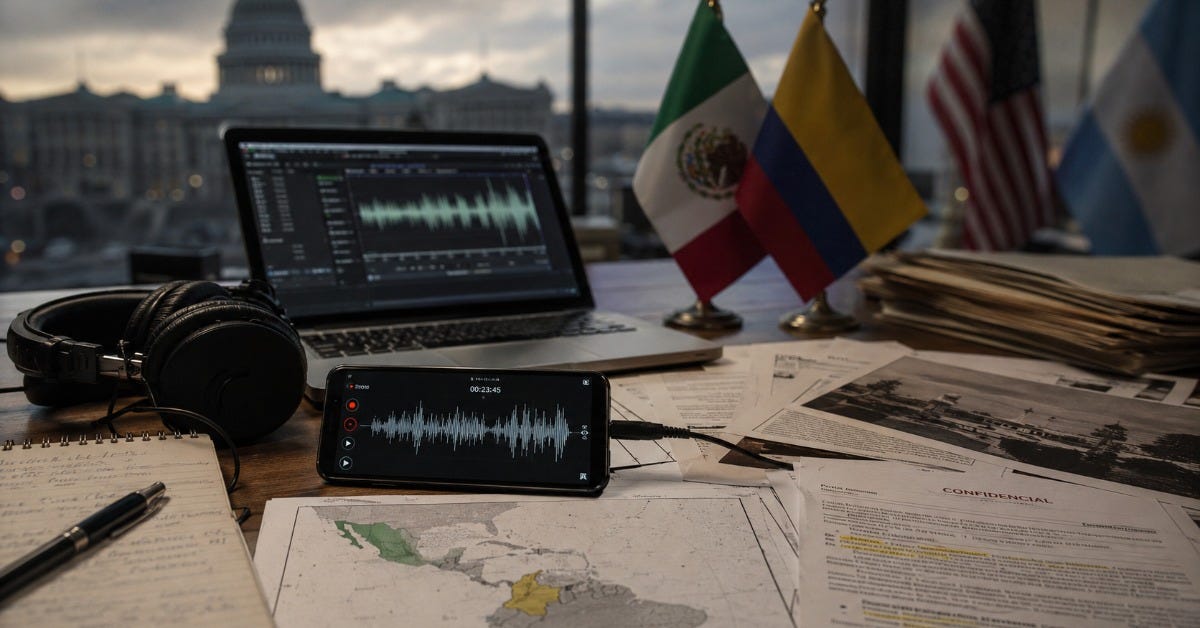
A new round of leaked recordings has pushed the Hondurasgate controversy beyond Central America and into Mexico’s political debate. The audios allegedly describe plans for a U.S.-based digital media operation aimed at damaging the governments of Mexico and Colombia. The claims involve former Honduran President Juan Orlando Hernández, who was convicted in the United States and later pardoned by Donald Trump. Mexican President Claudia Sheinbaum has responded publicly, while key questions remain over verification, intent, and political fallout.
Hondurasgate claims reach Mexico
A second set of Hondurasgate audio recordings has placed Mexico and Colombia inside a wider political controversy over alleged foreign-backed media operations in Latin America.
The recordings, published as part of an ongoing leak, allegedly include conversations involving former Honduran President Juan Orlando Hernández and current Honduran officials. The material claims that a digital media operation would be created in the United States to publish damaging material about the governments of Claudia Sheinbaum in Mexico and Gustavo Petro in Colombia.
The claims remain allegations. The recordings have not been proven in court, and there has been no public finding by an independent judicial authority confirming the full content or origin of the audio recordings.
Still, the leak has drawn attention because of Hernández’s recent history. In 2024, he was sentenced in the United States to 45 years in prison for drug trafficking and weapons-related offenses. In December 2025, Donald Trump granted him a pardon, leading to his release.
What the leaked audios allege
The central allegation is that Hernández discussed setting up a digital journalism unit outside Honduras. The stated purpose, according to the leaked material, was to create a Latin America-focused information platform that could not easily be traced back to Honduran political actors.
The audio allegedly refers to funding for an office, staffing, and a campaign to produce material against political opponents in Honduras, Mexico, and Colombia. One claim in the leaked material says Argentine President Javier Milei would provide financial support for the effort.
The recordings also allegedly mention figures linked to the Republican Party in the United States. The material does not, on its own, establish that any government formally approved such a plan.
Sheinbaum responds to the claims
Sheinbaum has addressed the controversy by framing it as part of a broader disinformation effort against governments that defend national sovereignty.
Her response was measured but firm. She said such campaigns may create confusion for a time, but argued they would not damage her administration if it remained connected to the public.
For residents in Mexico, including foreign residents who follow national politics closely, the immediate takeaway is not a change in daily life or policy. The story is more about the information environment around Mexico, and how political narratives can be shaped from outside the country.
Mexico’s government has already been managing pressure from Washington over security cooperation, cartels, and sovereignty. The Hondurasgate claims land inside that larger debate.
Why the Hernández connection matters
Hernández is not a minor figure in this story. He governed Honduras from 2014 to 2022 and was later extradited to the United States. Prosecutors accused him of helping move hundreds of tons of cocaine through Honduras toward the U.S. market.
His conviction made him one of the most prominent former Latin American presidents sentenced in a U.S. drug case. His pardon by Trump months later created political controversy across the region.
The new allegations are sensitive because they suggest Hernández may have remained politically active after his release. They also suggest his role may have extended beyond Honduran politics into wider regional messaging efforts.
Hernández has denied that at least one of the voices in the recordings is his. Honduran President Nasry Asfura has not given a detailed public response to the allegations.
Verification remains the central issue
The group behind the leak says the recordings were reviewed using voice-analysis software. That may support the publishers’ confidence in the material, but it does not settle every question.
Audio leaks are difficult to handle in journalism because they can be edited, taken out of context, or misidentified. They can also be authentic and still require careful reporting to determine who was speaking, when the conversation happened, and whether any proposed plans were carried out.
The audios allege a media operation. They claim funding and coordination. They raise questions about foreign influence and regional disinformation.
They do not, by themselves, prove that the governments of the United States, Argentina, or Israel carried out an official campaign against Mexico or Colombia.
A regional story with local relevance
The Hondurasgate controversy comes as Mexico continues to push back against outside pressure over security, migration, and organized crime. Sheinbaum has repeatedly said Mexico will cooperate with other countries, but will not accept foreign operations that violate sovereignty.
That position is central to the current political climate. It also helps explain why the leaked audios gained traction in Mexico.
The story is a reminder that national politics in Mexico are often shaped by regional pressures. U.S. policy, Latin American alliances, and online information campaigns can all affect the way Mexico is discussed abroad.