
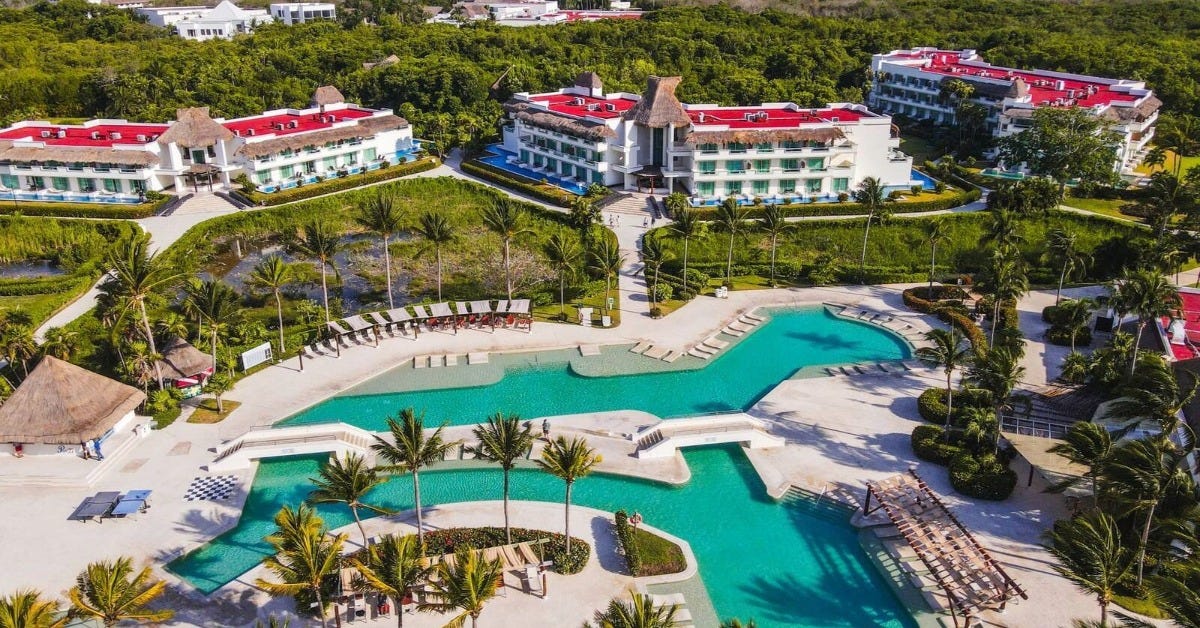
Marriott, Aimbridge Hospitality, and Grupo Satli are moving toward a 980-room all-inclusive resort in the Riviera Maya, with plans to bring the property into Marriott’s all-inclusive portfolio in 2027. The announcement adds another large resort project to a corridor already defined by scale, beachfront branding, and pressure on local infrastructure. The companies disclosed major amenities, including 12 pools and 13 food-and-beverage venues, but left several public details unanswered, such as the project cost and the exact municipality.
Marriott’s huge Riviera Maya resort plan is no small bet
Marriott International, Aimbridge Hospitality, and Grupo Satli have announced a 980-room all-inclusive resort project for the Riviera Maya. The plan adds another large property to a coastal corridor already crowded with hotel investment.
The project is planned for a 180-hectare beachfront site. It would have about 400 meters of beachfrontage. The companies said the property would include 13 food-and-beverage venues, 12 pools, broad water areas, and a large spa. Plans also include more than 4,000 square meters of indoor meeting and event space. A lazy river, two tennis courts, and entertainment areas are also planned.
The announcement did not identify the municipality. It did not give a project cost, cite a federal environmental authorization, or disclose a construction start date. The companies said the resort is expected to operate first as an independent brand. It would then join the Marriott Hotels All-Inclusive portfolio in 2027.
A large project in a crowded corridor
Grupo Satli is listed as the developer and owner. Aimbridge’s All-Inclusive Division is expected to operate the property. Marriott would bring it into its all-inclusive portfolio in Mexico. That portfolio already includes Marriott Cancun, an all-inclusive resort in northern Cancun.
Uriel Burak, Marriott’s vice president of development for the Caribbean and Latin America, described the deal as the company’s “first Marriott Hotels & Resorts branded all-inclusive property in the Riviera Maya region.”
Jamal Satli Iglesias, chair of Grupo Satli, said the project has an “anticipated opening in 2027.” Aimbridge executives said the agreement expands the company’s all-inclusive work in Mexico and Latin America.
The scale is the story. A 980-room resort is not a boutique addition. It is a room-heavy bet on the continued strength of the Riviera Maya. It also bets on travelers who want a mostly self-contained vacation. The package is built around food, pools, beach access, meetings, weddings, and entertainment.
All-inclusive growth keeps moving
The announcement lands during a period of continued large-hotel planning along the Mexican Caribbean. A recent 1,000-room Riviera Cancún complex from Grupo Posadas showed the same pattern. Developers are still building around premium rooms, group travel, and large amenity packages.
The same model can produce uneven effects outside the hotel gates. Tourism operators in Quintana Roo have said some resort guests are spending less outside all-inclusive properties. That includes parks, tours, and other activities. That can happen even when hotels remain busy.
More rooms can mean more payroll, tax activity, and demand for suppliers. They can also keep more visitor spending within a single property. That is especially true when meals, drinks, entertainment, and activities are bundled into the room price.
Investment continues despite strain
Quintana Roo remains one of Mexico’s strongest magnets for tourism capital. The federal tourism investment portfolio for the first four months of 2026 listed 773 projects across the country. Together, they were worth more than 42.452 billion dollars. Quintana Roo accounted for 20 percent of programmed tourism investment, the largest share among Mexican states.
That helps explain why large brands keep moving into the corridor. The Riviera Maya has global name recognition. It has airport access through Cancun and Tulum. It also has a long record of selling beach vacations to North American and European markets.
It also explains the scrutiny. New beachfront projects now arrive in a region with harder limits. Water, roads, coastal access, labor housing, sargassum, wastewater, and land clearing are no longer side issues. They are part of the cost of growth.
What has not been disclosed
The companies have described the brand plan and the resort amenities. They have not publicly provided a project budget, a permitting timeline, the precise site, or the number of expected jobs. They also have not said whether the work involves new construction, conversion, expansion, or a combination of these.
Those details matter because the Riviera Maya is no longer judged only by arrivals and room counts. Each new project now faces that test. Tourism demand remains high, but land, infrastructure, and public patience are finite.