
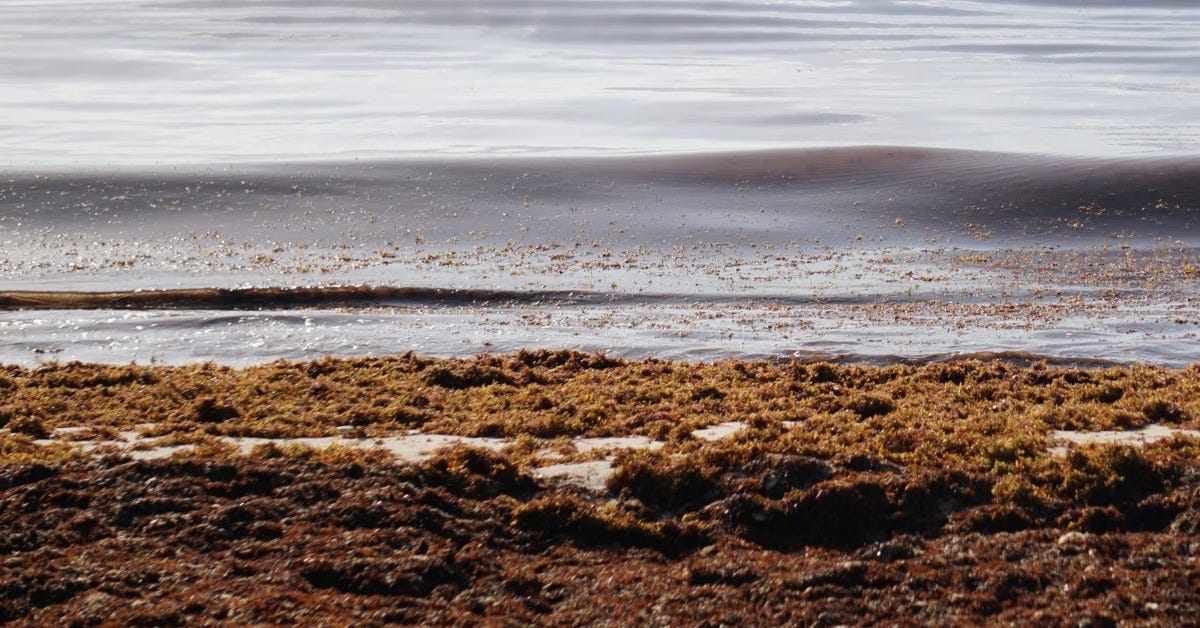
A new sargassum warning is putting Mexico’s Caribbean coast back in focus before the heaviest beach season fully unfolds. A UNAM-linked specialist says the Atlantic could hold 40 million metric tons of sargassum biomass this year, with Quintana Roo expected to collect more than it did in 2025. The seaweed is not new, and it is not always harmful. But when large amounts reach shore, it becomes a beach, tourism, health, and environmental problem that is increasingly hard to manage.
UNAM-linked warning points to another heavy sargassum year
Mexico’s Caribbean coast is facing another difficult sargassum season, with a UNAM-linked specialist warning that the Atlantic could hold about 40 million metric tons of sargassum biomass this year.
Jorge Prado Molina, coordinator of the National Laboratory for Earth Observation, based at UNAM’s Institute of Geography, said authorities expect higher collection levels in Quintana Roo. Last year, the state collected about 96,000 tons of sargassum.
The estimate does not mean all of that seaweed will reach Mexico. The figure refers to biomass across the Atlantic. Still, it signals a large bloom system moving through the same ocean region that feeds arrivals in the Caribbean, Gulf of Mexico, and parts of the tropical Atlantic.
For Quintana Roo, the concern is practical. When sargassum stays offshore, it can serve as habitat for fish, turtles, and other marine life. When it reaches beaches in large volumes, it can affect swimming areas, hotel zones, water quality, reefs, seagrass beds, and public health.
What sargassum is and why it reaches Mexico
Sargassum is a floating brown seaweed that moves with winds and ocean currents. It has long existed in the Atlantic and can be useful in the open sea. It provides food, shelter, and breeding habitat for many marine species.
The problem begins when large mats drift toward shore and accumulate faster than crews can remove them. Once stranded on land, sargassum begins to decompose. That can create strong odors, stain coastal waters, and make beaches less usable.
Since 2011, scientists have tracked major blooms linked to what is often called the Great Atlantic Sargassum Belt. This belt stretches across parts of the tropical Atlantic and can send large amounts of seaweed toward the Caribbean.
Recent research has looked beyond the old idea that most of the problem comes from the Sargasso Sea. Newer studies point to a more complex system involving West Africa, Atlantic circulation, wind shifts, nutrient availability, and ocean warming.
Why this affects beaches, tourism and health
The most visible impact is on beaches. Heavy sargassum can cover the sand, turn nearshore water brown, and make swimming unpleasant. For tourism areas such as Cancún, Playa del Carmen, Tulum, Puerto Morelos, Isla Mujeres, and Mahahual, this can affect hotel operations and visitor expectations.
There are also environmental concerns. Large amounts of decomposing sargassum can reduce oxygen in shallow water. It can block the sunlight that seagrass and coral systems need. If handled poorly, it can add pressure to already stressed coastal ecosystems.
Health concerns usually come from decomposing sargassum, not fresh floating seaweed offshore. As it breaks down, it can release hydrogen sulfide and ammonia. These gases can irritate the eyes, nose, and throat. People with asthma, respiratory problems, heart conditions, children, and older adults may be more sensitive.
Sargassum can also accumulate substances such as arsenic and heavy metals, which makes disposal more complicated. That is one reason specialists caution against using it casually as animal feed or dumping it in places where runoff could reach groundwater.
Cleanup is expensive and imperfect
Quintana Roo has used a mix of barriers, collection boats, beach crews, and monitoring systems to manage arrivals. The goal is to remove as much sargassum as possible before it decomposes on shore.
That is not easy. Sargassum does not always arrive as one large mat. It can move in strips, patches, and loose accumulations across wide ocean areas. Winds can also shift quickly, changing which beaches receive heavy arrivals.
UNAM specialists have used satellite images and models involving currents, wind, and waves to improve monitoring. The work is meant to help predict where floating rafts may arrive and reduce the damage before the seaweed reaches reefs and beaches.
Even so, the scale can overwhelm local systems. Barriers may help in some areas, but they cannot fully stop large volumes. Mechanical beach cleaning can remove seaweed, but it can also remove sand and disturb coastal areas if not managed carefully.
The 2026 season was already showing pressure
The warning comes after early signs of a heavy 2026 season. Satellite-based outlooks from the University of South Florida showed record-high March sargassum amounts in several monitored regions, except the eastern Atlantic.
By early April, Mexican authorities had reported collecting more than 16,000 tons of sargassum in Quintana Roo in 2026. The work was concentrated in affected municipalities, including Isla Mujeres, Benito Juárez, Puerto Morelos, Playa del Carmen, Tulum, and Othón P. Blanco.
State and federal officials have also discussed increasing collection capacity and improving offshore removal. The strategy is based on a simple idea: Sargassum is easier to manage before it reaches the beach and starts to rot.
The challenge is that offshore collection requires boats, fuel, crews, weather windows, and good forecasting. Once the seaweed spreads across a large area, collecting it efficiently becomes much harder.
What residents and visitors should know
A heavy sargassum season does not mean every beach is affected every day. Conditions can vary from one town to the next and even from one section of the beach to the next.
For residents and visitors, the most useful step is to check current local beach conditions before making plans. Some beaches may be clear while others have heavy buildup. Hotel zones are often cleaned daily, but public beaches can vary depending on municipal resources and arrival volume.
People with respiratory issues should avoid spending long periods near decomposing sargassum, especially where the odor is strong. Beach workers and cleanup crews face greater exposure because they handle the material directly and may work near it for hours.
The broader issue is not only beach appearance. Sargassum has become a recurring environmental management problem for the Mexican Caribbean. It affects tourism, public health, municipal budgets, marine habitats, and coastal planning.
This year’s Atlantic biomass estimate suggests Quintana Roo may be entering another season where quick response and reliable monitoring will matter. The state has learned to live with sargassum. The harder question is how to manage larger blooms that keep returning.
Playa del Carmen now has a sargassum gas monitor