
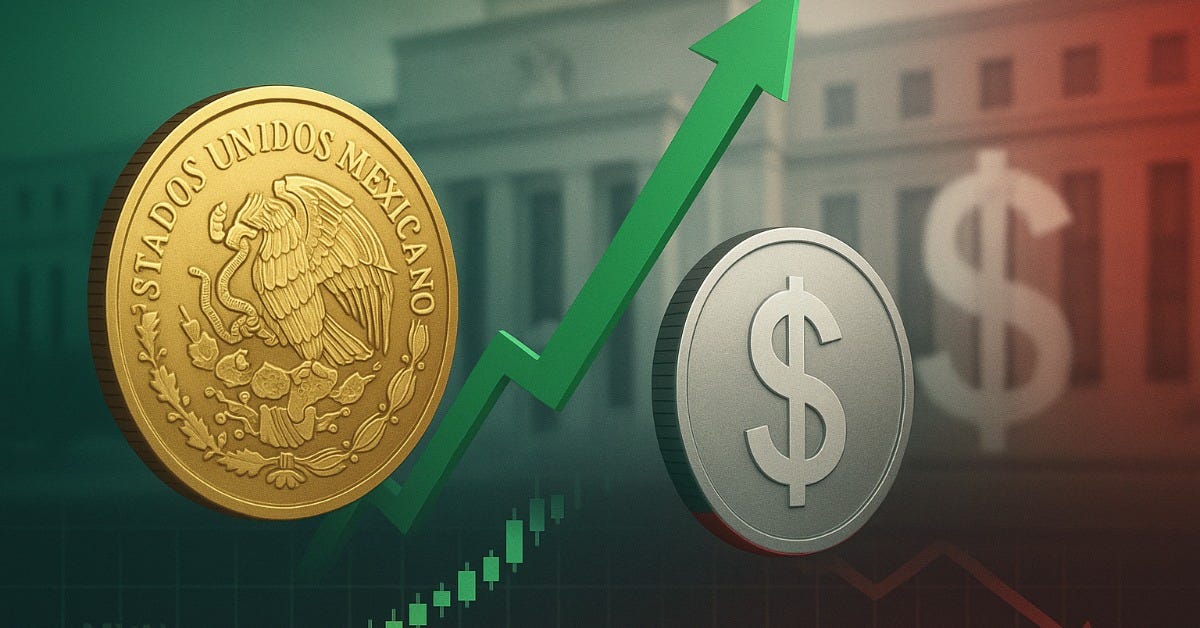
The peso opened May 8 with fresh strength against the U.S. dollar, reaching its best level in about a month by Banxico’s official FIX rate. The move can lower costs for some buyers, importers, and travelers, but it also changes the math for anyone living in Mexico on a dollar income. The stronger peso comes as Banxico just cut interest rates and signaled a pause, making the exchange rate one of the key numbers to watch.
Peso opens May 8 at its strongest level in a month
The Mexican peso opened Friday, May 8, at its strongest official level against the U.S. dollar in about a month, according to Banco de México exchange-rate data.
Banxico’s FIX rate stood at 17.2400 pesos per U.S. dollar, placing the peso near levels last seen in late April. The rate marked a clear recovery from early April, when the dollar traded closer to 17.81 pesos, according to recent reference data.
For people following Mexico’s daily cost of living, the number is more than a market headline. A stronger peso changes what travelers pay, what importers spend, and how much foreign income is worth once converted into pesos.
The move also comes at a sensitive time for Mexico’s economy. Banxico cut its benchmark interest rate to 6.50%, effective May 8, and said it was ending the rate-cutting cycle that began in March 2024. The central bank also noted that the peso had appreciated since its previous monetary policy decision.
What the Banxico FIX rate actually means
The FIX rate is not the same as the rate shown at every bank window, exchange house, ATM, or credit card processor. It is an official reference rate calculated by Banco de México using wholesale currency-market quotations.
Banxico publishes the FIX on banking business days. It is later published in the Diario Oficial de la Federación and is used for some dollar-denominated obligations payable in Mexico.
That means the FIX is a useful benchmark, but most consumers will not receive that exact number. A person exchanging dollars at a bank may see a different buy or sell rate. ATM withdrawals and card purchases can also include network rates, bank spreads, and fees.
For readers who live in Mexico and receive income in dollars, the practical point is simple. When the peso strengthens, each dollar buys fewer pesos. When the peso weakens, each dollar buys more pesos. The official rate helps show the market's direction, but the final rate depends on where and how the exchange occurs.
Who benefits from a stronger peso
A stronger peso can help businesses and consumers who buy goods priced in dollars. That includes importers, retailers bringing in foreign products, and companies that pay for equipment, supplies, or technology in U.S. currency.
Travelers can also see some benefits. Mexicans going abroad may find that flights, hotels, and purchases priced in dollars become cheaper in peso terms. People in Mexico buying foreign goods online may also get some relief, depending on the payment platform and exchange spread.
There can also be an inflation effect. A stronger peso can help reduce the peso cost of imported goods, fuel-related inputs, and some wholesale products. That does not mean prices fall immediately at the supermarket. It can, however, reduce one source of pressure for businesses that buy from abroad.
For households, the effect is mixed. Some imported products may become easier to buy. Local rent, services, restaurant prices, and groceries may not move in the same direction. Many daily expenses depend more on local demand, wages, supply costs, and business pricing than on the exchange rate alone.
The other side for dollar earners in Mexico
A strong peso can be harder for retirees, remote workers, and long-stay residents who receive income in U.S. dollars. A monthly budget that felt comfortable at 19 or 20 pesos per dollar stretches less at 17.24.
For example, every $1,000 dollars converts to about 17,240 pesos at the official FIX rate. At 18.50 pesos per dollar, that same $1,000 would convert to 18,500 pesos. The difference is more than 1,200 pesos before bank spreads or fees.
That gap can matter for rent, utilities, medical visits, groceries, and local transportation. It can also affect people who priced their Mexico budget using older exchange-rate assumptions.
The stronger peso does not mean Mexico is suddenly more expensive in every category. It does mean dollar-based income has less buying power than it did when the dollar traded higher.
Banxico’s rate cut adds context
The peso’s strength is notable because it came alongside a rate cut by Banxico. In many cases, lower interest rates can reduce a currency's appeal. This time, the peso remained firm as investors weighed Mexico’s inflation path, the dollar’s recent weakness, and the central bank’s signal that further cuts are not expected for now.
Banxico reduced its reference rate by 25 basis points to 6.50%. The decision was not unanimous. Three members voted for the cut, while two preferred to keep the rate at 6.75%.
The central bank said headline inflation fell from 4.63% in the first half of March to 4.45% in April. Core inflation also eased, moving from 4.46% to 4.26% over the same period.
Even with that improvement, inflation remains above Banxico’s 3% target. The bank said it expects inflation to converge to that target in the second quarter of 2027. It also pointed to risks from geopolitical conflict, trade policy changes, cost pressures, climate impacts, and possible depreciation of the peso.
What to watch next
The exchange rate can move quickly, especially when several forces hit at once. Mexico’s interest-rate path, U.S. Federal Reserve policy, inflation data, oil prices, trade tensions, and global risk sentiment can all shift the peso-dollar rate.
For now, the peso is trading near a level that helps importers and some buyers of dollar-priced goods. It also creates pressure for people in Mexico who depend on U.S. dollar income.
The next important question is whether the peso can hold near these levels, or whether the dollar regains ground after Banxico’s rate cut. For residents and travelers, the safest approach is to treat the current rate as a snapshot rather than a guarantee.