
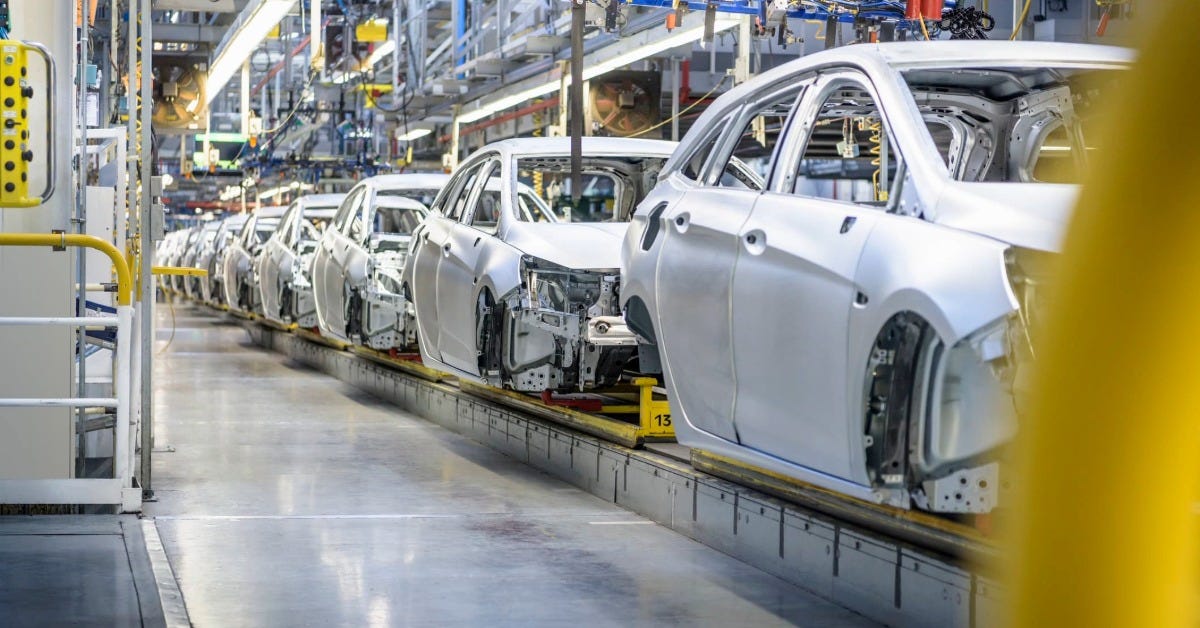
Mexico is still one of the world’s major auto-making countries, but its latest global ranking shows how quickly trade pressure can change the picture. New industry data place Mexico behind Germany and South Korea after a drop in total vehicle assembly. The shift was narrow, but the causes are larger: weaker heavy-truck production, softer exports, and U.S. tariffs that are adding new costs to North America’s tightly linked auto supply chain.
Mexico drops from top five in global auto production
Mexico fell from fifth to seventh place among the world’s largest vehicle-producing countries in 2025, a shift that highlights new pressure on one of the country’s most important industries.
The latest global production data show Mexico assembled 4,092,488 vehicles last year. That was a 2.6% decline from 2024 and enough to push the country below South Korea and Germany.
The change was not a collapse. It was a narrow loss of ground. South Korea produced 4,102,200 vehicles, fewer than 10,000 more than Mexico. Germany produced 4,148,836 vehicles, placing it fifth.
Still, the drop matters because Mexico had moved ahead of both countries in 2024. The latest ranking suggests that Mexico’s auto sector remains strong, but is more exposed to trade shocks than it was a year earlier.
A narrow fall with a wider signal
The top four global producers remained well ahead of Mexico. China held first place with more than 34.5 million vehicles, followed by the United States, Japan, and India.
Mexico’s position is different. It is not competing mainly on the basis of the size of its domestic market. Its strength comes from export production, supplier networks, and its role inside the North American auto supply chain.
That is where the latest data raises concern. Mexico’s decline came during a year when North America’s share of global assembly also slipped. Asia-Oceania gained ground, led by China’s continued expansion.
For readers in Mexico, this not only affects factory towns. The auto sector is tied to exports, transport, logistics, ports, rail, customs, industrial parks, and public revenue. When production slows, the effect can move through the wider economy.
Heavy trucks were the main drag
The biggest hit came from heavy vehicles, not passenger cars.
Mexico’s heavy-truck production fell 34.8% in 2025 to 138,954 units. That represented almost 75,000 fewer vehicles than the year before.
Light-vehicle production was weaker, but not nearly as severe. Mexico produced 3,953,494 light vehicles in 2025, down 0.9% from 2024.
That split helps explain the ranking change. Mexico’s car and light-truck industry remained large, but the sharp decline in heavy vehicles pulled down the national total.
Heavy trucks are also closely tied to business confidence. Companies buy cargo vehicles when they expect more freight, construction, manufacturing, and trade. When fixed investment slows, transport equipment purchases can be delayed.
Tariffs add pressure to Mexico’s model
The other major pressure came from U.S. tariffs.
In 2025, the United States imposed a 25% tariff on imported automobiles and later applied tariffs to certain auto parts. Later in the year, it imposed a 25% tariff on medium- and heavy-duty trucks and parts, and a 10% tariff on buses.
Mexico and Canada have some protection under T-MEC, known in English as USMCA. Vehicles that meet the agreement’s rules can receive partial relief, with the tariff applied only to non-U.S. content.
That treatment softens the blow, but it does not erase the problem. Automakers still face paperwork, compliance costs, uncertainty, and pressure to review where each part is made.
For Mexico, that is a serious issue. The country’s auto industry was built around regional integration. A vehicle may cross borders several times before it reaches a buyer. Tariffs make that system more expensive and less predictable.
Mexico is still a major auto hub
Mexico’s fall to seventh place should not be read as the end of its auto rise.
The country remains one of the world’s leading manufacturing platforms. It has a large base of global automakers, supplier networks, skilled labor, and proximity to the U.S. market.
The auto industry also remains a key part of Mexico’s economy. It accounts for a major share of manufacturing activity and is one of the country’s strongest sources of export revenue.
Several major automakers continue to operate or invest in Mexico. The country’s production base includes plants making compact cars, SUVs, pickup trucks, engines, transmissions, and parts.
But the latest ranking shows that Mexico’s advantage is not automatic. It depends on trade rules, energy costs, infrastructure, security, supplier depth, and stable access to the United States.
The T-MEC review now carries more weight
The timing is important because the T-MEC review is approaching.
That review is expected to include difficult talks over rules of origin, Chinese investment, labor standards, regional content, and tariffs. The auto sector sits near the center of those discussions.
For Mexico, the goal will be to protect access to the U.S. market while keeping the country attractive for new investment. That is not a simple balance.
If rules become stricter, some companies may need to change sourcing. If tariffs remain in place, automakers may shift more production to the United States. If uncertainty continues, investment decisions may slow.
The question is not whether Mexico can remain an auto power. It can. The question is whether it can keep climbing while the rules around North American trade keep changing.
What to watch next
The next signal will come from the 2026 production data.
If heavy-truck output stabilizes, Mexico could recover some ground. The country was close enough to South Korea and Germany that a modest rebound could change the ranking again.
Exports will also be important. Mexico’s auto sector depends heavily on the U.S. market, so demand north of the border remains a key factor.
The larger issue is confidence. Automakers make long-term decisions. They need clear rules before committing billions of dollars to new plants, supplier contracts, and electric-vehicle platforms.
Mexico has not lost its role in global auto manufacturing. But the latest numbers show it is entering a more difficult stage. The country still has the factories, workers, and trade links. What it needs now is a steadier path through tariffs and the next round of North American trade talks.
Nissan warns Mexico jobs may feel U.S. auto tariffs