
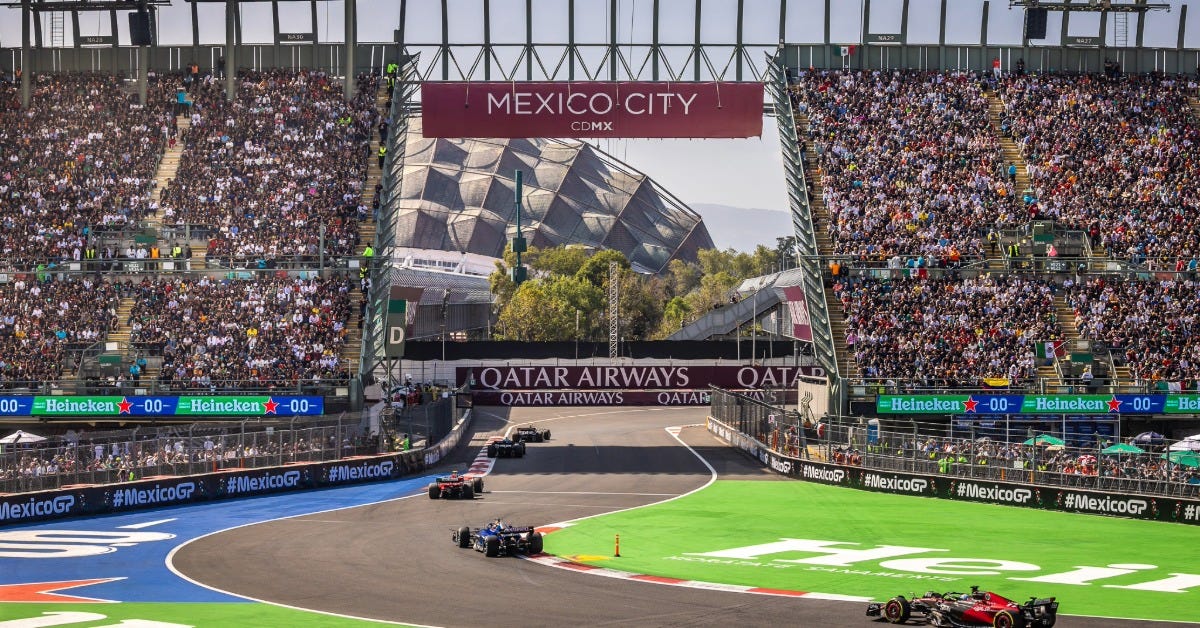
The Mexico City Grand Prix is no longer just a Formula 1 weekend. New figures show the 2025 race delivered nearly 19.84 billion pesos in economic impact and media exposure, while drawing more than 401,000 fans over three days. The numbers help explain why the race has become one of Mexico’s strongest annual sports platforms, and why its future through 2028 carries weight beyond the track. For hotels, restaurants, transport, tourism, and Mexico’s global image, the event has become a major yearly test of what sports tourism can do.
Mexico Grand Prix generated nearly 19.84 billion pesos in economic impact
The Mexico City Grand Prix generated an estimated 19.84 billion pesos in economic impact and media exposure in 2025, according to figures released for the Formula 1 event.
The total included 6.715 billion pesos in direct economic impact and 13.125 billion pesos in media exposure for Mexico. That distinction matters. The figure does not mean nearly 20 billion pesos were spent directly in Mexico City during the race weekend. It combines local economic activity with the estimated value of global visibility tied to the event.
Even with that caveat, the numbers show the scale of the race. The 2025 Grand Prix brought 401,326 attendees to the Autódromo Hermanos Rodríguez over three days. The Sunday race alone drew 153,867 spectators.
The event took place from October 24 to 26, 2025, during one of Mexico City’s busiest tourism periods. The race weekend also falls near the Day of the Dead season, giving the city added global exposure at a time when international attention is already high.
What the numbers say about Mexico’s F1 weekend
The 2025 race was measured through analyses prepared by AECOM and Formula Money, which were hired by CIE, the company that promotes the event.
The breakdown shows several layers of activity. Race operations by CIE generated 3.705 billion pesos in economic benefits. The event supported 10,649 jobs in the region and produced 1.13 billion pesos in wages.
CIE’s own operations accounted for 5,170 jobs and more than 770 million pesos in wages. Spending by Formula 1 teams and tourists away from the track added another 3.41 billion pesos in economic activity for Mexico City.
That spending supported 5,600 jobs and 370 million pesos in wages, according to the event figures.
The broader total also includes the value of international media exposure. For a global sport like Formula 1, this is a large part of the event’s reported impact. Television broadcasts, digital coverage, social media, sponsor visibility, and destination promotion all form part of that calculation.
A sports event that doubles as tourism promotion
For Mexico City, the race works as both a live event and a tourism campaign. Fans travel for the race, but many also spend on hotels, restaurants, transport, shopping, and entertainment.
That makes the Grand Prix different from a single-night concert or a local match. The F1 weekend runs over several days and draws visitors from across Mexico and abroad. Many fans arrive early or extend their stay, especially when the race overlaps with late October travel plans.
The 2025 figures said 238,000 tourists entered the country between October 25 and 27, an increase of 2.8 percent from the prior year. Hotel occupancy averaged 79.2 percent, with 132,667 occupied rooms.
Hotel revenue tied to that occupancy was estimated at just over 2.203 billion pesos.
For expats and foreign residents who follow Mexico’s economy, the race is an example of how major events can shape a city’s service economy. The benefits are not limited to ticket sales. They extend into lodging, airport traffic, ride-hailing, restaurants, bars, security, temporary work, and media value.
Why Mexico keeps fighting to stay on the F1 calendar
Formula 1 has become more competitive as a global hosting business. Cities and countries want races because they bring visitors, media attention, and high-spending fans. But F1 has limited space on its calendar, and host cities must prove they can deliver.
Mexico City has done that since Formula 1 returned to the country in 2015. The race has built a reputation for strong crowds, a large stadium atmosphere, and a local fan base that turns the event into more than a motorsport weekend.
Since its return, the Mexico GP has generated an accumulated economic impact of 157.594 billion pesos and media exposure. It has also supported 93,175 jobs, with 12.629 billion pesos in accumulated wages.
The race’s contract was extended through 2028, giving Mexico City three more editions after the 2025 race. Formula 1 confirmed the extension in 2025, covering the 2026, 2027, and 2028 seasons.
That extension is significant because it keeps Mexico in the Americas swing of the F1 calendar. It also gives city officials, tourism operators, and race organizers more time to plan around a recurring global event.
Checo Pérez adds another layer for 2026
The 2025 race happened without Sergio “Checo” Pérez on the Formula 1 grid. That made the attendance figure more notable because the event still drew more than 401,000 people without Mexico’s best-known modern F1 driver competing.
That will likely change the tone of the 2026 edition. Pérez is returning to Formula 1 with Cadillac, which joins the grid as a new team. Cadillac signed Pérez and Valtteri Bottas as its drivers for the team’s first F1 season.
For Mexican fans, Pérez’s return could add demand to an event that already sells itself as one of the most festive races on the calendar. It may also increase sponsor interest, media attention, and travel demand from fans across Mexico.
The 2026 Mexico City Grand Prix is scheduled for October 30 to November 1 at the Autódromo Hermanos Rodríguez.
That timing again places the race near Day of the Dead, one of Mexico’s most visible cultural periods. For international visitors, it creates a travel window that combines sport, culture, and city tourism.
The economic upside and the questions behind it
Large-event figures should always be read carefully. Economic impact studies often include spending that is easy to quantify, such as hotel and operations costs, along with estimates that are harder to measure, such as media exposure.
That does not make the figures useless. It means readers should understand what is being counted.
In the Mexico GP case, the 19.84 billion peso figure includes both direct economic activity and media value. Direct spending is the more concrete part. Media exposure is an estimate of how much Mexico is seen around the world through broadcasts, coverage, and promotional content.
There is also the question of who benefits most. Hotels, restaurants, event contractors, transport providers, and tourism operators are clear winners. Temporary workers also benefit, though often for a short window.
For residents, the tradeoff can include traffic, higher hotel prices, crowded transit, and road closures. These are common issues for major events in large cities.
Still, Mexico City’s Grand Prix has become a rare annual event that connects tourism, sports, entertainment, and international branding in one weekend. That is why it remains politically and economically important.
Mexico’s race has become part of the country’s global image
The Mexico City Grand Prix now sits in the same conversation as other major events that shape how Mexico is viewed abroad. It is a sports event, but it also functions as a showcase for the capital.
The images seen by international audiences include the Autódromo Hermanos Rodríguez stadium section, Mexican celebrations, crowds, music, food, and city scenes. For a country that depends heavily on tourism, that visibility has value.
The challenge is to ensure the benefits extend beyond the immediate event economy. Large global events can promote a country, but they do not automatically solve deeper tourism or infrastructure issues.
For now, the race gives Mexico a high-profile place in one of the world’s most-watched sports. The 2025 figures show why organizers and officials continue to defend the event as more than a weekend for racing fans.
With its contract secured through 2028 and Pérez returning to the grid, the Mexico City Grand Prix is positioned to remain one of the country’s most visible annual sports events.
7 Experience-Driven Luxury Travel Trends for 2026 in Mexico
Mexican Formula One Grand Prix organizers ‘blown away’ by crowd size