
It’s another ordinary afternoon in Mexico. Traffic is crawling, someone is honking at absolutely nothing, and the little neighborhood pharmacies are doing their usual steady business. Life looks pretty normal, which makes today’s health news feel a little unsettling.
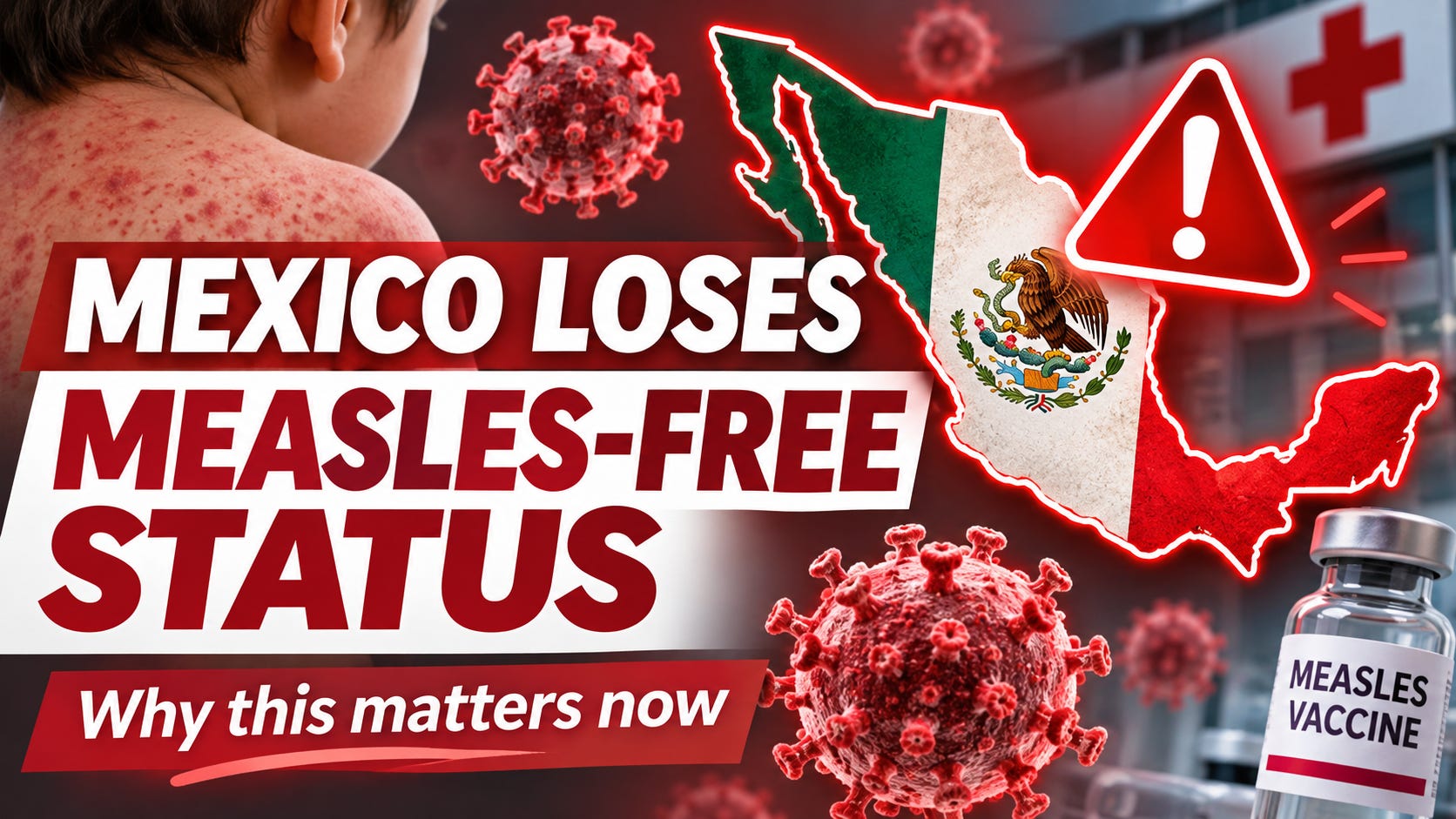
Mexico has officially lost its measles-elimination status.
Yes, measles. That disease many of us associate with childhood vaccination records, old medical textbooks, and something we thought modern medicine had largely put behind us.
Well, apparently, it’s not quite behind us anymore.
And Mexico isn’t alone.
The Pan American Health Organization (PAHO), the regional public health agency affiliated with the World Health Organization, announced Tuesday that Mexico, the United States, and Bolivia have all lost their official measles-elimination designations.
Canada already lost its status last year.
Think about that for a moment. All three North American countries have now lost a public health achievement that took decades of vaccination campaigns and medical progress to accomplish.
That’s not exactly the kind of regional cooperation anyone was hoping for.
So, what does losing measles-elimination status actually mean?
First, it doesn’t mean everyone in Mexico is suddenly at risk of catching measles tomorrow.
It doesn’t mean every state is experiencing an outbreak, either.
What it means is that measles has been spreading continuously within the country for at least 12 months. That’s the threshold health authorities use to determine whether a disease once considered eliminated has become established again.
There’s an important distinction here.
A country can experience isolated measles cases, particularly when someone brings the virus from another country, and still maintain its elimination status. The problem comes when those cases turn into an uninterrupted chain of local transmission.
And that’s exactly what happened in Mexico.
According to PAHO, the transmission chain that led to Mexico losing its designation began in February 2025. The situation continued long enough to cross the 12-month threshold in February 2026.
Tuesday’s announcement simply made the loss of status official.
Here’s the number that really caught my attention.
UNICEF says Mexico has recorded more than 13,900 confirmed measles cases in 2026 alone, according to Mexico’s Ministry of Health.
That’s the country’s highest annual count since the massive measles epidemic of 1989–1990.
And the children carrying the heaviest burden since this outbreak began? Those between one and four years old.
That last detail is what makes this story particularly troubling.
We’re not talking about an obscure illness with no known prevention. We’re talking about a disease for which we’ve had an effective vaccine for generations.
Yet here we are in 2026, watching it make a comeback.
The Mexico story is part of something much bigger.
One thing I’ve noticed about living in Mexico is how easy it can be to mentally separate what’s happening here from what’s happening north of the border.
But diseases don’t stop at immigration checkpoints.
The United States is dealing with its own major measles resurgence. Canada has already experienced prolonged transmission, and now Mexico is officially in the same category.
This isn’t simply a Mexican public health problem.
It’s a North American one.
And while it’s tempting to point fingers at whichever government happens to be in office, the bigger issue is that vaccination gaps have allowed an extremely contagious disease to find its way back into communities where it had largely disappeared.
Some people missed vaccinations because healthcare wasn’t accessible. Others fell behind during the pandemic. And yes, vaccine misinformation and hesitancy have contributed to the problem.
Not every unvaccinated person arrived at that situation for the same reason.
But the virus doesn’t care why someone isn’t protected.
What does this mean for foreigners living in Mexico?
For Americans and Canadians living here, particularly retirees and families spending extended periods in Mexico, I think this is one of those stories worth paying attention to without letting it ruin your afternoon.
There’s no reason to panic or start canceling travel plans simply because Mexico lost a public health designation.
But there is a good reason to check your vaccination records.
Many adults assume they’re protected because they remember getting childhood vaccinations. That may be true, but if you don’t know your vaccination history, it’s worth discussing with a healthcare professional.
The measles, mumps, and rubella vaccine, commonly called MMR, remains the primary protection against the disease.
PAHO recommends checking that you and your children have received the appropriate doses. People with uncertain vaccination histories should consult their healthcare provider about whether they need vaccination.
And if someone develops symptoms consistent with measles, particularly fever followed by a rash, the advice is to call a healthcare provider before showing up at a clinic. That helps prevent exposing other patients.
It’s a simple precaution, but an important one.
There’s something frustrating about this entire story.
Mexico has no shortage of major challenges competing for public attention.
Security, infrastructure, economic pressures, healthcare access, and the everyday cost of living already give people plenty to worry about.
Measles shouldn’t need to be added to that list.
What bothers me most isn’t the loss of an international designation. Most people probably didn’t know Mexico even had one.
It’s what losing that designation represents.
We had an established way to prevent this disease from spreading widely. We knew what worked. We had decades of evidence showing the benefits.
And somehow, across multiple countries, we’ve allowed significant gaps in protection to develop.
That’s a difficult reality to ignore.
The good news? Mexico can get that status back.
This isn’t a permanent black mark against the country.
PAHO says Mexico and the other affected countries can regain elimination status by interrupting sustained transmission for at least 12 consecutive months and demonstrating that their vaccination and disease-monitoring systems are strong enough to keep it from returning.
It’s happened before.
Brazil lost its elimination status in 2019 and regained it in 2024 after renewed public health efforts.
So there’s a proven path forward.
But it’s going to require more than government announcements, press conferences, and promises to improve vaccination coverage.
It requires actually reaching the communities that have been missed.
And that’s where the hard work begins.
My takeaway this Tuesday afternoon?
Mexico losing its measles-elimination status isn’t a reason to be afraid of living here. It’s a reminder that some of the public health victories we take for granted are more fragile than we realize.
For those of us who call Mexico home, even part of the year, staying informed and checking our own protection is a reasonable place to start.
Because losing a public health achievement is disappointing.
Losing people to a disease we already know how to prevent is considerably worse.