
Mexico’s Caribbean beaches are facing another heavy sargassum season, and the Navy is expanding its response before more seaweed reaches shore. The latest operation includes barriers, collection crews, and support vessels in key tourism areas. For residents and visitors in Quintana Roo, the issue is not only about beach views. It also affects water quality, navigation, tourism jobs, and the wider coastal economy.
Sargassum Fight Along Caribbean
Mexico’s Navy has expanded its 2026 sargassum operation in the Mexican Caribbean as Quintana Roo faces another difficult season along some of its most visited beaches.
The latest strategy includes more than 7,500 meters of containment barriers and anchoring systems in key coastal areas, including Puerto Morelos, Playa del Carmen, Tulum, and Mahahual. The goal is to stop more sargassum offshore before it reaches beaches, where removal becomes harder and more damaging.
Authorities say the operation is tied directly to tourism, navigation, environmental protection, and the regional economy. That matters in Quintana Roo, where beach conditions can quickly affect hotels, restaurants, tour operators, boat captains, and workers who depend on visitors.
Why the Navy is stepping up now
Sargassum is a floating brown seaweed that occurs naturally in the Atlantic. In normal amounts, it can provide shelter for fish, turtles, and other marine life. The problem begins when large mats drift toward shore and pile up on beaches.
Once it decomposes, sargassum can produce strong odors, affect water quality, and discourage beach use. Large accumulations can also interfere with small boats and nearshore activities. In tourism areas, it can become an economic problem within days.
The Navy’s expanded response comes during a season that researchers and officials have warned could be heavier than usual. UNAM specialists have estimated that the Atlantic could hold around 40 million metric tons of sargassum biomass this year. Not all of that reaches Mexico, but the scale helps explain why officials are preparing for a larger cleanup burden.
Quintana Roo collected about 96,000 tons of sargassum in 2025, according to UNAM reporting. For 2026, officials and monitoring groups expect stronger pressure on the coastline.
Where the barriers are being installed
The Navy’s latest deployment is focused on some of the Caribbean’s most important tourism corridors. Barriers and anchoring systems have been placed in Puerto Morelos, Playa del Carmen, Tulum, and Mahahual.
These areas are not all affected in the same way. Currents, wind, beach shape, and offshore conditions can make one beach look clear while another nearby beach is covered. That is one reason sargassum reports can change quickly.
The barriers are designed to hold or redirect floating seaweed before it reaches the shore. When successful, crews can collect it from the water, reducing the amount that decomposes on the sand. This approach is generally preferred because beach cleanup can remove sand and disturb coastal areas when heavy machinery is used.
Still, barriers are not a full solution. Heavy seaweed mats can pass under or around containment lines. Storms, winds, and changing currents can also overwhelm equipment. That is why authorities combine barriers with boats, beach crews, and monitoring.
Crews and collection work remain active
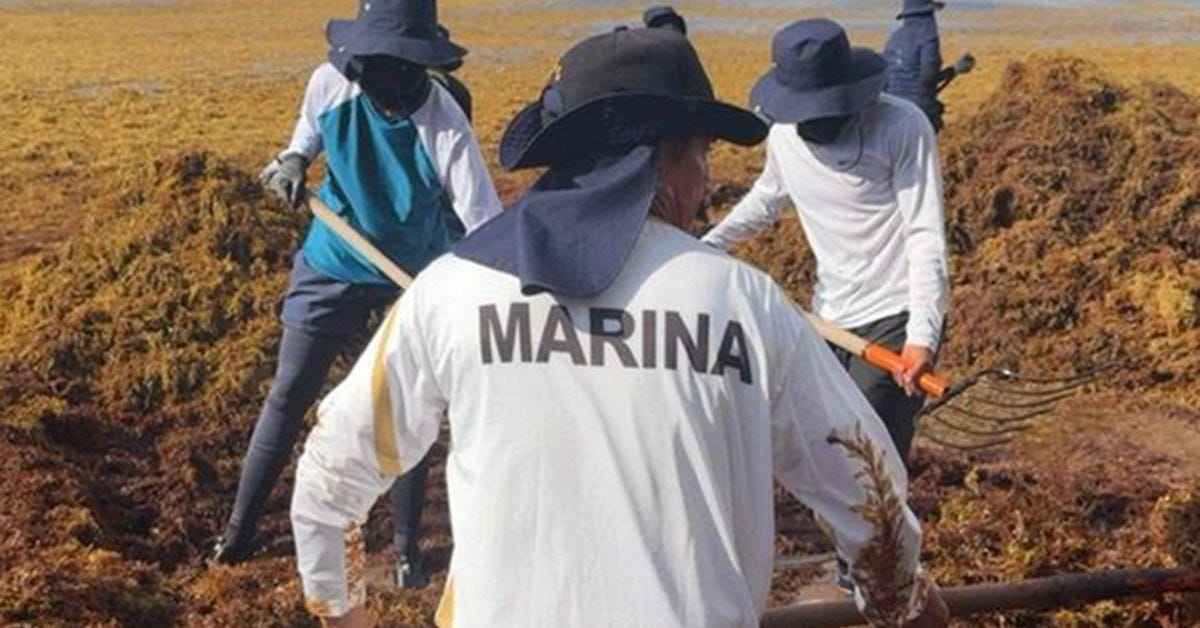
The Navy reported that more than 28,000 tons of sargassum had already been collected in six municipalities as of the latest update.
Emergency beach collection groups remain active in several high-impact areas. Playa del Carmen, Tulum, and Mahahual are among the places with deployed personnel working on removal and containment.
The operation also includes vessels and support equipment. Earlier updates from the federal and state response described the use of coastal collection boats, an ocean-going sargassum vessel, amphibious units, smaller support boats, and drones.
For residents and visitors, the most visible part of the response is often the beach cleanup. But the more important work can happen offshore. The earlier the sargassum is collected, the lower the chance it will rot on the beach and create wider environmental and tourism problems.
Why this matters beyond beach conditions
For many travelers, sargassum is viewed as an inconvenience on the beach. For Quintana Roo, it is much more than that.
The state’s economy depends heavily on the Caribbean coastline. Beach conditions influence hotel occupancy, restaurant traffic, water tours, fishing, weddings, real estate marketing, and local employment. A heavy season can place added pressure on municipalities already managing waste, public services, and coastal maintenance.
There is also an environmental cost. Large sargassum piles can reduce oxygen in nearshore waters as they break down. They can affect seagrasses, reefs, and coastal habitats. If collected seaweed is dumped in the wrong places, it can create new problems for groundwater and soil.
This is why authorities are also looking at reuse and processing. Quintana Roo has promoted circular-economy projects that would convert collected sargassum into raw material for other uses. Those efforts are still developing, but they show how the issue has moved beyond simple beach cleaning.
What residents and visitors should watch
Beach conditions in the Mexican Caribbean can change from one day to the next. A beach with heavy sargassum in the morning may improve after cleaning, while another beach can receive a new arrival later the same day.
Travelers should check local beach reports before planning water activities. Residents and visitors with respiratory sensitivity should avoid spending long periods near decomposing sargassum, especially where odors are strong.
People should also avoid moving or dumping sargassum themselves. Collected seaweed can contain salt, sand, organic matter, and contaminants. It needs proper handling and disposal.
The Navy’s expanded operation will not eliminate sargassum from the Caribbean. But it may reduce the amount reaching some of the most-visited beaches and limit the damage as arrivals intensify.
For Quintana Roo, the challenge is now seasonal, economic, and environmental. The 2026 response shows that sargassum is no longer treated as a temporary nuisance. It has become part of coastal management in the Mexican Caribbean.
Massive Sargassum Bloom Could Hit Mexico Beaches