
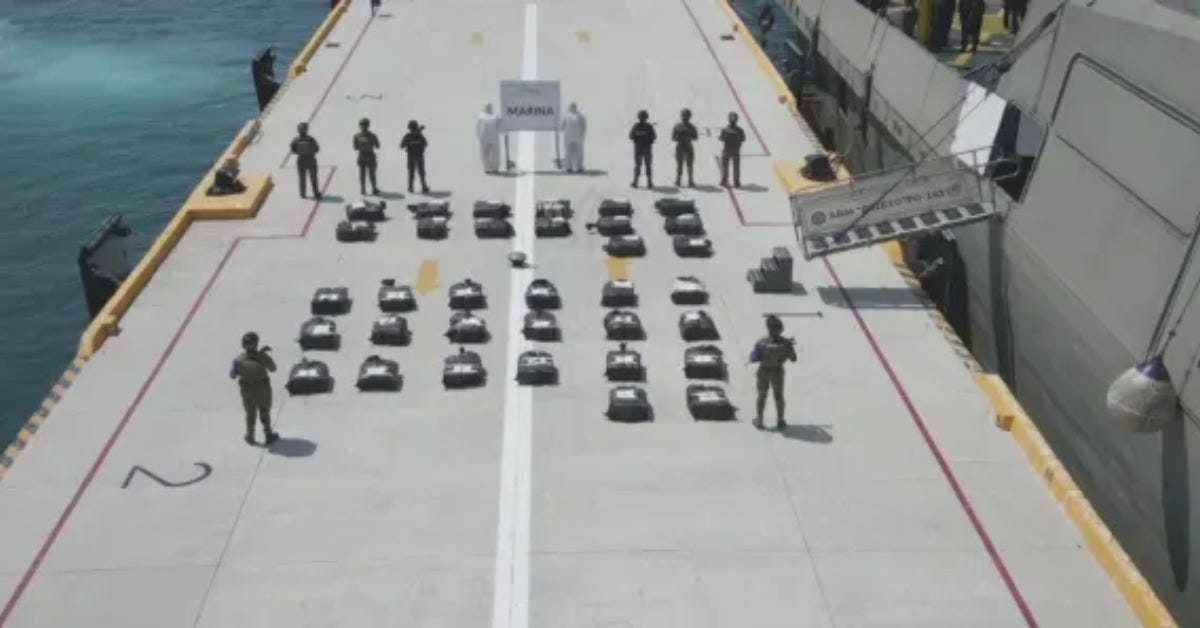
Mexico’s Navy says three Pacific operations led to the seizure of 63 bundles of suspected cocaine, the rescue of 11 castaways, and the discovery of three foreign stowaways aboard a container ship. The cases happened far from tourist areas, but they point to a wider pattern along Mexico’s Pacific coast. Authorities say maritime seizures are now a major part of the federal strategy against organized crime logistics.
Navy reports three Pacific operations involving drugs, rescues and stowaways
Mexico’s Navy reported three separate maritime operations in the Pacific Ocean involving 63 bundles of suspected cocaine, 11 rescued castaways, and three foreign stowaways found aboard a container ship.
The operations were carried out off the coast of Guerrero and in the port of Manzanillo, Colima. Federal officials said the cases were part of ongoing maritime surveillance and security operations aimed at disrupting criminal logistics at sea.
The Navy said the first operation took place about 180 nautical miles, or 334 kilometers, southwest of Acapulco. A Navy ocean patrol vessel found 22 floating bundles containing packages with characteristics similar to cocaine.
About two nautical miles from that point, crews rescued 11 people described as castaways. They received medical evaluations and were found to be in good health. After arriving in Manzanillo, they were turned over to immigration authorities.
Container ship inspection finds stowaways and suspected cocaine
A second operation took place at the port of Manzanillo, one of Mexico’s main Pacific cargo gateways. During an inspection of a container ship arriving at the port, authorities found seven bundles of suspected cocaine.
Three foreign men were also found aboard the vessel. Authorities said they were traveling as stowaways and were placed at the disposal of the Attorney General’s Office.
The case combines two different concerns for maritime authorities: drug trafficking through commercial shipping routes and the movement of people hidden aboard vessels. Both can create legal, security, and humanitarian issues for port officials.
Manzanillo is a key point in Mexico’s Pacific trade network. That makes the port important for legal commerce, but also a target for criminal groups trying to move drugs or other illicit cargo through container traffic.
More bundles recovered far off Acapulco
The third operation involved the recovery of 34 more bundles of suspected illicit cargo. Authorities said the material was found about 235 nautical miles, or 435 kilometers, from the coast of Acapulco.
Navy surface units collected the bundles and transported them to the port of Huatulco. From there, the cargo was turned over to the proper authorities.
Federal officials said the final ministerial weight of the seized material had not yet been determined. That detail matters because early reports often count bundles, while prosecutors later confirm the exact weight and legal classification of the substance.
The Navy said the three operations bring the total to more than 65.5 tons of illicit cargo seized at sea during the current federal administration.
What the Pacific seizures show about maritime trafficking
The case adds to a broader pattern of Pacific maritime seizures reported in recent months. In these cases, drugs may be moved by small boats, semi-submersible vessels, floating packages, or hidden cargo aboard larger ships.
For readers in coastal communities, including Puerto Vallarta, the case does not point to a local public safety alert. These operations happened far offshore or inside federal port inspection areas. The larger issue is how Mexico’s Pacific coast continues to be used as a route for organized crime logistics.
The Pacific route matters because it connects South American cocaine production zones with transit points in Mexico. From there, criminal groups may try to move shipments north or distribute them through other networks.
Floating bundles also raise questions for investigators. Authorities must determine whether the packages were abandoned, dropped for later recovery, or separated from a vessel during an attempted transfer.
Rescues are part of the Navy’s maritime role
The rescue of 11 castaways is a reminder that Navy operations are not limited to drug seizures. Mexico’s Navy also carries out search, rescue, and maritime safety duties.
In this case, the rescued people were located near the area where the first bundles were found. Authorities did not immediately provide details about their nationalities, the vessel they came from, or how they became stranded.
That leaves unanswered questions. Investigators may still need to determine whether the rescued people were connected to the cargo, were traveling separately, or were victims of another maritime incident.
Until authorities provide more details, the confirmed facts are limited to the rescue, medical evaluation, and transfer to immigration officials.
A federal case with local relevance for coastal Mexico
For foreigners living in Mexico, the main takeaway is not to panic. It is context. Maritime seizures often happen far from daily life, but they help explain why federal patrols, port inspections, and Navy operations remain visible along Mexico’s Pacific coast.
These cases also show the difference between local crime and federal organized crime enforcement. A seizure hundreds of kilometers offshore does not mean a tourist area is unsafe. It means the federal government is tracking routes used by organized crime networks.
The investigation now moves to prosecutors and federal agencies. They will need to confirm the weight, substance, origin, and any possible criminal links associated with the 63 bundles.