
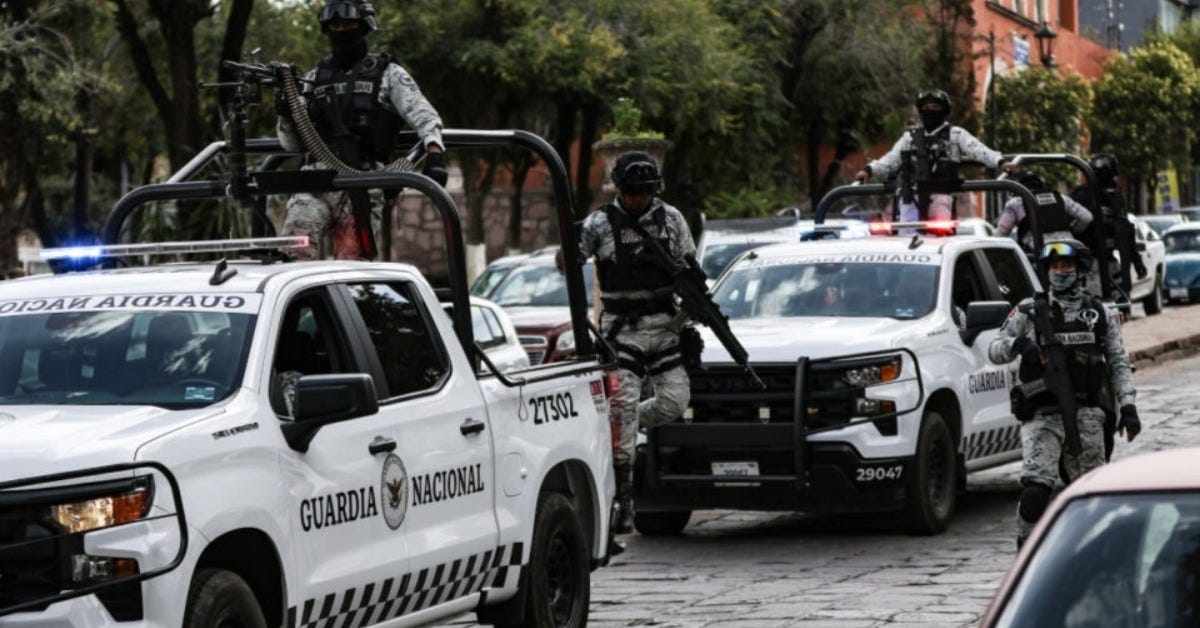
At least 113 public security officers have been killed in Mexico so far this year, a figure that points to one of the country’s hardest security problems. The victims include municipal police, state officers, and National Guard personnel. The numbers also show how uneven the risk is across Mexico, with a handful of states driving much of the toll. For foreign residents, the story is not only about crime statistics. It is about how public security works, where it breaks down, and why local police often face the greatest danger.
113 public security officers have been killed in Mexico
At least 113 public security officers have been killed in Mexico so far in 2026, according to the latest count from Causa en Común, a civil society organization that tracks violence against police.
The figure covers municipal police, state police, and members of the National Guard. It includes documented cases through April 30, 2026. During the week of April 24 to April 30 alone, at least four officers were killed in Tabasco, Sinaloa, Zacatecas, and Guerrero.
The count places Jalisco at the top of the national list, with 30 officers killed so far this year. Sinaloa follows with 15. Morelos has recorded 11, the State of Mexico nine, and Guanajuato six.
The numbers are a reminder that violence against police in Mexico is not limited to one region. It reaches across local, state, and federal forces, though the burden falls hardest on those working closest to the street.
Why the number matters
Police killings are one measure of Mexico’s wider security crisis, but they tell a more specific story. They show where the state is being challenged directly.
When officers are attacked, the message often reaches beyond the victim. These killings can intimidate entire police departments, weaken local enforcement, and make it harder for communities to report crime. In areas where organized crime groups are fighting for control, police can become direct targets.
The victims this year include 54 municipal police officers, 32 National Guard members, and 27 state police officers. That breakdown matters because each force plays a different role.
Municipal police are usually the most visible. They handle patrols, traffic, neighborhood complaints, and local emergencies. They are also often the least protected and most exposed.
State police usually respond to larger regional threats. The National Guard is a federal force, often deployed in areas where local authorities need support or where organized crime violence has escalated.
Why municipal police are especially vulnerable
Municipal officers often work in the same communities where criminal groups operate. They may know local actors, patrol known conflict areas, and respond first when violence breaks out.
That can make them valuable to residents, but also vulnerable to pressure. In some municipalities, officers face threats, bribery attempts, or direct attacks. In others, they lack training, equipment, intelligence support, or backup.
This is one reason attacks on police can shake local confidence. When a municipal officer is killed, residents may wonder whether authorities can protect the people assigned to protect them.
The issue is especially important for foreigners living in Mexico. Many daily safety concerns are handled locally, not federally. A traffic stop, a neighborhood dispute, a robbery report, or a call for help usually begins with local authorities.
That does not mean every city faces the same risk. Mexico’s security situation is highly local. Some municipalities remain calm, while others face cartel disputes, extortion networks, or political violence.
Jalisco leads the 2026 count
Jalisco’s position at the top of the 2026 count is partly tied to a violent year for security forces in the state.
The February operation against Nemesio Oseguera Cervantes, known as El Mencho, and the violence that followed placed heavy pressure on federal and state forces. That event was one of the year’s most serious security episodes and helps explain why Jalisco’s numbers are far above most other states.
Jalisco is also strategically important. It sits along key transportation corridors and has long been tied to the Jalisco New Generation Cartel (CJNG). Violence linked to that group has affected several states, including Jalisco, Nayarit, Guanajuato, Michoacán, and parts of the Pacific corridor.
For Puerto Vallarta-area readers, that matters because regional security events can ripple into nearby communities. The city may not be the center of cartel violence, but it is not fully removed from the dynamics around Jalisco and Nayarit.
Sinaloa, Morelos, Edomex and Guanajuato also stand out
Sinaloa ranks second in the 2026 count, with 15 officers killed. The state has faced ongoing instability driven by organized crime disputes and political pressure on security institutions.
Morelos, the State of Mexico, and Guanajuato also appear among the highest totals. Each state has its own security dynamics, but all have seen persistent violence affecting residents, businesses, and public officials.
Guanajuato has been one of Mexico’s most violent states in recent years. Much of that violence has been linked to competition over fuel theft, drug distribution, extortion, and territorial control.
The State of Mexico presents another challenge. Its size, population, and proximity to Mexico City complicate policing. Morelos, meanwhile, sits along key routes between central and southern Mexico, where criminal groups have fought for influence.
How the count is compiled
The Causa en Común count is based on documented cases gathered from public information, official reports, and media monitoring. That means it is not the same as a final court record.
The number can change as new cases are confirmed, corrected, or added. It also depends on whether enough public information is available to document each killing.
Still, the count is widely used because Mexico does not always provide fast, easy-to-read public data on police killings by force, state, and date. Civil society tracking helps fill that gap.
For readers, the best way to understand the number is to treat it as a documented minimum. It shows the scale of the problem, but it may not capture every case immediately.
The longer trend is still serious
The 2026 figure comes after years of sustained violence against police.
Causa en Común documented 348 police killings in 2025 and 320 in 2024. In 2023, the group recorded at least 412 cases. In 2020, the count reached 524.
Those yearly totals show that 2026 is not an isolated spike. Violence against officers has been a continuing problem across different administrations, security strategies, and cartel conflicts.
The current count also includes a broader measure from the start of the Sheinbaum administration. From October 1, 2024, to April 30, 2026, at least 555 public security agents have been killed in Mexico, according to the same tracking.
That number places the issue inside a longer national debate over policing, militarization, local security budgets, and the role of the National Guard.
What this means for residents
For residents, including foreigners living in Mexico, the figure should be read carefully. It does not mean the whole country is equally dangerous. It also does not mean that everyday life in every city is shaped by the same level of risk.
But the number does show that police institutions remain under pressure in several parts of the country. That pressure can affect emergency response, investigations, and local trust.
In tourist and expat communities, security can look stable on the surface while serious violence takes place in nearby corridors. This is especially true in states where organized crime groups operate beyond city limits, along highways, ports, or rural routes.
The practical takeaway is not to panic. It is awareness. Local conditions matter. So do official alerts, road conditions, police capacity, and the difference between tourist zones and surrounding regions.
The killing of police officers is one of the clearest signs of where Mexico’s security system is being tested. In 2026, that test remains visible across several states.