
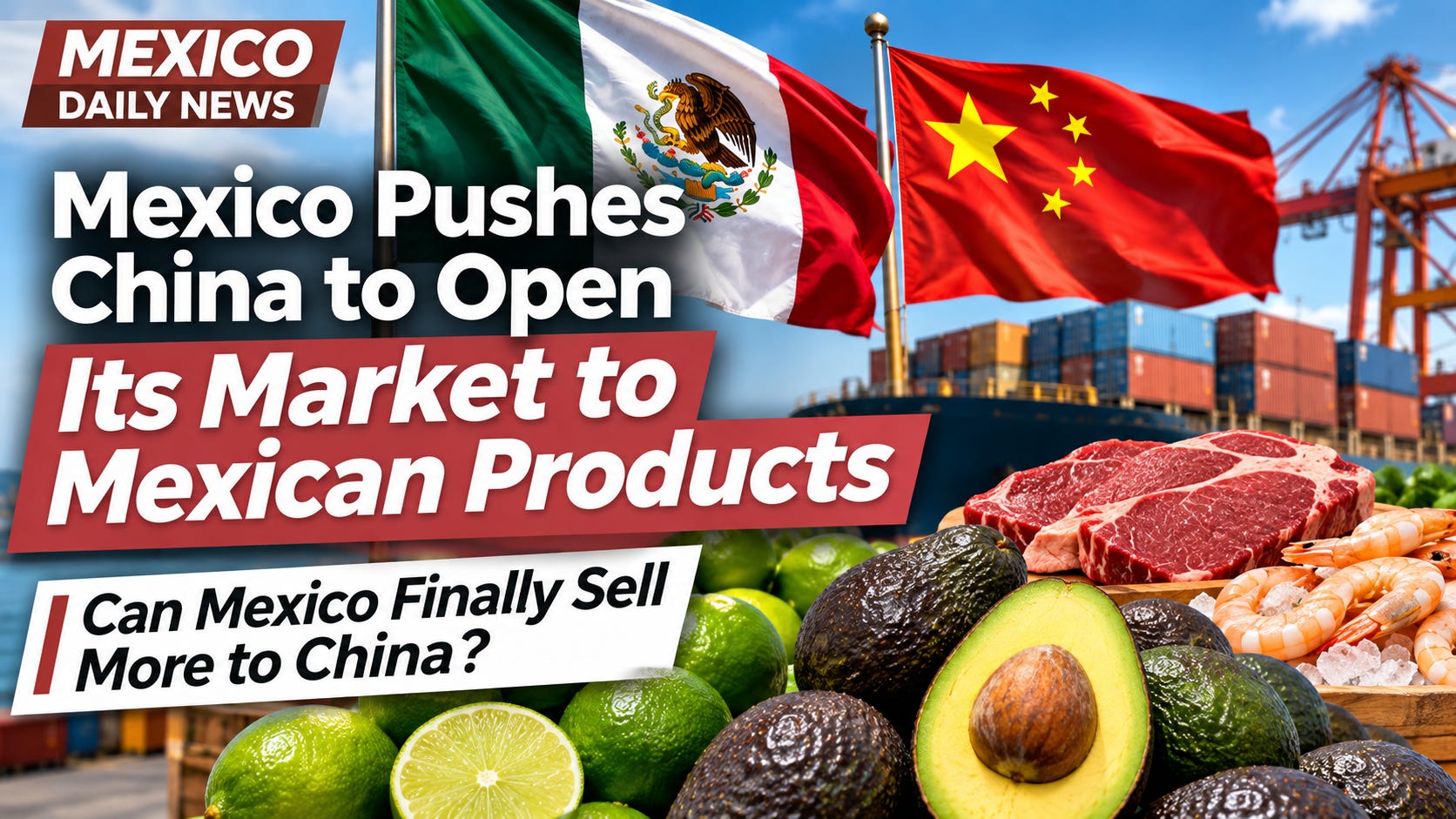
Beijing, China, November 23, 2026 — Mexico has a problem with China, and it can be explained with two numbers.
China is expected to sell more than $130 billion worth of goods to Mexico this year. Meanwhile, Mexican businesses are expected to sell only about $10 billion worth of products to China.
That’s a pretty big difference.
And on Monday, Mexico’s Economy Secretary Marcelo Ebrard traveled to Beijing with a message for the Chinese government: It’s time for China to start buying more Mexican products.
The two countries have now agreed to establish a working group to improve their trade relationship, with Mexico pushing for better access to the Chinese market.
According to the announcement following Ebrard’s meeting with Chinese Commerce Minister Wang Wentao, the discussions will focus on increasing Mexican exports, resolving longstanding trade barriers, and exploring opportunities for Chinese companies to invest in production inside Mexico.
That might sound like ordinary diplomatic business.
But here’s what makes the announcement interesting.
Some Mexican products have reportedly been waiting up to 10 years for the approvals needed to enter China’s market.
We’re talking about everyday products such as avocados, limes, beef, pork, and seafood.
Mexico produces plenty of them. China has an enormous consumer market.
Getting those products into that market has been a much bigger challenge than it might seem.
China sells Mexico far more than Mexico sells China
The imbalance between the two countries is enormous.
During Monday’s meeting, Ebrard told Chinese officials that China’s exports to Mexico are expected to exceed $130 billion in 2026.
Mexican exports in the other direction are expected to reach approximately $10 billion.
Those are the economy secretary’s projections for the full year, not finalized annual trade figures.
But they illustrate the problem Mexico wants to address.
Based on those estimates, China would sell Mexico roughly 13 times as much merchandise as Mexico sells China.
That leaves a projected trade gap of around $120 billion or more.
Now, a trade deficit doesn’t automatically mean Mexico is losing that amount of money.
Countries import products because businesses and consumers want them. Imported machinery, electronic components, equipment, and other materials can also help Mexican companies manufacture their own goods.
But the imbalance does show how differently the two countries participate in their trading relationship.
China has developed an enormous market for products it manufactures and exports to Mexico.
Mexico, despite being one of the world’s major exporting economies, has struggled to build a comparable presence in China.
And Ebrard wants that to change.
During the 11th meeting of the Mexico-China High-Level Group, he argued that Mexican exports should begin growing at a pace that helps reduce the widening difference between what the two countries buy from each other.
The goal isn’t necessarily to stop buying Chinese products.
It’s to give Mexican businesses more opportunities to sell their own products to Chinese customers.
Mexico wants to sell more than just manufactured goods
One of the more interesting parts of Monday’s negotiations involves agriculture and food.
Mexico wants China to move faster on approving the sanitary and commercial requirements necessary for certain Mexican products to enter the Chinese market.
The list includes avocados, limes, beef, pork, sorghum, and processed aquatic products.
Ebrard also specifically mentioned tuna, shrimp, and squash as products Mexico wants to expand into the Chinese market.
And there’s a potentially large opportunity here.
China has a population of more than 1.4 billion people. Even capturing a small share of that consumer market could create additional demand for Mexican agricultural and seafood producers.
But selling food internationally isn’t as simple as putting it on a ship.
Countries establish requirements for agricultural imports to manage pests, diseases, food safety, production standards, and other concerns.
Those requirements can involve inspections, certification, approved facilities, and agreements between the importing and exporting governments.
In trade negotiations, these arrangements are often called sanitary protocols.
And for Mexican exporters, some of those protocols have apparently become a long-running frustration.
According to Mexico’s Economy Ministry, certain approvals have been pending for as long as a decade.
That doesn’t establish that every Mexican avocado, lime, or meat product is prohibited from entering China. Market access depends on the particular product and the applicable rules.
But it does mean that unresolved approvals have been preventing Mexico from taking full advantage of some potential export opportunities.
Ebrard wants those barriers addressed.
And rather than simply raising the issue again, the two governments have agreed to establish a working group that will follow up on the outstanding requirements.
That’s progress, although it isn’t the same as receiving the approvals.
Why should Mexican farmers care?
For agricultural producers, access to another major market can be valuable.
A farmer or food producer who depends heavily on a limited number of buyers can be vulnerable when prices fall, demand weakens, or another country changes its trade policies.
Having additional customers can provide more options.
That doesn’t guarantee higher prices or bigger profits, of course. Transportation costs, competition, food safety requirements, and the ability to supply consistent quantities all matter.
But a broader customer base can make a difference.
Consider Mexico’s avocado industry.
Mexican avocados are already an established export product, particularly in North America.
Gaining additional access to Chinese consumers could potentially create new demand, although producers would still need competitive pricing, distribution partners, and the necessary export approvals.
The same principle applies to meat producers, seafood companies, and other agricultural businesses.
There’s also a regional connection.
Jalisco is an important agricultural state, while Mexico’s Pacific coast supports fishing and seafood businesses that could eventually benefit from expanded export opportunities.
That doesn’t mean a producer in Puerto Vallarta, Jalisco, or neighboring Nayarit suddenly has a new buyer in China.
No such local contracts were announced Monday.
The immediate opportunity is at the national level. Any benefits for individual producers would depend on approvals, actual purchase agreements, and the ability to reach Chinese customers.
Even Mexico’s salt industry wants a bigger share
Here’s a detail from Monday’s meeting that deserves more attention.
Mexico isn’t only talking about food exports.
The government is also looking at a proposal from Exportadora de Sal, the Mexican state-owned salt producer.
The company wants to expand its presence in China and has offered to supply as much as 10 million metric tons of salt over the next four years.
That’s a substantial amount of salt.
For perspective, the federal government’s description of Exportadora de Sal identifies the company as one of the major suppliers of industrial salt in the Pacific region.
Its operations are based in Guerrero Negro, Baja California Sur, where it operates one of the world’s largest salt-production facilities.
The company’s products are used in industries including chemical manufacturing, water treatment, road de-icing, and food production.
China’s industrial economy offers a potentially significant market for those products.
But there’s an important distinction.
Exportadora de Sal has offered to supply up to 10 million tons over four years. That does not mean China has agreed to purchase that amount.
The proposal will be among the issues reviewed by the new bilateral working group.
Actual sales would still require agreements covering quantities, prices, delivery schedules, and other commercial conditions.
For now, it’s an opportunity being pursued, not a completed sale.
Mexico also wants Chinese companies to manufacture here
The negotiations weren’t limited to increasing Mexican exports.
Ebrard also raised the possibility of Chinese companies moving some production currently taking place in China to facilities inside Mexico.
The idea is relatively straightforward.
If a Chinese company is producing goods for Mexican customers, why not manufacture some of those products in Mexico instead of shipping everything across the Pacific?
Depending on the industry, that could mean investment in factories, equipment, suppliers, and employment.
It might also help shorten supply chains and reduce some transportation costs.
But those potential benefits would depend on the economics of individual projects.
Manufacturing in Mexico isn’t automatically cheaper, and companies considering investments would have to evaluate labor costs, electricity, water, infrastructure, taxes, regulations, and access to customers.
There are also political considerations.
Mexico’s manufacturing sector is deeply integrated with the United States, particularly through the USMCA trade agreement.
Any Chinese investment intended to produce goods for North American markets would need to consider the applicable trade rules.
And foreign investments can face government scrutiny depending on the type of transaction.
As Vallarta Daily recently reported, Mexico has tightened certain foreign-investment review rules, particularly for transactions involving sensitive industries.
Those rules don’t mean Chinese companies are barred from investing in Mexico.
They do illustrate why an invitation to invest is only the beginning of the process.
No specific new Chinese factory, investment amount, or production relocation was confirmed as a result of Monday’s meeting.
This follows Sheinbaum’s meeting with China’s president
Monday’s negotiations are part of a larger diplomatic effort.
Last week, President Claudia Sheinbaum traveled to Shenzhen, China, for the Asia-Pacific Economic Cooperation summit, commonly known as APEC.
During the event, she met with Chinese President Xi Jinping to discuss cooperation between the two countries.
As Vallarta Daily reported during Sheinbaum’s trip to China, the visit also attracted attention because the president traveled in economy class on a commercial flight.
But beyond the discussion about how she traveled, the summit provided an opportunity to advance Mexico’s economic relationship with China.
Monday’s trade meeting was one of the follow-up steps.
And the Mexican government has been careful to explain what that cooperation does and doesn’t mean.
During her official press conference following the APEC summit, Sheinbaum said Mexico is not currently seeking a free trade agreement with China.
Instead, the government wants to improve cooperation in areas such as trade, investment, science, technology, and other economic activities.
That’s an important distinction.
A free trade agreement could involve extensive negotiations over tariffs, market access, regulations, and legal obligations.
Monday’s announcement was much narrower.
The countries agreed to create a working group to address specific trade priorities.
That could produce valuable results, but it isn’t a new free trade agreement or a broad opening of both markets.
What does the United States think about all this?
There’s another layer to this story that Mexico can’t ignore.
The United States remains Mexico’s largest trading partner and a central market for Mexican manufacturing exports.
Mexico’s relationship with the American economy is much deeper than its trading relationship with China.
And Washington has spent years expressing concerns about China’s influence in international manufacturing, technology, and supply chains.
That creates a complicated balancing act for Mexico.
The government wants stronger economic relationships with countries outside North America, including China.
But it also wants to protect the commercial relationship with the United States that supports a significant share of Mexican jobs and exports.
Those goals aren’t necessarily incompatible.
Mexico can sell more agricultural products to China while continuing to export manufactured goods to the United States.
It can also pursue new markets without abandoning its existing trade commitments.
But specific investment and manufacturing proposals will need to comply with the rules governing Mexican and North American trade.
For now, the Mexican government is presenting its China talks as an effort to improve economic balance and expand opportunities for Mexican businesses.
Nothing announced Monday establishes a change to the USMCA agreement.
What did China actually agree to?
This may be the most important question in the entire announcement.
China agreed to establish a bilateral working group with Mexico.
The group will examine ways to increase Mexican exports, review outstanding sanitary and commercial protocols, and consider proposals involving investment and products such as industrial salt.
That’s the confirmed agreement.
It is not yet an agreement for China to purchase more Mexican agricultural products.
It doesn’t mean the pending sanitary protocols have been approved.
And it doesn’t establish that the projected $120 billion trade imbalance will actually shrink.
Those results would depend on what happens next.
Ebrard said the two sides intend to work on the outstanding issues over the coming months.
The real measure of progress will be whether China begins approving specific Mexican products, whether exporters secure actual customers, and whether trade figures eventually show more Mexican goods entering the Chinese market.
A government announcement can open doors.
Businesses still have to walk through them.
Mexico has a big opportunity, but also a lot of work ahead
There is something encouraging about Monday’s agreement.
Mexico isn’t simply accepting its enormous trade imbalance with China as something that cannot change.
It’s asking for better access to one of the world’s largest consumer markets, and China has agreed to continue working through those issues.
For farmers, seafood producers, and other Mexican businesses, that could eventually mean more customers and more export opportunities.
For companies considering investments in Mexico, it could also create new possibilities.
But none of those benefits are guaranteed.
Some approvals have reportedly been waiting for a decade. A new working group won’t erase that history overnight.
The questions now are practical.
Will China finally approve the outstanding export protocols? Will Mexican companies be able to compete in the Chinese market? And will any new business actually make a measurable difference in the trade relationship?
Those answers will matter much more than the photographs of officials shaking hands in Beijing.
Mexico says China is on course to sell it more than $130 billion in goods this year, while buying around $10 billion in return.
Monday’s agreement is a first step toward changing that relationship.
The real test is whether, a year from now, China is buying more of what Mexico produces.