
There’s that familiar afternoon buzz in Mexico City. Cars are honking, someone is selling something delicious from a sidewalk stand, and people are trying to squeeze one more errand into the day before heading home. Somewhere in all that noise, there’s probably a conversation happening about how expensive life has become.
Which makes today’s news about poverty in Mexico particularly interesting.
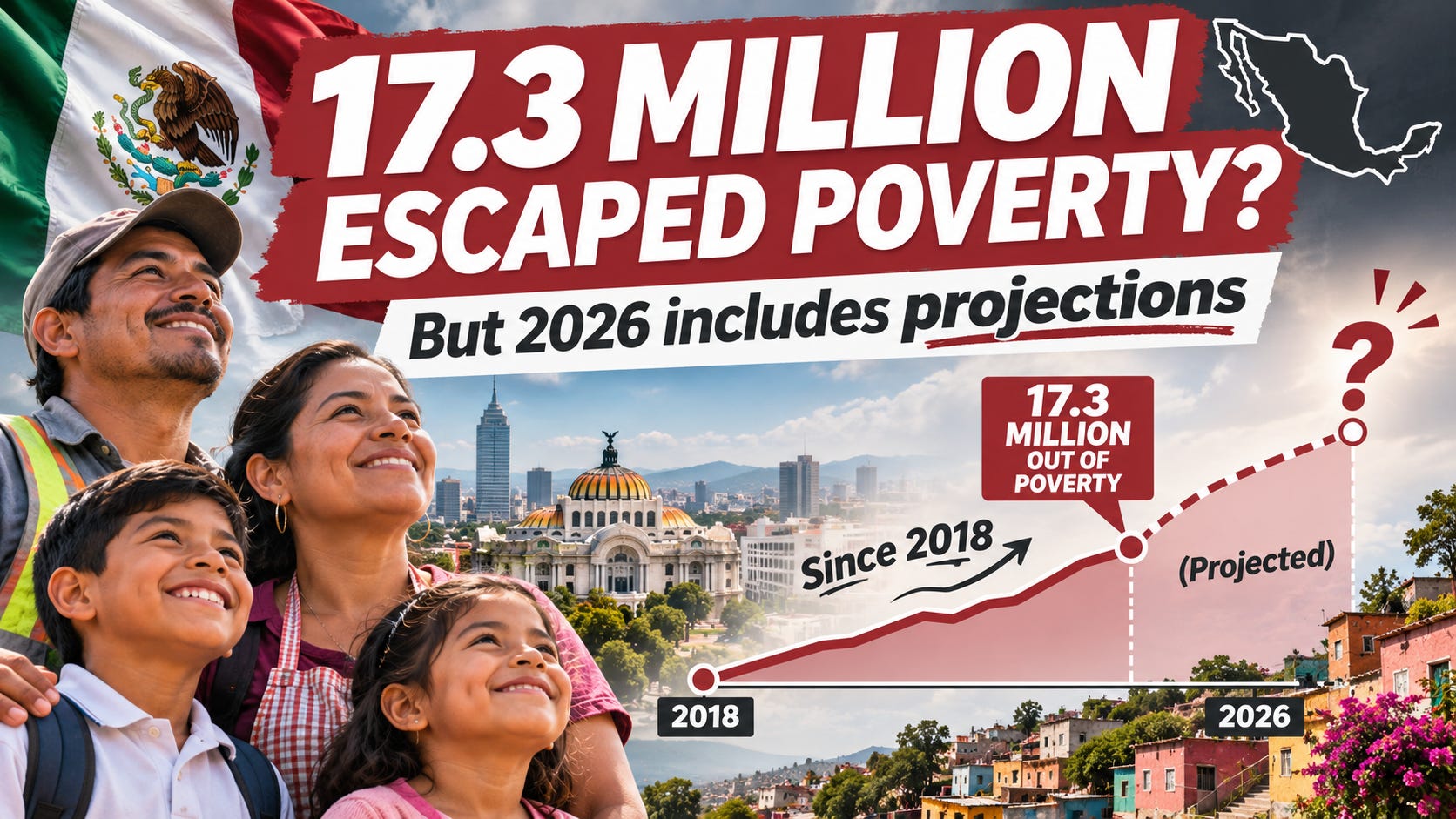
The Mexican government announced Monday that 17.3 million people have moved out of poverty since 2018, citing figures from the World Bank.
That’s a pretty remarkable number. We’re talking about millions of families potentially having more money for groceries, rent, school supplies, and the little things that make everyday life less stressful.
But there’s something important buried in those numbers.
Not all 17.3 million have actually been counted yet.
Here’s what’s happening.
According to the figures presented by federal officials, Mexico had approximately 43.9 million people living in income poverty in 2018. By 2026, that number is projected to fall to 26.6 million.
The key word is projected.
The World Bank’s latest observed poverty figures come from 2024. Its numbers for 2025 are estimates, while those for 2026 are forecasts.
In other words, the government is combining what has already happened with what economists expect to happen.
Now, before anyone dismisses the announcement as political spin, there’s another side worth acknowledging.
Mexico really has made substantial progress against poverty.
Even using the World Bank’s last observed figures from 2024, the number of people living below its income-poverty threshold had fallen to approximately 28 million.
Higher wages and expanded government assistance programs have helped put more money into Mexican households.
And that’s something worth recognizing, regardless of where you stand politically.
But there’s another wrinkle.
Mexico’s own statistics agency, INEGI, measures poverty differently. It doesn’t just look at income. It also considers whether families have access to healthcare, education, decent housing, food, and social security.
By that broader measure, 38.5 million Mexicans were still living in poverty in 2024, although that was 13.4 million fewer than in 2018.
Think about that for a moment.
A family might earn enough to climb above an income-poverty threshold while still struggling to find affordable healthcare or living in a neighborhood without reliable public services.
Both things can be true.
For those of us who live in Mexico, I think that’s the part of this story that matters most.
It’s easy to get caught up in the political arguments over who deserves credit. But behind these statistics are families trying to build better lives, parents hoping their children will have more opportunities, and workers trying to make their paychecks stretch a little further.
If millions of people are genuinely finding some financial breathing room, that’s good news for Mexico.
We should also be careful not to confuse an economic forecast with a finished accomplishment.
The poverty numbers are moving in an encouraging direction. The question now is whether that progress continues and whether families actually feel the difference in their everyday lives.
That’s a much more meaningful measure of success than any headline.
Sources: Publimetro México, November 16, 2026 and the World Bank’s October 2026 Macro Poverty Outlook.