
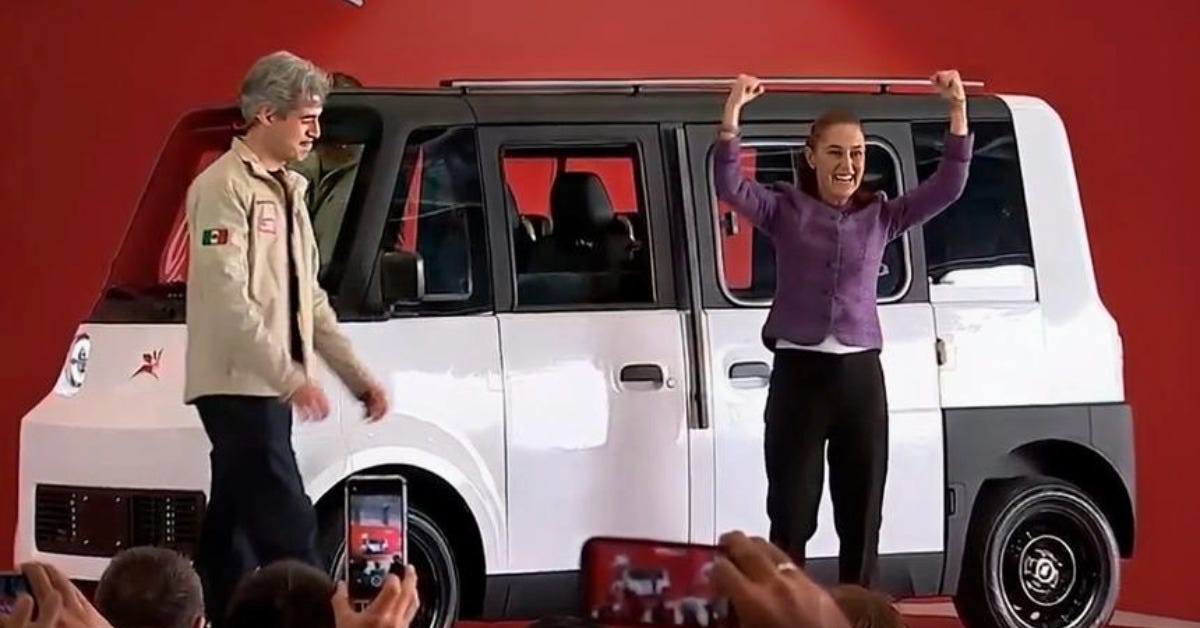
Mexico’s electric car project has moved from a government promise to a public prototype. President Claudia Sheinbaum presented Olinia Uno, a small electric vehicle designed in Mexico for short urban trips, taxi-style service, and local mobility. The model comes with a lower price target than most electric cars, a domestic production plan, and a few design choices that caught attention during Sunday’s presentation. The larger question now is whether Mexico can turn a symbolic debut into a working vehicle industry.
Claudia Sheinbaum presents Olinia, Mexico’s first electric car
President Claudia Sheinbaum presented Olinia Uno on Sunday, giving Mexico its first public look at a fully electric vehicle designed under a national development project.
The presentation took place in Zumpango, State of Mexico, where Sheinbaum arrived driving the small white vehicle into the event space. The government framed the debut as a step toward a Mexican electric-vehicle brand, not merely an isolated prototype.
“Olinia means movement, to move in Nahuatl,” Sheinbaum said during the official presentation of the vehicle. She called it “for Mexico and for the world.”
The car is officially named Olinia Uno. According to the official Olinia site, the model is scheduled to enter production in summer 2027 and will start at 150,000 pesos.
A small electric car built around short trips
Olinia Uno is not being pitched as a highway car or a luxury electric vehicle. It is a compact, low-speed model designed for short local trips, with a top speed of 50 kilometers per hour (about 31 miles per hour).
The vehicle has six seats, a closed cabin, seat belts for each passenger, and an estimated range of more than 100 kilometers (about 62 miles) on a full charge. Its battery is listed as a 14.7 kWh lithium iron phosphate pack, with a 13 kW motor and a recharge time of four to eight hours depending on the connection.
The design choice that drew immediate attention is accessibility. The vehicle includes room for a wheelchair user without folding the chair, while still allowing an accompanying passenger. Rafael Garayoa Guajardo, the project’s technical director, described the model as a “vehicle made to serve.”
The official specifications also list roof bars, a spare tire, a rear camera, LED headlights, a seven-inch central screen, Bluetooth, USB ports, electric locks, electric windows, and water-resistant electrical sealing for wet urban conditions.
Mexico wants its own electric vehicle brand
The project grew out of Sheinbaum’s push to build national technology capacity in strategic industries. A federal May project briefing said the goal was to create “our own brand” and a vehicle that would be cheaper to operate than a gasoline model.
Sheinbaum said Mexico is one of the world’s major vehicle producers, but has long served mainly as an assembly base for foreign automakers. Olinia is meant to answer that gap with a Mexican-designed product.
Roberto Capuano Tripp, director of the Olinia project, said in the federal briefing that the vehicle had been under development for more than 18 months. He described it as “a project from Mexico for the world.”
The project is coordinated by SECIHTI and developed with the IPN, TecNM, and public research centers, with support from UNAM and UPAEP. Olinia says the vehicle will be produced in Puebla, where much of the project team is based.
The project team page lists specialists in engineering, design, manufacturing, software, energy, mobility, batteries, embedded systems, supply chains, industrialization, and administration.
From prototype to production
The first public model is aimed at passengers. A cargo version is also planned, though the Olinia Cargo page currently lists it as coming soon.
Olinia Uno is being positioned against two common forms of local transport. The official site compares its operating cost to those of a sedan taxi and a mototaxi, putting Olinia at 50 centavos per kilometer, below both.
The next step is production, supplier development, service capacity, regulation, and consumer trust.
Mexico has already signaled that Olinia is part of a broader industrial plan. The new model builds on earlier semiconductor and electric vehicle projects tied to Mexico’s technology strategy, including work on Kutsari and Olinia that expanded the country’s 2030 tech ambitions.
Battery supply will also stay under scrutiny. Mexico’s debate over lithium and other critical minerals has already become part of the country’s broader industrial policy, as seen in previous coverage of Mexico’s stated refusal to cede control of critical minerals.
An electric car with political weight
Olinia gives Sheinbaum a visible technology project at a time when electric vehicles have become part of the global competition over manufacturing, batteries, and industrial policy.
The design also reflects the government’s focus on smaller vehicles for local use rather than high-end electric cars. It is aimed at taxi-style mobility, short-distance family trips, neighborhood movement, and small local service routes.
That makes the 150,000-peso starting price central to the project. It places Olinia below most electric vehicles sold in Mexico, though the final cost will depend on equipment, production scale, financing, and the extent to which the supply chain can be localized.
Olinia’s official site now includes a registration form for people who want updates before orders open. The page says the first units are expected in summer 2027.