
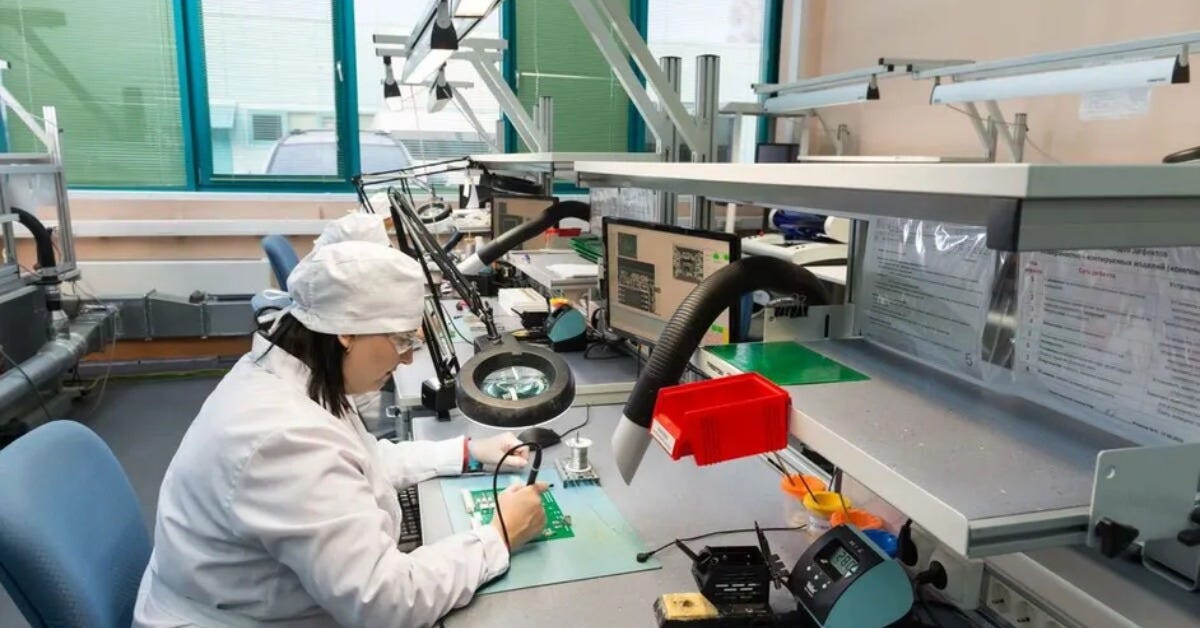
Mexico is becoming a key stop in the global AI supply chain, not by designing the chips but by assembling the hardware that carries them. Taiwanese firms are using Mexican plants to serve U.S. customers faster and with fewer geopolitical risks. The trend is giving Mexico a new role in high-tech manufacturing, but it also raises questions about trade rules, energy supply, water use, and how much value Mexico can keep inside its own economy.
Mexico Becomes an AI Assembly Hub for Taiwanese Firms
Mexico is gaining a larger role in the global artificial intelligence supply chain as Taiwanese technology companies expand assembly work in the country for export to the United States.
A recent UBS analysis says Mexico is benefiting from the AI boom by assembling technology components for servers, data centers, and advanced computing systems. The trend is tied to nearshoring, the movement of production closer to end markets, especially the United States.
The shift does not mean Mexico has become a major chip-design center. Its role is more practical and industrial. Components arrive from Taiwan and other Asian suppliers, are assembled or integrated in Mexican facilities, and are then shipped north to U.S. customers.
That makes Mexico a bridge between Taiwan’s electronics industry and the fast-growing U.S. demand for AI infrastructure.
How Mexico fits into the AI hardware chain
AI tools may feel digital, but they depend on physical infrastructure. Data centers need servers, motherboards, racks, cooling systems, fiber connections, and power equipment. Much of that hardware is produced by Taiwanese firms with long experience in manufacturing for global technology brands.
UBS says Mexico’s recent growth in technology exports reflects a sharp rise in imports from Taiwan. In simple terms, more parts are entering Mexico, being assembled into higher-value systems, and leaving as exports to the United States.
This is where Mexico’s location matters. A server assembled in northern Mexico or western Mexico can reach U.S. customers much faster than one shipped across the Pacific. That shorter route helps companies manage costs, delivery times, and political risk.
It also helps explain why firms such as Foxconn, Pegatron, Quanta, Inventec, and Wiwynn have become important names in Mexico’s advanced manufacturing story. These companies are known as contract manufacturers or original design manufacturers. They build complex equipment for major global technology customers.
Taiwan’s role is central
Taiwan is a major force in global electronics manufacturing. Its companies are deeply involved in the production of servers, circuit boards, and systems used by cloud providers and AI developers.
The UBS analysis points to Mexico as an intermediary for Taiwanese exports headed to the U.S. market. That is an important distinction. Mexico is not replacing Taiwan. It is becoming part of Taiwan’s North American production route.
This arrangement gives Taiwanese firms a way to stay close to U.S. customers without placing every step of production inside the United States. It also allows U.S. buyers to reduce some exposure to China-based manufacturing.
That matters because AI hardware has become part of a larger debate about national security, technology leadership, and supply-chain control. The United States wants more critical technology production closer to home. Mexico is one of the countries positioned to benefit.
Foxconn and the Nvidia connection
One of the clearest signs of Mexico’s changing role came when Foxconn said it was building a major facility in Mexico linked to Nvidia’s GB200 platform. The GB200 is part of Nvidia’s Blackwell generation of AI computing technology.
The plant has been described as one of the largest global facilities for assembling this type of AI hardware. Guadalajara, Jalisco, has been identified as the planned location.
That project matters because it connects Mexico directly to one of the most important companies in the AI economy. Nvidia designs the chips and platforms that power many advanced AI systems. Foxconn provides large-scale manufacturing muscle.
For Mexico, the opportunity is not only the factory itself. It is the larger supply chain that can form around it. That includes logistics companies, industrial parks, component suppliers, cooling systems, technicians, and specialized maintenance services.
Nearshoring is no longer just about cars
For years, Mexico’s export story was heavily tied to autos, appliances, and traditional manufacturing. Those sectors remain important, but AI hardware adds a different layer.
The growth of computer and electronic product manufacturing shows how Mexico’s industrial base is changing. Northern states such as Chihuahua and border cities such as Ciudad Juárez have become important locations for electronics and server production. Jalisco also has a long-standing technology sector, especially around Guadalajara.
This is a shift from low-cost assembly toward more complex production. It still involves assembly, but the products are more valuable and more closely tied to future technology demand.
For Mexico, that can mean better industrial jobs and more investment. But the long-term benefit depends on whether the country can deepen its role beyond final assembly.
If Mexico only receives parts, assembles them, and sends them out, much of the value stays elsewhere. If more suppliers, engineers, testing facilities, and design support grow locally, the economic impact becomes larger.
T-MEC talks could shape the next stage
The biggest outside risk is trade policy. Mexico’s access to the U.S. market depends heavily on T-MEC, known in English as USMCA. The agreement gives North America a shared trade framework, but it is under review in 2026.
UBS warned that stricter rules of origin or new tariff pressures could affect Mexico’s position. Rules of origin determine how much of a product must be made within the region to receive preferential trade treatment.
This matters for AI hardware because many key components still come from Asia. If trade rules become stricter, companies may need to prove that more content comes from Mexico, the United States, or Canada.
That could create pressure, but it could also push more suppliers to move into Mexico. The result depends on how the rules are written and how quickly companies can adapt.
Energy and water are not small details
Advanced manufacturing needs reliable electricity. AI hardware manufacturing also depends on cooling, precision systems, and stable industrial infrastructure. Data centers, which are part of the same AI boom, place even more pressure on power and water systems.
UBS pointed to energy and water constraints as possible limits on Mexico’s growth. This is already a concern in several industrial regions, especially in northern states where water stress is a long-running issue.
For companies, an attractive location is not only about wages or distance to the U.S. border. It is also about whether a plant can get enough electricity, water, transport access, and trained workers.
If Mexico cannot expand infrastructure fast enough, some investment could slow down or move elsewhere. If the country solves those problems, it could strengthen its place in North America’s technology supply chain.
What this means for Mexico’s economy
Mexico’s role in AI assembly could bring more exports, more factory jobs, and more attention from global investors. It also gives the country a stronger position in conversations about North American industrial policy.
But the story should be read carefully. Mexico is gaining from the AI boom, but mostly through manufacturing and assembly. That is still valuable. It is also different from becoming a full AI innovation hub.
The next step is whether Mexico can capture a larger share of the supply chain. That means more local suppliers, more engineering work, more training programs, and more reliable infrastructure.
For residents in Mexico, this is not just a business story. It can affect industrial growth, regional job markets, electricity demand, water use, and government decisions on trade policy.
The AI boom may be global, but part of its physical foundation is now being built in Mexico.