
The best part of a late afternoon in Mexico is that moment when the sun finally stops trying to cook you. Chairs move into the shade, the drinks get a little colder, and somebody inevitably mentions which friends are coming down from Canada for the winter. Snowbird season has a way of announcing itself.
But there’s another group of winter visitors arriving in Mexico right now, and they’re considerably more interesting than your neighbor from Minnesota.
They don’t need passports, airline reservations, or a furnished condo with reliable Wi-Fi.
They have wings.
Mexico’s monarch butterflies are back. And if you’ve never witnessed their winter migration, you might want to add it to your Mexico bucket list.
The snowbirds who got here first
Every autumn, millions of monarch butterflies begin one of nature’s most improbable journeys.
Some travel more than 2,500 miles from Canada and the United States to spend the winter in the mountain forests of central Mexico.
Think about that for a moment.
A creature that weighs less than a paperclip somehow navigates across an entire continent, arriving in the same general region where generations before it spent their winters.
And unlike the rest of us, they don’t have Google Maps.
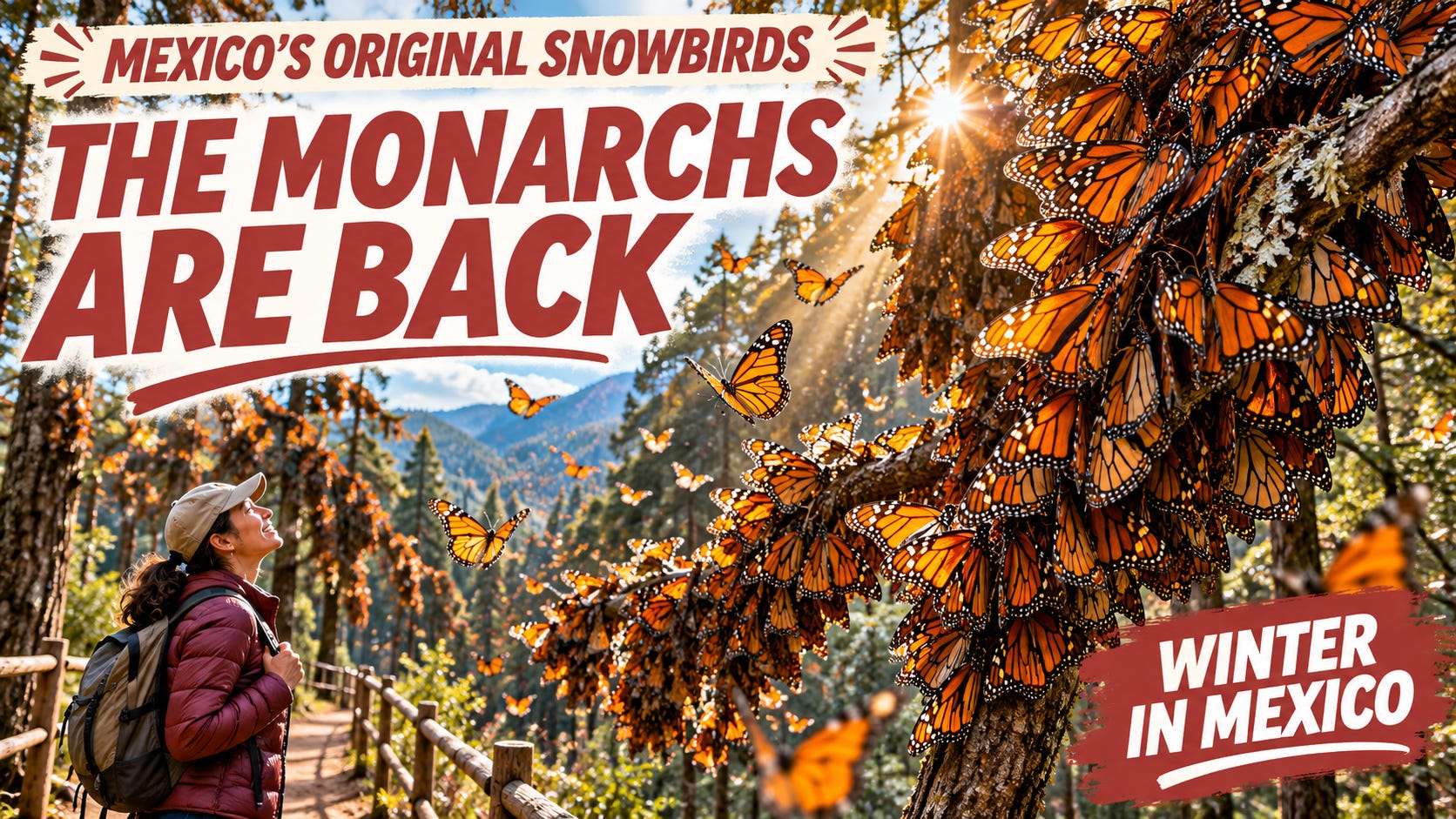
Their destination isn’t Cancun, Puerto Vallarta, or anywhere with a swim-up bar. It’s the cool, mountainous forests of Michoacán and the State of Mexico, where thousands of butterflies gather so densely that entire tree branches can appear covered in orange.
On a warm, sunny day, they take flight, and the forest seems to come alive.
I’ve seen plenty of beautiful photographs of this migration, but I suspect it’s one of those experiences that no camera can really capture.
And as of Saturday, November 21, the new visitor season is officially underway.
Here’s the good news. And the uncomfortable part.
Last winter brought something monarch conservationists hadn’t had enough of lately: genuinely encouraging numbers.
According to WWF, the international conservation organization, monarch colonies occupied 2.93 hectares of Mexican forest during the 2025–2026 winter season.
That’s a 64% increase over the previous winter.
Wonderful news, right?
Absolutely. But here’s where the celebration needs a little perspective.
About three decades ago, monarch colonies occupied roughly 18.2 hectares of forest.
So while a 64% rebound sounds spectacular, the butterflies are still occupying only a fraction of the winter habitat they once covered.
This is something I find fascinating about environmental success stories. We love a big percentage because it feels like a victory, but percentages don’t always tell us how far we still have to go.
The monarchs are doing better. That doesn’t mean they’re out of trouble.
And nobody knows yet how this winter’s population will compare. Scientists will need to complete their seasonal monitoring before those numbers become clear.
So, can you actually go see them?
Yes, and this is where the story gets especially interesting for anyone living in Mexico or planning a winter visit.
Five butterfly sanctuaries have opened for the season, which runs through March 31, 2027.
Three are in Michoacán: El Rosario, Sierra Chincua, and Senguio.
The other two, Piedra Herrada and La Mesa, are in the State of Mexico, the state surrounding much of Mexico City.
These aren’t butterfly gardens or carefully maintained tourist exhibits. You’re visiting the forests where the monarchs have chosen to spend the winter.
And I think that makes the experience considerably more special.
If you’re planning a trip, January and February are generally worth considering. By then, the butterflies have established their winter colonies, and warmer days can bring some spectacular activity.
But remember, nature doesn’t operate on a tourist schedule.
A chilly, cloudy morning might mean thousands of butterflies remain clustered quietly in the trees. A sunny afternoon could produce the kind of scene that makes you forget about your phone entirely.
And one practical warning for anyone coming from Puerto Vallarta: this is mountain country.
Bring warm clothing and proper walking shoes. The trails can be steep, the air can be chilly, and the altitude makes this a very different outing from a walk along the Malecón.
The strangest rule might also be the most important
Here’s something that caught my attention.
Visitors this season are allowed just 18 minutes with the butterflies in the designated observation areas.
Eighteen minutes.
Not 20. Not half an hour. Eighteen.
At first, that sounds a little ridiculous. Imagine traveling hundreds or thousands of miles to see something extraordinary and being told your time is up before you’ve really settled into the moment.
But there’s a good reason.
The restrictions help reduce disturbances to the wintering colonies while allowing more people to enjoy the experience.
And that 18-minute limit applies only to the butterfly observation area, not your entire sanctuary visit.
Visitors are also expected to stay quiet, avoid touching butterflies, remain on designated trails, and leave the flash photography behind. Pets aren’t allowed, and officials have even asked people not to use hand sanitizer near the colonies.
Some might consider the rules excessive.
I see them a little differently.
These tiny creatures have survived a journey across North America, navigating weather, changing landscapes, and countless obstacles just to reach these forests.
Surely we can manage to behave ourselves for 18 minutes.
Maybe there’s a bigger lesson here
There’s something rather charming about the fact that millions of butterflies and thousands of foreign retirees have independently reached the same conclusion.
Mexico is a pretty wonderful place to spend the winter.
But there’s an important difference.
We choose Mexico for its weather, affordability, culture, and the lifestyle it offers. The monarch butterflies come because these particular forests provide the conditions they need to survive.
They don’t have another vacation destination lined up if things go wrong.
And their future depends on what happens not just in Mexico, but throughout their migration route across three countries.
That’s what makes this annual arrival more than a beautiful tourist attraction.
It’s a reminder that Mexico is part of something much bigger than the beaches, resorts, and retirement communities we tend to talk about.
Sometimes the country’s most extraordinary visitors are the ones we barely notice.
And sometimes the best thing we can do as visitors is simply stand quietly, watch, and remember whose home we’re standing in.
Would you travel to central Mexico to witness the monarch migration? Or, even better, have you already experienced it? I’d love to hear whether those 18 minutes were enough.