
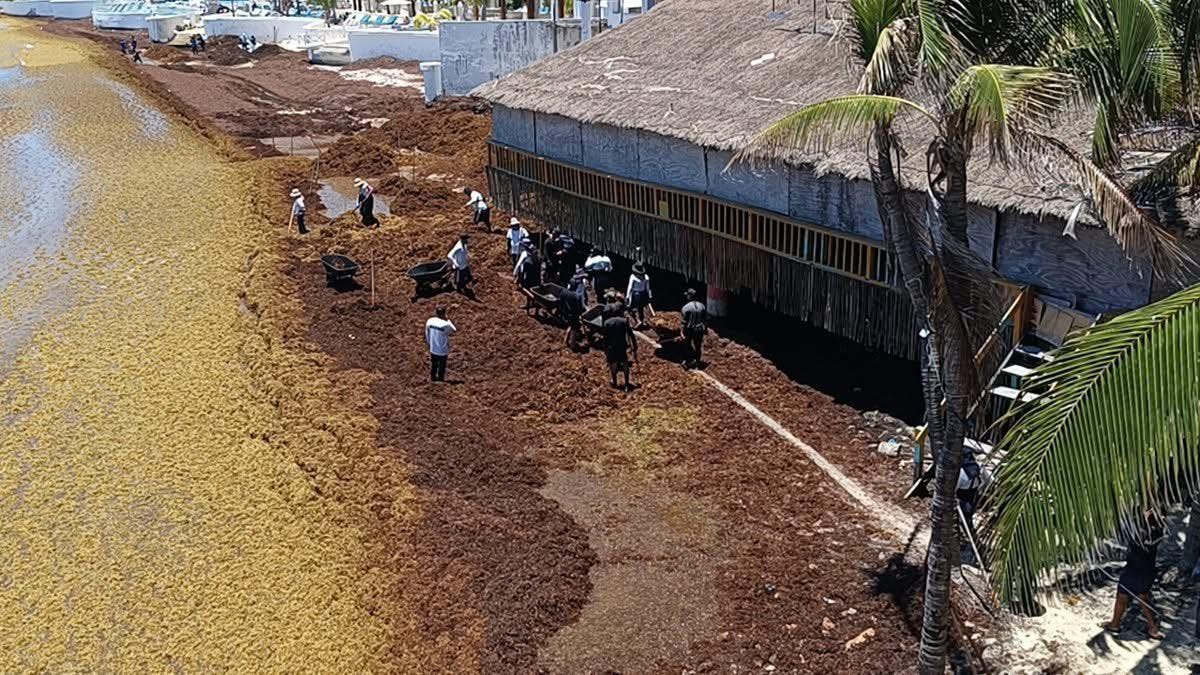
Sargassum is no longer a seasonal nuisance on Mexico’s Caribbean coast. The floating brown algae now sit at the center of a larger challenge involving tourism, public health, marine ecosystems, fisheries, waste management, and coastal planning. Mexico is trying to clean beaches, monitor offshore blooms, and turn the biomass into a usable resource. But the scale of the arrivals is forcing a harder question: can the country manage sargassum before it reaches the sand again?
Mexico faces a larger test as sargassum keeps arriving
Mexico’s Caribbean coast is entering another demanding sargassum season, with scientists, environmental officials, tourism operators, and coastal communities watching a problem that has grown far beyond beach cleanup.
The floating brown algae, known as sargassum, have always existed in the Atlantic. In the open ocean, it can be useful. It provides habitat, food, and shelter for fish, turtles, crabs, shrimp, and other marine life. The trouble begins when large mats drift toward shore, pile up in shallow water, and rot on the sand.
That is now a recurring reality in the Mexican Caribbean. Since 2011, large arrivals have affected the coast of Quintana Roo with increasing frequency. The worst impacts are often felt from spring through summer, although heavy years can start earlier and last longer.
For Mexico, this is not only an environmental issue. Sargassum now affects tourism, public health, municipal budgets, beach access, fisheries, marine ecosystems, and coastal infrastructure. It also tests how quickly different levels of government can coordinate a response across a long coastline.
The challenge is especially visible in places such as Cancún, Playa del Carmen, Tulum, Puerto Morelos, Cozumel, Mahahual, and Xcalak. These destinations depend heavily on the beach experience. When visitors arrive and find brown water, piles of seaweed, and a strong smell of decay, the economic effect can spread quickly.
Hotels pay for cleanup crews. Municipalities move workers and equipment to beaches. The Navy deploys vessels and barriers. Scientists monitor offshore mats from satellites, drones, and field stations. Health concerns rise when the algae decomposes. And local residents are left to live with a problem that tourists may only see for a week.
What sargassum is and why it is not always bad
Sargassum is a type of floating brown algae. It has small air bladders that help it stay at the surface, where it moves with winds and ocean currents. In moderate amounts, it is part of a healthy ocean system.
At sea, sargassum mats function like floating islands. Young fish use them for protection. Turtles and seabirds feed around them. Small marine organisms attach to the algae and create a living system that moves across the Atlantic.
This is one reason experts warn against treating all sargassum as waste. Removing it from the open ocean without clear rules could damage marine species' habitats. Any large-scale harvesting plan must weigh the benefits of collection against ecological loss.
The problem begins when the volume becomes excessive. Thick mats can block sunlight from reaching seagrass beds and coral reefs. In shallow water, they can reduce oxygen levels and change water chemistry. Once the algae decomposes, it releases gases and leachate that can affect people, animals, and groundwater.
This is the central contradiction. Sargassum is ecologically valuable offshore but damaging when it arrives in large amounts on populated coasts. That makes management difficult. Mexico cannot simply remove all of it, but it also cannot ignore the growing impact on coastal life.
The Great Atlantic Sargassum Belt changed the scale
For many readers, the first question is simple: where is all this seaweed coming from?
The answer involves the Great Atlantic Sargassum Belt, a massive and shifting region of floating algae that stretches across parts of the tropical Atlantic. Since 2011, this belt has produced large blooms that move west through the Caribbean and into the Gulf.
Researchers are still studying the drivers. The growth appears linked to several factors, including ocean currents, wind patterns, nutrient movement, warmer waters, and changes in Atlantic circulation. Some studies point to nutrient-rich upwelling and shifting atmospheric patterns. Others continue to examine the role of river runoff and broader climate variability.
What is clear is that the pattern has changed. Massive blooms are no longer rare events. Since 2018, heavy sargassum years have become a recurring problem across the Caribbean, including the Mexican coast.
The 2026 outlook has raised fresh concern. Satellite monitoring has shown large amounts of sargassum across the Atlantic and Caribbean regions. By late April, monitoring from the University of South Florida indicated that nearly every monitored region had record-high amounts for that month. It also warned that 2026 could become another major year, possibly a record year by summer.
That does not mean every Mexican beach will be covered every day. Local beach conditions depend on winds, currents, geography, barriers, and cleanup operations. One beach can be clear while another nearby beach is heavily affected.
But the broader trend matters. Mexico is facing a recurring offshore algae bloom that can overwhelm local response systems when wind and current conditions push it toward shore.
Why the Mexican Caribbean is exposed
Quintana Roo sits directly in the path of Caribbean currents that can carry sargassum toward Mexico’s coastline. Once mats enter the western Caribbean, they can move toward the Yucatán Channel and affect beaches along the state’s eastern edge.
The shape of the coast also matters. Bays, coves, and shallow areas can trap seaweed. Reefs and seagrass beds may slow or collect it. Beaches that face certain wind directions can receive more landings than others.
This helps explain why the problem is uneven. Some areas of Cancún’s Hotel Zone may remain relatively clear while beaches farther south struggle. Tulum can see heavy accumulations during one period, then improve when winds shift. Mahahual and Xcalak can experience severe arrivals due to their exposure and coastal morphology.
The season also changes. Sargassum often increases during warmer months, but major years can bring early arrivals. That creates planning problems for hotels, municipalities, and visitors.
For expats and frequent travelers in Mexico, the most practical takeaway is that sargassum is not a simple yes-or-no beach condition. It changes by location and by day. Checking current local reports matters more than relying on broad seasonal assumptions when booking or traveling.
Tourism feels the pressure first
The most visible impact is tourism. The Mexican Caribbean sells clear water, white sand and easy beach access. Heavy sargassum directly threatens that image.
When large amounts arrive, hotels and beach clubs must remove seaweed before guests wake up. Crews use rakes, wheelbarrows, tractors, barriers, and boats. Some resorts spend heavily to keep their beachfront usable. Smaller businesses often have fewer options.
Restaurants, tour operators, beach clubs, dive shops, and fishing guides can all feel the effect. If visitors avoid the beach, cancel excursions, or choose other destinations, the impact reaches workers who depend on tips, wages, and seasonal demand.
The problem is not limited to luxury tourism. A beach covered in rotting algae affects public spaces, local recreation, small vendors, and residents who live near the coast. The smell can reach streets, businesses, and homes close to the water.
Tourism remains one of Mexico’s major economic engines. In Quintana Roo, it is central to employment and local government revenue. That makes sargassum a direct economic concern, not just an environmental inconvenience.
The challenge for the tourism sector is also reputational. A single viral image of a brown beach can shape perceptions of an entire destination, even when nearby beaches are clear. That creates pressure for faster information, better beach-by-beach reporting, and more transparent management.
Public health concerns are part of the story
Fresh sargassum in the water is usually not the main health concern. The greater risk comes when large piles sit on shore and begin to decompose.
As sargassum breaks down, it can release hydrogen sulfide and ammonia. Hydrogen sulfide is the gas often associated with a rotten-egg smell. In areas with heavy buildup, exposure can irritate the eyes, throat, and lungs. It can also worsen symptoms for people with asthma, bronchitis, or other respiratory conditions.
Some people report headaches, nausea, dizziness, or skin irritation after exposure to decomposing sargassum. Cleanup workers may face higher exposure because they spend hours near the piles.
This does not mean every beach with sargassum is unsafe. The risk depends on the amount of algae, how long it has been decomposing, weather conditions, ventilation, and the sensitivity of the person exposed.
Still, the health issue is serious enough that some communities are considering monitoring for gases near affected beaches. That is a shift from treating sargassum mainly as a beach appearance problem. It recognizes that rotting algae can affect air quality in busy coastal zones.
There are also disposal concerns. If sargassum is dumped in unsuitable areas, leachate can seep into the soil and threaten groundwater. In parts of the Yucatán Peninsula, where groundwater systems are connected through porous limestone, that risk requires careful planning.
Marine ecosystems can be damaged before the algae reaches shore
The damage does not begin only when the seaweed lands on the beach. Heavy sargassum can affect marine ecosystems while still in shallow water.
Thick mats reduce sunlight. This can hurt seagrass beds, which are important for fish habitat, water clarity, and coastal stability. Seagrass also stores carbon and supports marine food chains.
Coral reefs can also suffer. When sargassum piles up near reefs, decomposition can lower oxygen levels and change water chemistry. In some cases, this can stress corals and other organisms already facing heat, pollution, and disease.
The brown water associated with decomposing sargassum can smother marine life in nearshore areas. Fish kills have been reported in severe events across the Caribbean. The added nutrients can also alter local ecosystems.
These impacts matter because the Mexican Caribbean’s reefs and seagrass beds help support tourism, fisheries, and coastal protection. Healthy reefs reduce wave energy and protect beaches. Healthy seagrass beds support marine biodiversity. When these systems weaken, the coast becomes more vulnerable.
This is why some experts argue that the best place to manage sargassum is before it reaches sensitive coastal zones. Once it is decomposing in shallow water or onshore, the damage has already begun.
Mexico’s response is becoming more technical
Mexico’s response has become more coordinated as the problem has grown. Several institutions now play roles in monitoring, policy, collection, research, and possible reuse.
The Secretaría de Marina has led important containment and collection work, including the use of sargassum vessels, barriers, and cleanup crews. Naval operations can help intercept algae before it reaches beaches, although the scale of arrivals can exceed available capacity.
Semarnat has developed environmental policy and technical guidelines for managing algae. These guidelines matter because cleanup can damage dunes, turtle nesting areas, and beach ecosystems if done poorly.
Secihti and scientific institutions have supported research and coordination. Mexican researchers are using satellite imagery, models, fieldwork, and oceanographic surveys to understand where sargassum forms, how it moves, and where it may land.
IMIPAS, with support from international partners, has helped study sargassum as a possible resource. This includes research on its distribution, associated marine life, chemical composition, and potential regulated use.
The response is shifting from emergency cleanup toward a broader management system. That means forecasting, collection, environmental rules, disposal, health monitoring, and industrial use all need to work together.
The problem is that each part moves at a different speed. Science can identify risks. Authorities can issue rules. Businesses can test products. But beaches still need daily cleanup when heavy arrivals hit.
Turning sargassum into a resource is promising but complicated
Mexico has taken an important step by recognizing sargassum as a resource with development potential within the national fisheries framework. That opens the door to more regulated collection and possible commercial use.
The logic is clear. If sargassum can be collected before it decomposes, it may become a raw material rather than waste. Possible uses include biofertilizers, biogas, construction materials, alginates, resins, packaging, cosmetics, and other industrial products.
This could reduce disposal costs and create new economic activity. It could also give coastal communities a reason to collect sargassum earlier, when it has more value and causes less damage.
But the opportunity comes with limits. Sargassum can contain arsenic, cadmium, and other contaminants. Salt content can complicate processing. If used in fertilizers or animal feed without proper handling, it may pose health or environmental risks.
The supply is also unpredictable. Heavy years can overwhelm processors, while lighter years may leave businesses without enough raw material. That makes investment difficult.
There is also a governance question. If sargassum becomes profitable, who benefits? Coastal communities, fishers, hotels, municipalities, and private companies may all have competing interests. Experts have warned that any new market should avoid turning a public environmental problem into a private extraction opportunity with limited local benefit.
The most realistic view is that sargassum reuse can help, but it will not solve the problem on its own. It must be part of a larger system that includes prevention, monitoring, collection, safe storage, and environmental safeguards.
Beach cleanup has limits
Removing sargassum from beaches is necessary in tourism areas, but it is not ideal as the main strategy.
By the time sargassum reaches the sand, it may already be decomposing. Cleanup becomes more expensive and unpleasant. Heavy machinery can compact sand, damage dunes, and disturb turtle nesting areas. Workers also face exposure to gases and heat.
Manual cleanup is gentler but slower. It requires many workers and can be difficult during major arrivals. Municipal crews may clear one beach in the morning only to see new piles arrive by afternoon.
Barriers can help, but they are not a complete solution. If poorly placed, they can redirect the algae, damage marine life, or fail during rough seas. Some biomass sinks or passes underneath. Maintenance is constant.
Collection at sea is often preferred, but it is technically difficult. Sargassum mats are scattered and moving. Weather affects operations. Boats need fuel, crews, storage, and places to unload. The collection must also avoid destroying the floating habitat that supports marine species.
This is why forecasting is so important. The better the authorities can predict arrivals, the better they can position boats, barriers, and crews. Timing can determine whether sargassum is intercepted offshore or removed after it has already harmed a beach.
Better information helps residents and visitors
For people living in or visiting the Mexican Caribbean, better public information is one of the most practical tools.
Beach conditions can change quickly. A regional forecast may say sargassum is heavy, but one specific beach may be clean. Another beach may be affected because of local winds or currents. Reliable beach-level updates help travelers make informed decisions and reduce frustration.
This also helps businesses. Hotels can communicate more honestly with guests. Tour operators can shift activities. Municipalities can send crews to the most affected areas.
For residents, monitoring can help reduce exposure to health risks. If gas levels are high near decomposing piles, people with respiratory conditions may choose to avoid certain areas. Workers may need protective measures and shorter exposure periods.
The challenge is consistency. Information often comes from a mix of official sources, community networks, hotel updates, satellite products, and social media. Some reports are useful. Others are incomplete or outdated.
A stronger public information system would treat sargassum as it treats other recurring coastal hazards. It would combine forecasts, beach observations, health alerts, and cleanup status in a way that residents and visitors can understand.
The broader issue is coastal planning
Sargassum is also exposing larger weaknesses in coastal planning.
Many destinations in the Mexican Caribbean have grown quickly. Hotels, condos, beach clubs, and roads are located near sensitive ecosystems. Wastewater, stormwater runoff, and coastal development already pressure reefs, mangroves, and groundwater.
Sargassum adds another stressor. It brings large amounts of organic matter to already heavily used beaches. It requires disposal sites, transport routes, machinery, and labor. It raises questions about where coastal infrastructure should be placed and how much pressure beach towns can absorb.
There is also a climate dimension. Warmer waters, shifting currents, and changing weather patterns may make heavy sargassum seasons more likely or less predictable. Even if scientists continue to refine the causes, the management question remains urgent.
Mexico’s Caribbean coast cannot plan as if sargassum is temporary. The pattern now suggests a long-term challenge. That means local governments may need permanent budgets, trained crews, approved disposal sites, health protocols, and stronger coordination with federal agencies.
It also means tourism promotion must be matched by environmental capacity. Selling beach destinations without investing in coastal resilience creates problems when nature changes the terms.
What to watch next
The months ahead will show how severe the 2026 season becomes for Mexico. Offshore monitoring will remain important, but the real test will be local landfall. Winds and currents will decide which beaches are hit hardest.
The response will also show whether Mexico can move from cleanup to prevention. More offshore collection, better forecasting, gas monitoring, and regulated reuse could reduce the worst impacts. But they require money, coordination, and public trust.
The most important shift may be conceptual. Sargassum can no longer be treated as trash that washes ashore. It is a dynamic ocean system, a public health concern, a tourism risk, a fisheries issue, and a potential raw material.
For Mexico, the challenge is to manage all of those realities at once. The country has more science, more institutional experience, and more technology than it did when major arrivals began. But the algae is also arriving at a scale that continues to test those tools.
The sargassum problem is not going away. The question now is whether Mexico can build a response that protects beaches, marine ecosystems, workers, residents, and the tourism economy before each new wave reaches shore.