
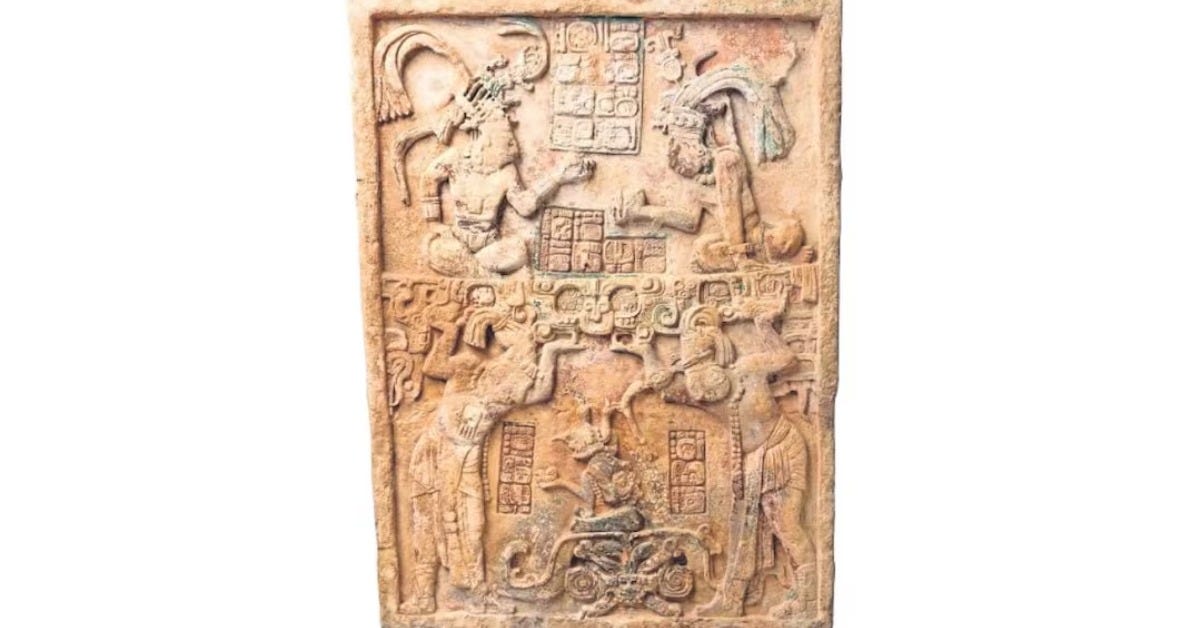
A Maya stone lintel returned through Mexico’s consulate in New York was first presented as part of a cultural recovery effort tied to Yaxchilán, Chiapas. The case has now become more complicated. Researchers and Guatemalan officials say the same piece may have come from El Túnel, a site in Guatemala’s Petén region. The dispute raises a sensitive question for both countries: when ancient Maya kingdoms crossed modern borders, how should recovered heritage be returned today?
Mexico-Guatemala Lintel Dispute
Mexico’s recovery of a carved Maya lintel in New York has opened a new dispute over archaeological patrimony, after researchers and officials in Guatemala said the piece may not have come from Mexico at all.
The lintel, a carved limestone beam once used above a doorway, was presented in April at the Consulate General of Mexico in New York. Mexican officials described it as a major cultural recovery from the region of Yaxchilán, Chiapas, one of the most important ancient Maya sites along the Usumacinta River.
The story appeared, at first, to fit into Mexico’s wider campaign to recover pre-Hispanic objects held abroad. Over the past several years, Mexico has pressed auction houses, private collectors, and foreign governments to return pieces it considers part of its national patrimony.
But the case became more complex when Maya specialists and Guatemalan cultural authorities said the lintel appears to come from El Túnel, also known by researchers as Laxtunich, in Guatemala’s Petén department.
That claim does not deny the lintel’s connection to Yaxchilán. Instead, it points to the difficult history of the ancient Maya region, where political power, trade, warfare, and ritual life did not fit neatly within today’s national borders.
A recovery announced as Mexican patrimony
The lintel was formally presented on April 16, 2026, at the Mexican consulate in New York. Mexican officials said the piece had been returned voluntarily by a New York businessman who asked to remain anonymous.
According to Mexico’s public description, the lintel is a limestone work from the Classic Maya period, roughly 600 to 900 A.D. It was described as originating from the Yaxchilán region of Chiapas and as part of Mexico’s archaeological heritage.
The piece is not small. It weighs close to one ton and bears a carved scene depicting Cheleew Chan K’inich, also known as Jaguar Acorazado IV, a ruler of Yaxchilán in the late eighth century. The scene includes figures connected to court ritual, political authority, and Maya cosmology.
Mexican officials said the lintel would be transferred to Mexico under official supervision, with the National Museum of Anthropology in Mexico City named as its intended destination.
For Mexico, the recovery fits a clear national policy. Archaeological monuments are treated under Mexican law as national property rather than ordinary private goods. That position is central to Mexico’s efforts to stop the sale of pre-Hispanic artifacts abroad.
The government has also framed these recoveries as part of a broader defense of cultural sovereignty. Mexico has recovered thousands of archaeological and historical objects in recent years through legal action, diplomatic pressure, and voluntary returns.
Why Guatemala is now challenging the claim
The dispute centers on where the lintel was originally found.
Several researchers argue that the piece came from El Túnel or Laxtunich, a site in Guatemala’s Petén region. That area sits near the Usumacinta River, close to the modern border with Mexico and near the ancient political world of Yaxchilán.
The distinction is important. A piece can refer to a Yaxchilán ruler and even belong to the political sphere of Yaxchilán, while still having been carved, installed, and found at a site now within Guatemala.
That is the heart of the disagreement.
Researchers, including Stephen Houston, a Maya epigrapher and archaeologist at Brown University, have studied a group of related lintels connected to this region. Their work points to field notes, old photographs, and later site studies that place the lintel’s origin on the Guatemalan side of the river.
Guatemalan archaeologist Oswaldo Chinchilla has also supported the view that the piece belongs to Guatemala. The argument is based not on modern political preference, but on documentary and archaeological evidence about the lintel’s original location.
Guatemala’s Ministry of Culture and Sports has said it is preparing a formal recovery request. Officials there have described the lintel as part of Guatemala’s Cultural Heritage of the Nation and said the matter will move through diplomatic channels.
The problem of ancient borders and modern states
The case is sensitive because the ancient Maya world covered what is now southern Mexico, Guatemala, Belize, and parts of Honduras and El Salvador. Ancient political boundaries rarely matched today’s national lines.
Yaxchilán itself sits in Chiapas, along the Usumacinta River. But its influence extended into areas that are now in Guatemala. Smaller centers and allied sites across the river could be tied to Yaxchilán’s dynasty, even if they are now outside Mexican territory.
That is why the lintel can be described in two ways that seem contradictory but are not necessarily so.
It can be a Yaxchilán-related Maya lintel because it refers to a ruler and political network centered at Yaxchilán. At the same time, it may be a Guatemalan archaeological object if it was originally installed at El Túnel or Laxtunich, inside what is now Guatemala.
This distinction matters for repatriation. Modern heritage claims usually depend on the territory where an object was found or removed, not only on the dynasty, style, or ruler shown in the carving.
For readers familiar with Mexico’s archaeological sites, the issue may seem similar to saying a piece is “Maya” or “Aztec.” Those terms describe culture and history, but legal ownership often depends on place, date, removal history, and national law.
What the lintel shows
The lintel is important because it preserves both art and political history.
The carved scene is tied to Cheleew Chan K’inich, a late ruler of Yaxchilán. He ruled during a period when Maya kingdoms in the Usumacinta basin used sculpture, architecture, and inscriptions to display political authority.
Lintels were not decorative wall art in the modern sense. They were part of buildings. A visitor entering a doorway would pass beneath these carved stones, which often showed rulers, nobles, captives, gods, or ritual events.
In Maya cities, such monuments helped tell the story of power. They named rulers, marked important dates, and recorded ceremonies. They also linked human authority to the divine order.
The recovered lintel includes elements that specialists have connected to courtly ritual and cosmology. It has been described as showing figures arranged around symbols of order, renewal, and sacred authority.
Researchers have also connected the lintel to a known Maya artist, Mayuy, whose signed or attributed works are important in the study of Classic Maya sculpture. That matters because named artists are not common in ancient art, and Maya sculptors who signed their work give scholars rare insight into individual creators.
A trail through private collections
The lintel’s modern history is part of the larger story of looting in the Maya region.
Researchers have linked the piece to the records of Dana Lamb, a mid-20th-century adventurer and writer who traveled through southern Mexico and Guatemala. His accounts have long been treated with care by scholars because they blend real observation with dramatic storytelling.
Even so, old notes, maps, and photographs connected to Lamb have become important evidence. They appear to document the lintels before they entered private hands.
The likely removal of the piece is believed to have occurred decades ago. Some accounts point to the 1960s, a period when looting in parts of the Maya region intensified. Large carved stones were cut down, thinned, or moved in pieces to facilitate transport.
From there, many artifacts followed complicated routes. Some passed through private collections in Europe and the United States. Others entered museums, auction houses, or storage facilities with incomplete histories.
The lintel now at the center of the dispute is believed to have circulated privately before reaching New York. Researchers say they had identified or examined it in a private collection years before its return through the Mexican consulate.
This is common in patrimony cases. The public often sees the final moment, when a piece is handed over. The harder story is the hidden path: who removed it, who sold it, who stored it, and what documents were created or lost along the way.
Mexico’s strong record on repatriation
Mexico has become one of the most active countries in the world in seeking the return of cultural property.
Its position rests on law, diplomacy, and public messaging. Under Mexico’s federal law on archaeological, artistic, and historical monuments, archaeological objects are national property. They are treated as inalienable and cannot be legally bought and sold like ordinary antiques.
The country has also used the phrase “Mi Patrimonio No Se Vende”, or “My Heritage Is Not for Sale,” in campaigns against auctions of pre-Hispanic objects in Europe and the United States.
This strategy has had results. Mexico has recovered more than 14,000 cultural objects in recent years through a mix of voluntary returns and legal or diplomatic action.
Those recoveries are important. Many pre-Hispanic objects left Mexico during periods when archaeological sites were poorly protected, when foreign collecting was common, or when looters supplied a global market with little scrutiny.
At the same time, the lintel case shows that repatriation can become complicated when the recovered object may belong to the broader Maya world rather than to the territory of a single modern nation.
Mexico’s claim appears to have been based on the lintel’s connection to Yaxchilán. Guatemala’s response is based on the argument that the original findspot lies in Petén.
Both countries are defending cultural patrimony. The question is which national patrimony applies.
Guatemala’s case is moving through official channels
Guatemala’s Ministry of Culture and Sports has said it is working on a formal file to support a recovery request. Officials have said that the case involves the ministry, the country’s cultural heritage authorities, and the Ministry of Foreign Affairs.
According to public statements, the ministry's position is that technical analysis places the piece at El Túnel in Petén. Officials say that would make the lintel part of Guatemala’s national cultural heritage.
That means the case may now become a diplomatic matter between Guatemala and Mexico, not only a debate among researchers.
There is no public indication that the dispute has reached a final resolution. The lintel was recovered in New York through Mexican diplomatic channels, but Guatemala is now preparing its own claim.
If the evidence supports Guatemala’s position, Mexico may face a choice. It could defend its initial claim, seek a joint review, negotiate a transfer, or create some form of shared cultural agreement.
The best outcome would likely depend on transparency. Both countries have an interest in showing that recovered cultural property is handled with care, evidence, and respect for origin.
What this means for museums and collectors
This case also sends a message to museums and private collectors.
For years, many collections relied on broad labels such as “Maya,” “Mexico,” “Guatemala,” or “Central America.” Those labels are often too vague for modern heritage standards.
Today, provenance matters. A piece’s legal and ethical status depends on its findspot, export history, collection history, and documentation. A label based only on style or subject is no longer enough.
The lintel also shows why voluntary returns, while useful, do not always answer every question. Returning an artifact to the wrong country can create a second dispute.
This does not mean every recovery is flawed. It means high-value archaeological objects need careful technical review before public claims are made.
The Maya region is especially complex because ancient kingdoms crossed modern borders. A ruler named in an inscription may have governed from a capital in one country while commissioning monuments in another.
That is exactly why specialists in epigraphy, archaeology, and regional history are essential in repatriation cases.
A story larger than one stone
The lintel dispute is about more than one carved stone.
For Mexico, it touches a national effort to bring home pieces removed from archaeological sites and sold through private channels. That effort has strong public support and a clear legal foundation.
For Guatemala, it raises a familiar concern: that Maya objects from its territory have often been absorbed into foreign collections or described under broader regional labels that blur their origin.
For both countries, the case is a reminder that Maya heritage is shared culturally, but legal recovery depends on evidence.
The lintel’s ancient meaning is also part of the story. It was not made as an isolated art object. It belonged to a building, a site, and a political landscape. Once removed, much of that context was damaged or lost.
Repatriation can return a piece to public custody, but it cannot fully restore the original context. That is why origin matters so much. Where a piece is displayed affects how its history is told.
A lintel from El Túnel tells one story about the Yaxchilán kingdom’s reach into the Guatemalan side of the Usumacinta. A lintel from Yaxchilán itself tells a different story about the capital in Chiapas. The carving may look the same, but the historical meaning changes with the findspot.
What happens next
The next step will depend on documentation.
Researchers have pointed to old field notes, maps, photographs, and comparative studies. Guatemalan officials say they are preparing a formal diplomatic request based on technical analysis.
Mexico has said its recovery followed established procedures, with technical accompaniment from cultural authorities. Mexican officials have also presented the recovery as part of the country’s broader fight against the trafficking of cultural property.
The key question is whether both governments will agree to review the evidence together.
If they do, the dispute could become an example of responsible regional cooperation. If not, it could become a more public disagreement over a piece that both countries see as tied to national memory.
For now, the lintel stands at the intersection of archaeology, diplomacy, and identity. It is a reminder that the ancient Maya world was not divided by today’s borders, even though modern heritage law is.
For international readers and expats in Mexico, the case offers a useful window into how seriously Mexico treats archaeological patrimony. It also shows why these recoveries can be more complicated than a simple “return home” headline.
The lintel did return from private hands. The unresolved question is where home is.
Mexico Demands NY Auction Not Sell Pre-Hispanic Artifacts
Who was ‘Reina Roja’ and how did her discovery change Mexican history?