
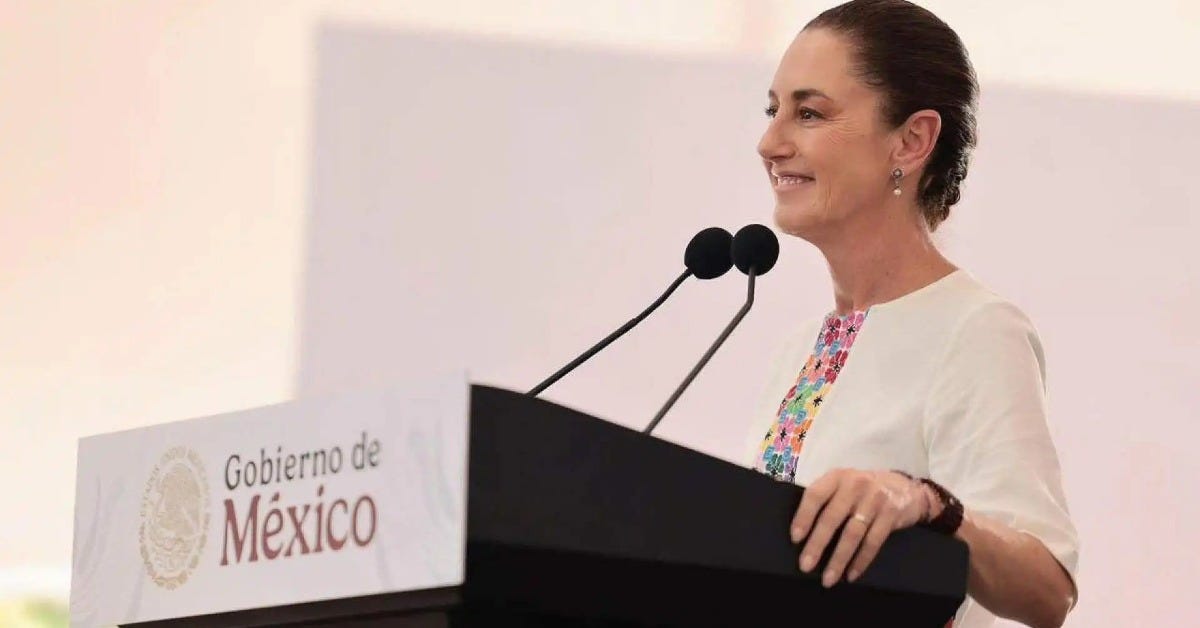
President Claudia Sheinbaum’s latest remarks were not only aimed at Washington. They were also meant for a Mexican public watching several sensitive security cases unfold at once. Her message was direct: Mexico will cooperate with the United States, but not as a subordinate country. The statement comes as her government faces pressure over extradition requests, alleged cartel links, and questions about foreign agents operating on Mexican soil.
Sheinbaum says Mexico is not a U.S. protectorate or colony
President Claudia Sheinbaum said Mexico must defend its national sovereignty and reject any form of subordination to the United States, as several recent security cases place new pressure on the bilateral relationship.
Speaking during her morning conference on Monday, May 4, Sheinbaum said Mexico supports cooperation with the United States, but only under the terms of equality and respect.
Her message was direct. Mexico, she said, is not a protectorate or a colony of the United States. It is a free and sovereign country that should deal with Washington as an equal.
The remarks came during a tense period in U.S.-Mexico relations. The two countries continue to work together on migration, organized crime, fentanyl, weapons trafficking, and trade. But Sheinbaum’s government is also pushing back against what it views as pressure from U.S. agencies and prosecutors.
A sovereignty message aimed beyond one case
Sheinbaum’s comments were framed as part of a broader defense of Mexico’s sovereignty. She said the relationship with the United States has long been marked by interventionist pressure, while also saying cooperation remains necessary.
That balance is now central to her foreign policy. Her government has repeatedly used the phrase coordination without subordination to describe how it wants to work with Washington.
For international residents in Mexico, the statement helps explain a recurring pattern in current Mexican politics. The government is not rejecting cooperation with the United States. It is trying to set legal and political limits around that cooperation.
Those limits matter because many of the most sensitive issues between the two countries take place inside Mexico. These include cartel investigations, foreign intelligence activity, extradition requests, and law enforcement operations involving U.S. agencies.
Sheinbaum’s position is that Mexico can share information and coordinate security work. But foreign agents cannot act as if Mexican territory is an extension of U.S. jurisdiction.
The Rocha case adds pressure
One of the main cases behind the current tension involves Rubén Rocha Moya, the governor of Sinaloa on leave, and several current or former officials accused by U.S. authorities of alleged links to organized crime.
Mexican officials have said the United States sent a request for provisional detention for extradition purposes, not a completed formal extradition package. That distinction matters under the bilateral extradition treaty.
A formal extradition request typically requires a more comprehensive legal file. A provisional detention request is used in urgent cases, before the full extradition package is completed.
Mexico’s legal counsel said U.S. authorities had not provided evidence proving the urgency needed for provisional detention. The federal attorney general’s office told the Foreign Relations Ministry to request additional information from the U.S. side.
That does not mean Mexico has cleared the accused officials. It means Mexican authorities say the request must meet Mexican legal standards before a judge can act.
Sheinbaum has also said Mexico will not protect criminals. But she has stressed that accusations from another country must be handled through due process, not public pressure.
What the extradition treaty says
The U.S.-Mexico extradition treaty allows either country to request provisional detention in urgent cases. The request must identify the person sought, describe the alleged crime, state that a formal extradition request will follow, and refer to an existing arrest warrant or conviction.
The treaty also says that a person provisionally detained may be released if the formal extradition request and supporting documents are not received within 60 days.
This is why the word urgency has become important. Mexico is not only debating whether the accusations are serious. It is asking whether the U.S. request met the legal threshold for the faster provisional process.
That legal point has now become a political issue. For Washington, the case is tied to cartel enforcement. For Mexico, it raises questions about sovereignty, due process, and how U.S. agencies handle sensitive claims involving Mexican officials.
The Chihuahua CIA case deepened the dispute
The tension is not limited to the Rocha case. Another dispute involves two U.S. agents reported to be connected to the CIA who died after a security-related operation in Chihuahua.
Mexican officials said the federal government had not been properly informed about the agents’ role in field activity. The case raised questions about whether foreign personnel were participating in operational work without proper authorization through federal channels.
The government later said one agent entered Mexico as a tourist and another with a diplomatic passport. It also said neither had formal accreditation for operational activities in Mexican territory.
That detail matters because Mexico allows security cooperation with the United States. But it does not allow foreign agents to carry out operations in Mexico outside the country’s legal framework.
The White House pushed back publicly and said Mexico should show empathy over the deaths of the U.S. personnel. Sheinbaum’s government responded by offering condolences and asking for explanations of the agents’ activities.
The result is a diplomatic dispute with two layers. One is human and political, involving the deaths of U.S. personnel. The other is legal, involving whether U.S. agents operated in Mexico without proper approval.
Cooperation remains necessary
Despite the tension, neither government appears to be walking away from security cooperation.
The United States depends on Mexico for enforcement against fentanyl trafficking, cartel finances, migration routes, and border security. Mexico depends on cooperation with U.S. agencies for intelligence, weapons tracing, financial investigations, and cross-border prosecutions.
The problem is not whether the two countries should work together. The problem is who controls the rules when that work happens inside Mexico.
Sheinbaum’s message is that Mexico’s federal government must remain the gatekeeper. State governments, local prosecutors, or foreign agencies cannot create parallel security arrangements.
That position reflects a long-running concern in Mexico. Many Mexicans remember past periods when U.S. security pressure was viewed as excessive or politically intrusive. Sheinbaum is trying to show that cooperation will continue, but only through Mexican institutions.
A political message at home
The sovereignty language also has a domestic audience.
Sheinbaum leads a government that presents itself as a defender of Mexican independence from foreign pressure. Her remarks connect today’s security disputes with a broader political story about national dignity, state authority, and resistance to outside interference.
That message can be effective in Mexico, where U.S. influence is often viewed with suspicion across the political spectrum.
At the same time, the government must avoid appearing to shield officials accused of serious crimes. That is the harder balance.
If Mexico rejects U.S. requests too broadly, critics may say the government is protecting political allies. If it accepts U.S. pressure too quickly, supporters may see it as surrendering sovereignty.
Sheinbaum’s answer is to emphasize legal procedure. Her government says it will act when the evidence is properly presented, and Mexican courts can review the request.
What comes next
The next step in the Rocha matter depends on whether U.S. authorities provide more information supporting the urgency of provisional detention. If they do, Mexican prosecutors could take the request to a judge.
If they do not, the case may remain stalled while Washington prepares a fuller extradition package.
The Chihuahua case also remains active. Mexican investigators are reviewing what happened, who knew about the operation, and whether foreign agents acted outside authorized channels.
For now, Sheinbaum’s statement sets the political line. Mexico will continue working with the United States, but it will not accept a relationship built on subordination.
That message is likely to remain central as both countries face more pressure over organized crime, fentanyl, migration, and the legal limits of cross-border security work.
Rocha Indictment Puts Sheinbaum in a Political Bind

The U.S. case against Sinaloa Governor Rubén Rocha Moya is not just another cartel indictment. It reaches into elected office, Morena politics, extradition law, and the limits of U.S.-Mexico cooperation. President Claudia Sheinbaum says Mexico will not protect criminals, but also will not act without clear proof. That balance now faces its hardest test,…
Mexico Senate Clears Armed U.S. Troops for Training

Mexico’s Senate has approved the entry of 12 armed U.S. military personnel for a five-month training exercise with Mexican special forces. The decision comes at a sensitive moment in bilateral relations, as Washington has increased pressure over organized crime and Mexican officials continue to stress sovereignty. For foreign residents, the vote offers …