
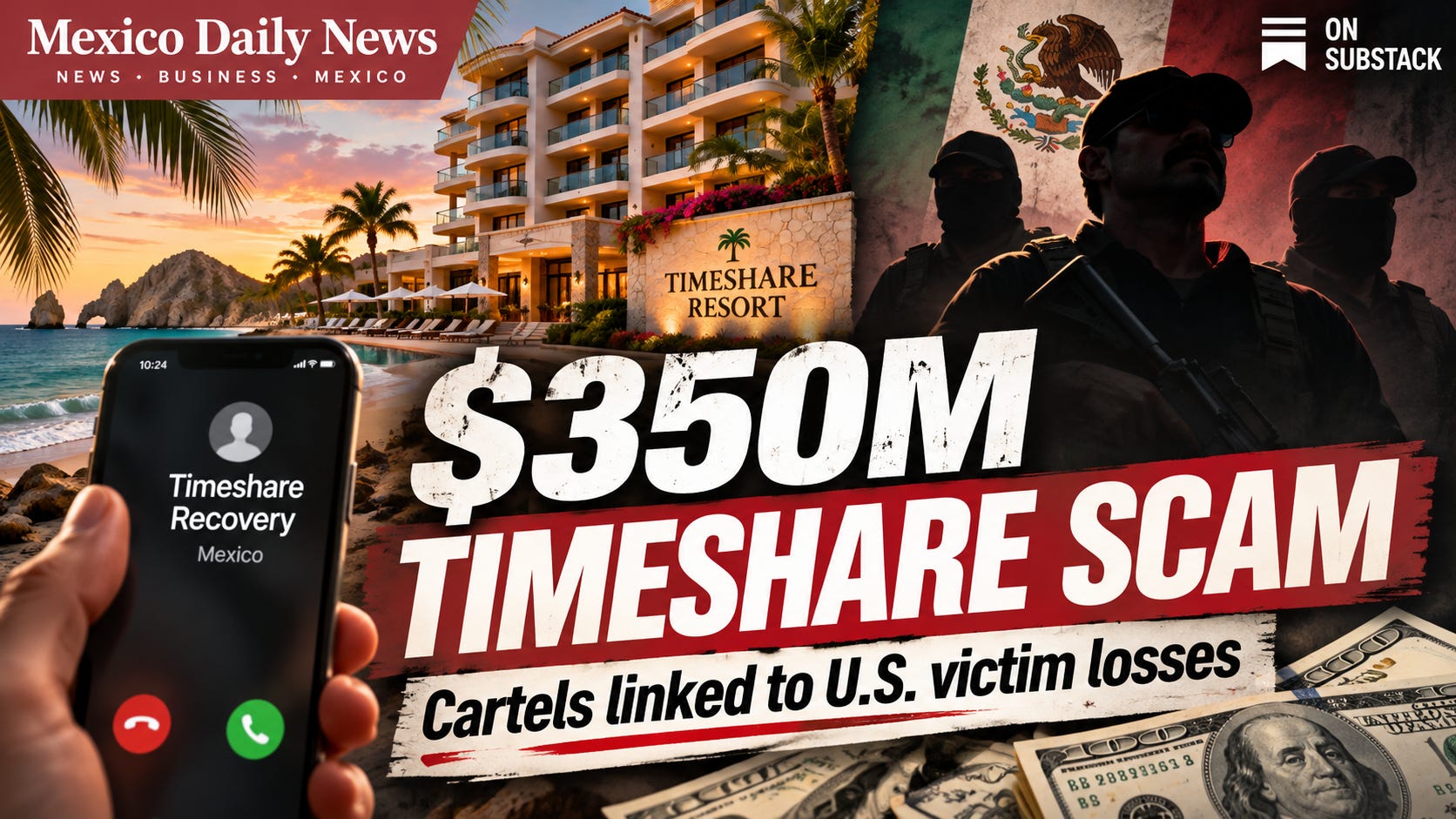
Imagine a late afternoon in Mexico. The sun is still shining, the ice in your margarita is melting, and life feels pretty good. Then your phone rings with an unexpected offer to buy that Mexican timeshare you’ve been thinking about getting rid of.
The caller knows your name, the resort where you own, and enough details about your property to sound completely legitimate.
What could possibly go wrong?
Apparently, about $350 million worth of things.
According to a report published today by El Economista, approximately 6,000 Americans reported losing a combined $350 million to timeshare scams operating out of Mexico between 2019 and 2024.
And here’s the twist: These weren’t necessarily small-time scammers working from somebody’s basement.
We’re talking about operations linked to some of Mexico’s most notorious drug cartels.
The Jalisco New Generation Cartel (CJNG), the Sinaloa Cartel, and the Gulf Cartel have all been identified by U.S. authorities as participants in this surprisingly lucrative criminal enterprise.
That’s right. While everyone has been watching the cartels fight over drug routes, some have also been making fortunes selling vacation dreams that don’t exist.
The Scariest Part? They Already Know Who You Are.
What caught my attention wasn’t even the $350 million.
It was something buried in the U.S. Treasury Department’s findings about how these operations actually work.
According to the department’s 2026 money-laundering risk assessment, criminals have obtained personal information about American timeshare owners from insiders working at resorts in Mexico.
Think about that for a moment.
You buy a timeshare at a legitimate resort. You hand over your name, contact information, ownership details, and probably a considerable amount of money.
Years later, someone calls with an offer that sounds almost too perfectly tailored to your circumstances.
That’s because, in some cases, it is.
The scammers may already know exactly what you own, where you own it, and how to make themselves sound credible.
And that raises a question I think deserves considerably more attention: What responsibility do timeshare companies have for protecting the personal information they’ve collected from their customers?
To be clear, this doesn’t mean every timeshare resort is involved in criminal activity. But when investigators identify insiders supplying customer information to organized crime, I want to know what’s being done to stop it.
Because there’s a big difference between falling for a random scam and being targeted using information you trusted a business to protect.
First They Take Your Money. Then They Offer to Help You Get It Back.
Here’s where this story gets particularly ugly.
The initial scam is almost ridiculously simple.
Someone calls claiming to represent a legitimate broker or investor interested in purchasing your timeshare. Maybe they offer an attractive price. Maybe they promise they can finally release you from those never-ending maintenance fees.
All you need to do is pay a little money upfront.
A transfer tax. A legal fee. Some administrative charge required to complete the transaction.
You pay.
Then there’s another fee.
And another.
Eventually, the buyer disappears, along with your money.
But for some victims, that isn’t the end.
Months later, another call arrives. This time, it’s supposedly from a lawyer, a government official, or an organization that can recover the money you lost.
There’s just one small problem.
You’ll need to pay a fee first.
Seriously.
The scammers have figured out how to turn someone’s desperation to recover their savings into an entirely new business opportunity.
The FBI describes these repeat approaches as part of the broader timeshare fraud operation.
And I find that especially cruel.
It’s bad enough to steal someone’s retirement savings. Coming back disguised as the person who can rescue them takes an entirely different level of calculated dishonesty.
This Is Bigger Than Timeshares
Something else worth understanding is that the cartels aren’t necessarily running these operations instead of selling drugs.
They’re diversifying.
Think of organized crime as a business constantly looking for new revenue streams. Drugs may be the most recognizable product, but fraud, extortion, fuel theft, and other criminal activities can also generate enormous sums of money.
And a convincing English-speaking salesperson working in a call center doesn’t attract quite the same attention as a truck full of armed men.
Puerto Vallarta and surrounding communities have been identified in previous U.S. Treasury enforcement actions as centers of cartel-linked timeshare fraud networks.
That’s an uncomfortable reality for a destination whose economy depends heavily on tourism, hospitality, and the trust of foreign visitors.
But there’s another uncomfortable truth.
These crimes don’t require tourists to wander into dangerous neighborhoods, make questionable decisions, or take unnecessary risks.
Sometimes the only thing a victim did was purchase a vacation property from a business they believed they could trust.
So Who’s Looking Out for the Victims?
U.S. authorities have sanctioned individuals and businesses connected to these operations, and the FBI continues to investigate.
But I keep coming back to the people behind those 6,000 complaints.
Some were probably retirees who spent decades putting money aside. Others may have been trying to unload a timeshare they no longer wanted or could afford.
For them, $350 million isn’t an interesting statistic in a government report.
It’s retirement plans postponed, savings accounts emptied, and family conversations nobody wants to have.
And while victims can report these crimes to the FBI’s Internet Crime Complaint Center at IC3.gov, filing a complaint is not a guarantee that their money will be recovered.
That’s the part that gets lost when we focus on the size of the criminal operation instead of the consequences.
We hear plenty about how much money the cartels are making. We hear considerably less about whether the people they robbed will ever see a dollar of it again.
One Last Thing Before You Answer That Phone
If you own a timeshare in Mexico and someone unexpectedly contacts you with an amazing offer, there’s nothing wrong with being skeptical.
Especially if they know an unsettling amount about you.
Verify the person’s identity independently. Never send upfront payments simply because someone claims they’re required to release money from a sale. And if you’ve already sent money, contact your bank immediately and report what happened.
Most importantly, don’t assume that someone promising to recover your losses is necessarily there to help.
The Treasury figures cover 2019 through 2024, so this isn’t $350 million stolen yesterday. The underlying assessment was published in March 2026, and today’s reporting is putting renewed attention on a problem that has been developing for years.
That’s what makes this worth talking about.
We’ve spent decades associating Mexican cartels with drugs, guns, and violence.
But apparently, one of the most effective weapons in their business arsenal can be a perfectly polite telephone conversation.
And that should make anyone who’s ever owned a piece of vacation paradise think twice before answering an unexpected call.