
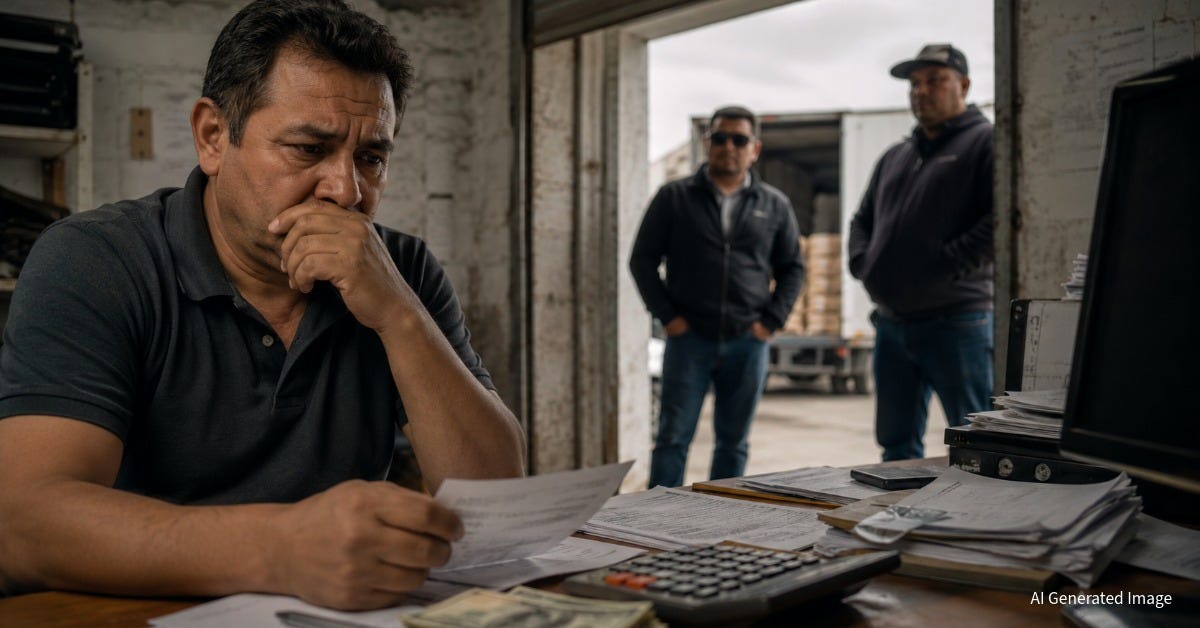
A new warning from security consultants puts a sharper business price on cartel power in Mexico. Companies are not only paying more for guards, cameras, insurance, and safer logistics. Some are also facing direct criminal demands that can reach levels usually associated with formal taxes. Official data shows extortion is already the most common crime reported by business victims, but the real scale remains harder to see. Many companies stay silent, quietly move projects, or pay.
Cartel charges move into company costs
Security consultants say Mexican companies in some states are being forced to absorb a criminal tax that can reach 20 percent, turning extortion into a business expense and another drag on investment confidence.
Eduardo Guerrero, founder of Lantia Intelligence, said companies are paying organized crime between 10 and 20 percent, according to a June 2 account of cartel extortion against companies. He described business extortion as “un problema masivo,” with thousands of victims.
The warning lands in an economy already trying to sell investors on geography, trade access, labor, and industrial capacity. Guerrero said businesses have closed, canceled construction projects, shifted planned investments inside Mexico, or abandoned plans to enter the country after threats in states such as Sinaloa, Baja California, Guanajuato, and Tamaulipas.
That kind of decision rarely appears in one clean public number. A company may cite costs, uncertainty, site risks, logistical issues, or a changed market. Extortion often lies beneath those explanations, especially when managers believe a complaint could worsen the danger.
Sergio Díaz, managing partner of Vestiga Consultores, also framed cartel pressure as a business risk, not only a policing problem. His warning was blunt. Mexican cartels, he said, have become the center of gravity for criminal activity well beyond Mexico’s borders.
Official data shows the reporting gap
The latest federal business victimization survey supports the scale of the problem, even if it does not verify the 20 percent figure for any single company.
In the 2024 National Business Victimization Survey, INEGI estimated that there were 747,000 extortion crimes against economic units in 2023. Of those, 113,000 were extortion in the street, inside an establishment, or cobro de piso. In 67 percent of extortion cases, the victim complied with the demands.
Extortion was the most frequent crime against businesses in that survey, with a rate of 1,562 crimes per 10,000 economic units. It ranked ahead of robbery or assault of merchandise, money, supplies, or goods.
The same survey found that only 12.2 percent of crimes against businesses were reported. A case file was opened in 9.7 percent of total crimes. In 90.3 percent of incidents, there was no complaint or no investigation file, the hidden figure that makes official crime data a partial map at best.
That gap helps explain why business chambers and consultants often describe a larger problem than prosecutors can show. Company owners may change routes, stop taking unknown calls, hire guards, or delay expansion without filing a report.
Earlier coverage has tracked similar pressure on investment confidence in Mexico, with small businesses in Puerto Vallarta and small shops pushed into criminal schemes.
Security is now part of the investment equation
The cartel charge is only one layer. Companies also pay for private guards, armored transport, cameras, access controls, insurance, legal advice, crisis consultants, and staff protection. In some corridors, the cost is built into logistics before a product leaves a warehouse.
Banxico’s May 2026 survey of private-sector economic analysts shows that security is no longer a side concern in economic forecasts. Analysts named public insecurity as the top individual factor that could obstruct Mexico’s growth over the next six months, with 19 percent of respondents citing it. Governance issues as a group accounted for 42 percent.
The same survey gave public insecurity a concern level of 6.2 on a seven-point scale. Other rule-of-law problems, corruption, and impunity also received high concern scores.
That finding matters because investors compare risks across countries and across Mexican states. A factory site, warehouse, mine, hotel project, or distribution route can lose value when criminal groups decide they also have a claim on the business.
The result is not always a dramatic exit. Sometimes it is a postponed lease. Sometimes a project moves from one state to another. Sometimes expansion gets approved elsewhere, while Mexico keeps the public announcement but loses the capital.
Federal strategy still faces a quiet crime
The federal government launched a national anti-extortion strategy in July 2025, built around the 089 reporting line and closer coordination among security agencies and prosecutors.
By March 2026, officials said the strategy had received 161,112 calls to 089. Federal Security Secretary Omar García Harfuch said 88.7 percent were attempted extortions that were not completed after real-time operator assistance. He also said 11 percent were completed extortions, leading to 5,888 investigation files.
Authorities reported 907 arrests for extortion in 24 states under the strategy. The number shows federal attention, but it also shows how far enforcement remains from the scale described by business surveys and private consultants.
At a February meeting with state prosecutors, Attorney General Ernestina Godoy said extortion leaves “no space for impunity” and called for a coordinated response by federal, state, and municipal authorities.
The harder issue is the silence around the crime. A phone call can be reported. A payment made under threat may never be. A construction project that quietly stops is harder to count. A company that leaves Mexico before announcing its investment leaves almost no public record.