
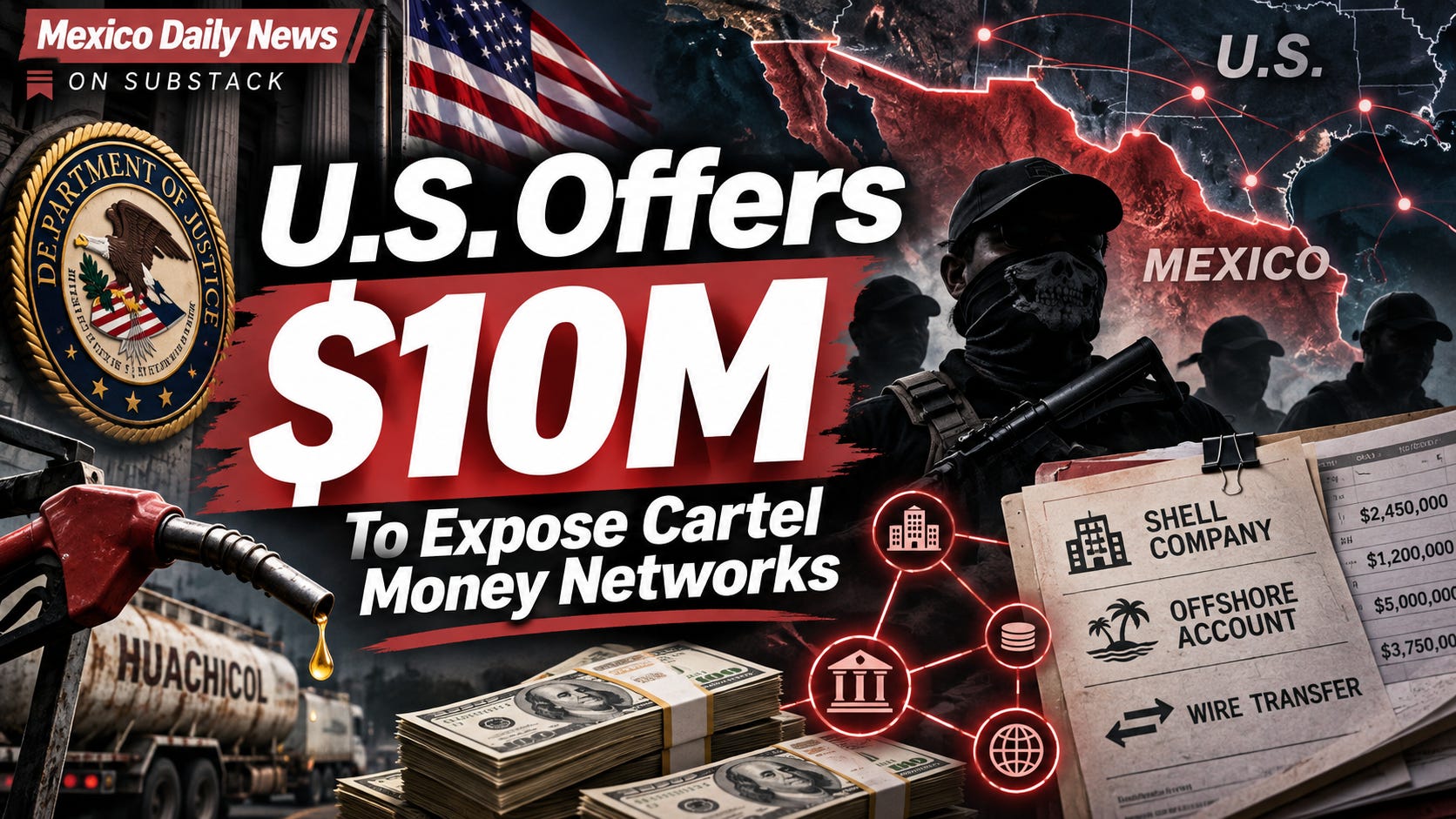
It’s approaching noon in Mexico. Someone’s filling up at the gas station, a delivery truck is making its rounds, and a few people are enjoying a cold drink, because that’s how we do it in Mexico. Just another perfectly ordinary day, with nothing particularly suspicious about it.
Except the business of keeping vehicles fueled has become part of a much bigger story.
The United States is offering up to $10 million for information that helps disrupt the financial networks of designated criminal organizations, including Mexico’s Cártel de Sinaloa and Cártel de Jalisco Nueva Generación (CJNG).
The U.S. Consulate in Tijuana promoted the offer this week through the State Department’s Rewards for Justice program.
And here’s what caught my attention: They’re not just looking for the guys with guns. They want to know who’s handling the money.
Forget the drugs for a minute. Follow the gasoline.
If you’ve lived in Mexico for any length of time, you’ve probably heard the word huachicol.
It’s the Mexican term commonly used for stolen fuel, although the broader criminal business also includes fuel smuggling and tax evasion.
It might not sound as dramatic as a drug shipment crossing the border, but the money involved can be enormous.
Think about it. Gasoline and diesel are products people need every single day. There are countless vehicles to fuel, businesses to supply, and opportunities to move large quantities of a valuable commodity.
And somewhere along the way, illegal fuel needs to be sold, the proceeds collected, and the profits hidden.
That’s where things get interesting.
In a separate U.S. reward notice, the State Department identifies a Mexican fuel logistics company, Jomadi Logistics and Cargo, which it accuses of disguising fuel shipments as lower-taxed products such as lubricants and using fraudulent customs paperwork.
The department alleges the company’s operations have moved tens of millions of dollars in illicit transactions connected to CJNG.
Think about that for a moment.
We’re talking about paperwork, customs declarations, financial accounts, and business transactions. Hardly the material of your typical cartel television drama.
But potentially just as important to keeping a criminal organization alive.
What if the real power isn’t holding a gun?
Here’s something I keep coming back to when reading about organized crime in Mexico.
We spend an incredible amount of time talking about cartel leaders. Who was arrested? Who replaced whom? Who controls which territory?
Those are legitimate questions. But capturing one powerful figure doesn’t necessarily shut down the operation that made that person powerful.
Money has a way of finding new management.
A criminal organization needs people who can move funds, arrange purchases, operate businesses, and make illegal profits appear legitimate.
And that’s what makes this reward particularly interesting.
The State Department is specifically seeking information about financial institutions, currency exchanges, businesses controlled by cartels, front companies, and people helping transfer money or resources.
In other words, Washington wants to understand the business behind the violence.
I can’t help wondering how many people who know something about these operations have never appeared on a wanted poster.
Would you risk everything for $10 million?
Now, before anyone starts imagining an early retirement in a beachfront villa, there’s an important catch.
It’s up to $10 million, not $10 million just for calling in a tip.
The information must produce a meaningful result, and the State Department decides whether a payment is warranted and how much it should be.
The program says it protects informants’ identities and may arrange relocation in certain circumstances.
That last detail says plenty about the stakes.
Imagine being an accountant, business associate, or someone with access to financial records who knows exactly how millions of dollars are being moved.
Would $10 million be enough to convince you to talk?
And perhaps the harder question: Would you believe anyone could keep you safe afterward?
Those aren’t hypothetical concerns when you’re dealing with organizations capable of intimidating witnesses and threatening families.
The question nobody can answer with a reward poster
Personally, I think following cartel money makes far more sense than treating every arrest as some enormous victory.
But I’m also skeptical that offering millions of dollars automatically translates into dismantling criminal networks.
A tip still needs investigators. Evidence still needs to be developed. Financial connections need to be traced, and authorities need to act on what they discover.
And there’s another uncomfortable reality: Money laundering doesn’t stop being a problem simply because the money crosses an international border.
Following a cartel’s finances means being willing to investigate wherever those transactions lead.
That’s the part I’ll be watching.
Because if these organizations can keep earning, moving, and hiding enormous amounts of money, replacing arrested leaders may remain little more than a business inconvenience.
The U.S. is offering $10 million to help uncover the money trail.
The question is whether anyone with the right information is willing to take the risk — and whether authorities can turn that information into something that actually changes the business.