
It’s late afternoon in Mexico. Someone is rushing home with a bag of fresh tortillas, a bus is running behind schedule, and half the neighborhood seems to be sitting in traffic. Just another ordinary day in a country where getting from one place to another isn’t always the most comfortable experience.
Which makes it particularly amusing that Mexico’s president just won herself a whole new fan club in China by doing something millions of ordinary travelers do every day.
She flew economy.
And apparently, the Chinese can’t get enough of it.
A president, an economy seat, and 21 hours in the air
President Claudia Sheinbaum traveled from Mexico City to Shenzhen, China, this week to attend the Asia-Pacific Economic Cooperation summit, better known as APEC, where leaders from 21 Pacific Rim economies meet to discuss trade and economic cooperation.
It’s the kind of international gathering where presidential jets, private aircraft, and elaborate VIP arrivals are practically part of the dress code.
But Sheinbaum had other plans.
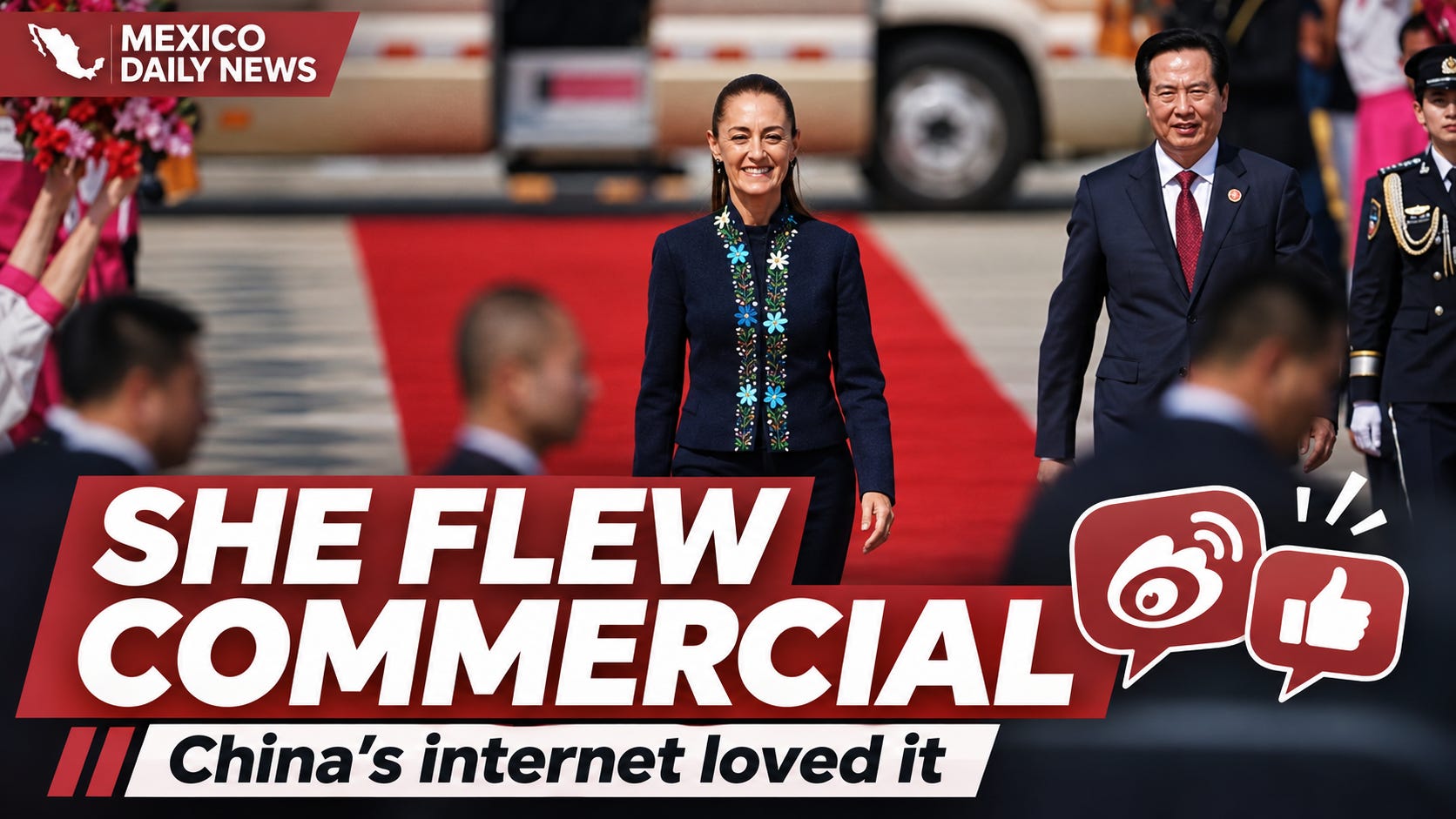
She boarded a regular China Southern Airlines flight, made a stop in Tijuana, and spent roughly 21 hours traveling to China alongside ordinary passengers.
There were selfies with fellow travelers at the airport, and online reports even placed her in seat 33B, an ordinary economy seat toward the back of the aircraft. That particular seat assignment hasn’t been independently confirmed, but her economy-class journey has.
And if you’ve ever spent 15 hours crossing the Pacific in a regular airline seat, you probably have a new appreciation for her commitment to the cause.
When she finally arrived in Shenzhen, there wasn’t a presidential jet waiting for photographers. She took an airport shuttle to the official reception area, where Chinese officials, performers, and a red carpet were waiting.
Not exactly the dramatic entrance we’ve come to expect from world leaders.
China absolutely loved it
Videos and photos of Sheinbaum’s journey began circulating on Chinese social media, where something unexpected happened.
People were impressed.
A hashtag about her arrival attracted more than 10 million views on Weibo, one of China’s major social media platforms.
Commenters praised her for not wasting public money on luxury travel. Others admired what they saw as a leader willing to live, at least temporarily, like ordinary people.
Think about that for a moment.
Mexico’s president traveled halfway around the world to discuss international trade, investment, and some fairly complicated diplomatic relationships.
And what captured the public’s imagination wasn’t a speech, an agreement, or a handshake with another president.
It was the fact that she didn’t fly first class.
That’s a pretty remarkable bit of political publicity, especially considering the Mexican government has supported tariffs on Chinese imports. The relationship between the two countries isn’t nearly as uncomplicated as the online applause might suggest.
But there’s a very Mexican story behind all this
For anyone who’s been living in Mexico for a while, Sheinbaum’s travel arrangements probably aren’t that surprising.
Her predecessor, Andrés Manuel López Obrador, commonly known as AMLO, made government austerity a central part of his political identity.
He famously refused to use Mexico’s lavish presidential aircraft, eventually selling it in 2023.
It was part of a broader message that public officials shouldn’t enjoy extraordinary privileges while millions of Mexicans struggle to pay their everyday bills.
Sheinbaum has largely continued that tradition.
Of course, depending on your politics, you might see this as admirable leadership or carefully calculated political theater.
And there’s a reasonable argument for both.
After all, buying an economy ticket doesn’t automatically make someone a better president.
It doesn’t fix a pothole, improve a public hospital, make a neighborhood safer, or solve the water problems that many Mexican communities deal with every day.
A government can save money on plane tickets and still waste enormous amounts elsewhere.
But I also think there’s something worth appreciating about a leader who doesn’t automatically assume that holding the country’s highest office should come with every possible luxury.
Especially when so many of the people paying the taxes that fund those luxuries will never experience them themselves.
The bigger question isn’t about flying economy
What interests me most about this story is how differently something so ordinary can be perceived.
In Mexico, commercial presidential travel has become familiar enough that many people barely give it a second thought.
In China, it made headlines and attracted millions of views.
It seems there’s still something genuinely refreshing, at least in the eyes of many people, about seeing a powerful politician forgo the royal treatment.
Perhaps that tells us something about how accustomed we’ve become to treating political leaders like celebrities rather than public servants.
And perhaps that’s the most interesting part of all.
Sheinbaum didn’t need an expensive advertising campaign to make a favorable impression on millions of people in another country. She simply boarded an airplane, sat among other passengers, and went about her business.
Whether that reflects genuine modesty, smart political instincts, or a little of both is something everyone can decide for themselves.
But there’s one thing I’d like to see carried beyond the airport.
If a president is willing to spend 21 hours traveling like an ordinary person, hopefully she’ll remember what ordinary people need when she returns home.
Because the real measure of a president isn’t how she travels.
It’s what she accomplishes at APEC.