
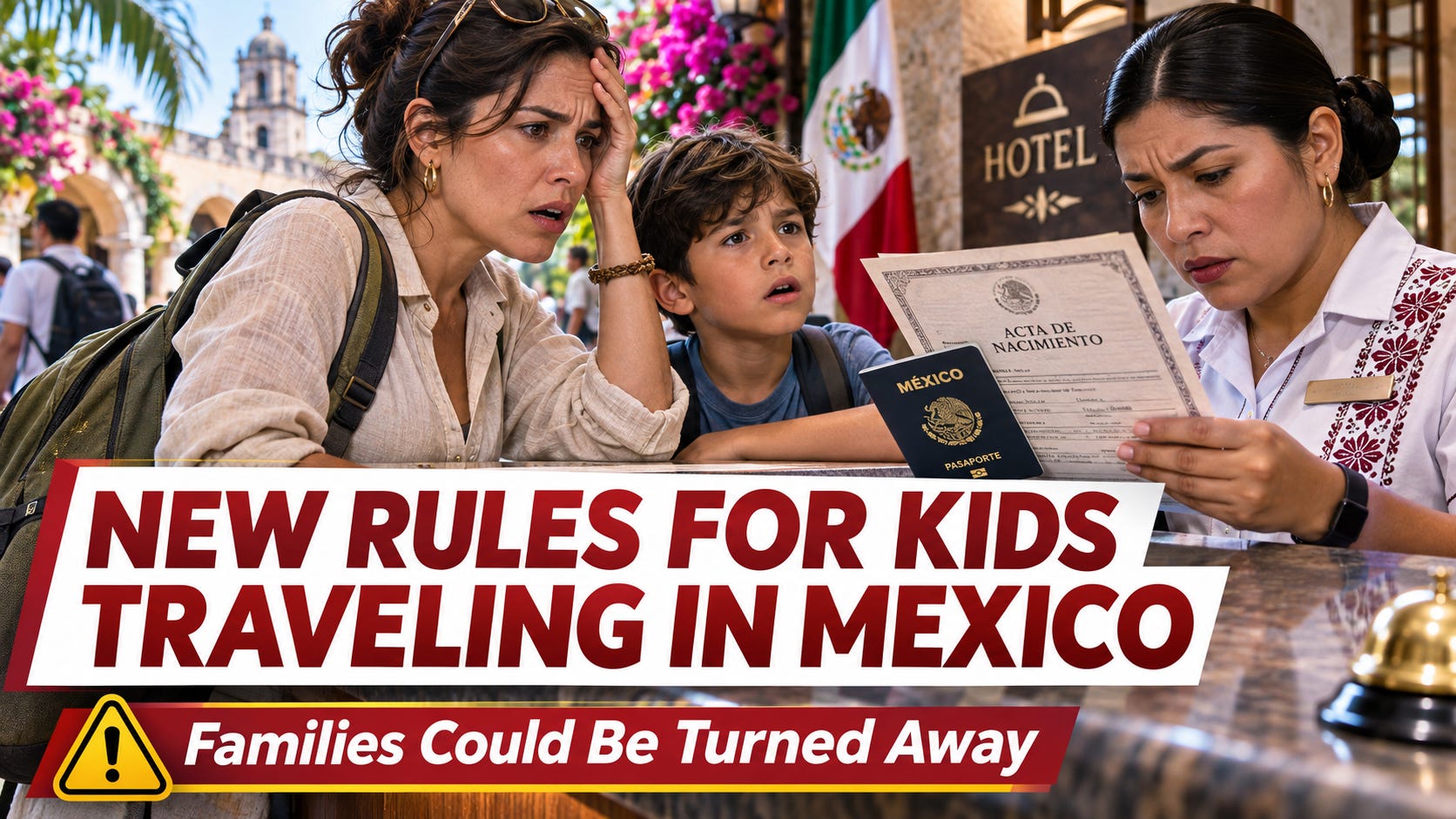
Traveling With Kids in Mexico? There’s a New Rule You Need to Know
Maybe you’ve got family visiting for the holidays, or the grandkids are coming down to spend a week with you.
Well, there’s something new you might want to know before you start making those hotel reservations.
Mexico quietly changed the rules for adults traveling with children over the weekend. And while the reason behind the change is a good one, I suspect it’s going to catch quite a few families by surprise.
Here’s what’s happening.
As of November 14, hotels and other tourism businesses in Mexico are required to verify the relationship between adults and the children accompanying them.
That means being a child’s parent, grandparent, aunt, or uncle might not be enough on its own anymore. You may need paperwork to prove it.
And this isn’t just a suggestion.
Under the new federal law published in Mexico’s official government journal, tourism providers must refuse service if the required relationship or legal responsibility can’t be verified. They’re also required to notify investigative authorities about a possible crime.
Yes, that could mean being turned away from a hotel even when you have a reservation.
So what does this mean for your family?
Let’s say you’re an American or Canadian retiree living in Puerto Vallarta, and your grandchildren are coming to visit.
You decide to take them to Guadalajara for a few days, or maybe book a beachfront resort for the weekend.
Until now, you probably wouldn’t have given much thought to proving that the kids were actually your grandchildren.
That’s changing.
The new law requires tourism providers to verify family relationships, parental authority, guardianship, or custody. But here’s the frustrating part: the government hasn’t spelled out exactly which documents every business must accept.
A birth certificate showing the parents’ names might help. Legal custody papers could be necessary in some situations. A child’s passport alone generally doesn’t prove who’s related to whom.
What about grandparents traveling with a signed permission letter from the parents? The law doesn’t clearly explain whether that would be enough.
That’s a pretty significant detail to leave unanswered.
There’s a serious reason behind all this
Before anyone gets too frustrated, the government isn’t doing this simply to make family vacations more complicated.
Mexico has been dealing with child trafficking and sexual exploitation, including cases involving hotels and vacation accommodations.
Puerto Vallarta has been part of that conversation for years.
Lawmakers want hotels and other tourism businesses to take more responsibility for identifying situations where children may be at risk.
That makes sense.
But turning a well-intentioned law into something that works smoothly for ordinary families is another matter. A grandmother taking her grandson on vacation shouldn’t have to guess which paperwork will satisfy the front desk.
And that’s the part I think deserves attention as this rolls out.
One important distinction
This is not a new rule about entering Mexico.
It’s a change to Mexico’s tourism law, which governs businesses providing services to travelers. Separate immigration rules already exist for certain minors leaving the country without their parents or legal guardians.
So even if you’ve cleared immigration without any problems, you could still encounter questions when checking into a hotel or arranging tourism services.
And because the new law also mentions services provided electronically, online bookings aren’t automatically outside its reach.
What I’d do before traveling
For now, I wouldn’t panic, but I also wouldn’t arrive at a hotel with children and assume everything will work the way it did last year.
I’d contact the property ahead of time, explain exactly who is traveling with whom, and ask what documents they’ll accept.
If you’re traveling with grandchildren, I’d want copies of their birth certificates and any relevant authorization or legal paperwork available. Just remember that bringing those documents doesn’t guarantee a hotel will consider them sufficient.
The law took effect November 14, so businesses are already subject to the new requirements, even though questions remain about how individual providers will handle them.
And here’s the detail worth remembering: a confirmed reservation doesn’t override the verification requirement. If a tourism business can’t establish the required relationship or legal responsibility, the law says it must deny service and notify the appropriate authorities.
That’s something I’d rather know before packing the car than discover at a hotel reception desk with three tired kids standing beside me.