
It’s another warm afternoon in Mexico. The delivery trucks are making their rounds, the mechanic down the street has three cars waiting outside, and someone at the corner store is complaining that everything seems more expensive than it used to be.
Just another ordinary Wednesday. Except something happened thousands of miles away today that could eventually have a lot to do with how much money moves through this country.
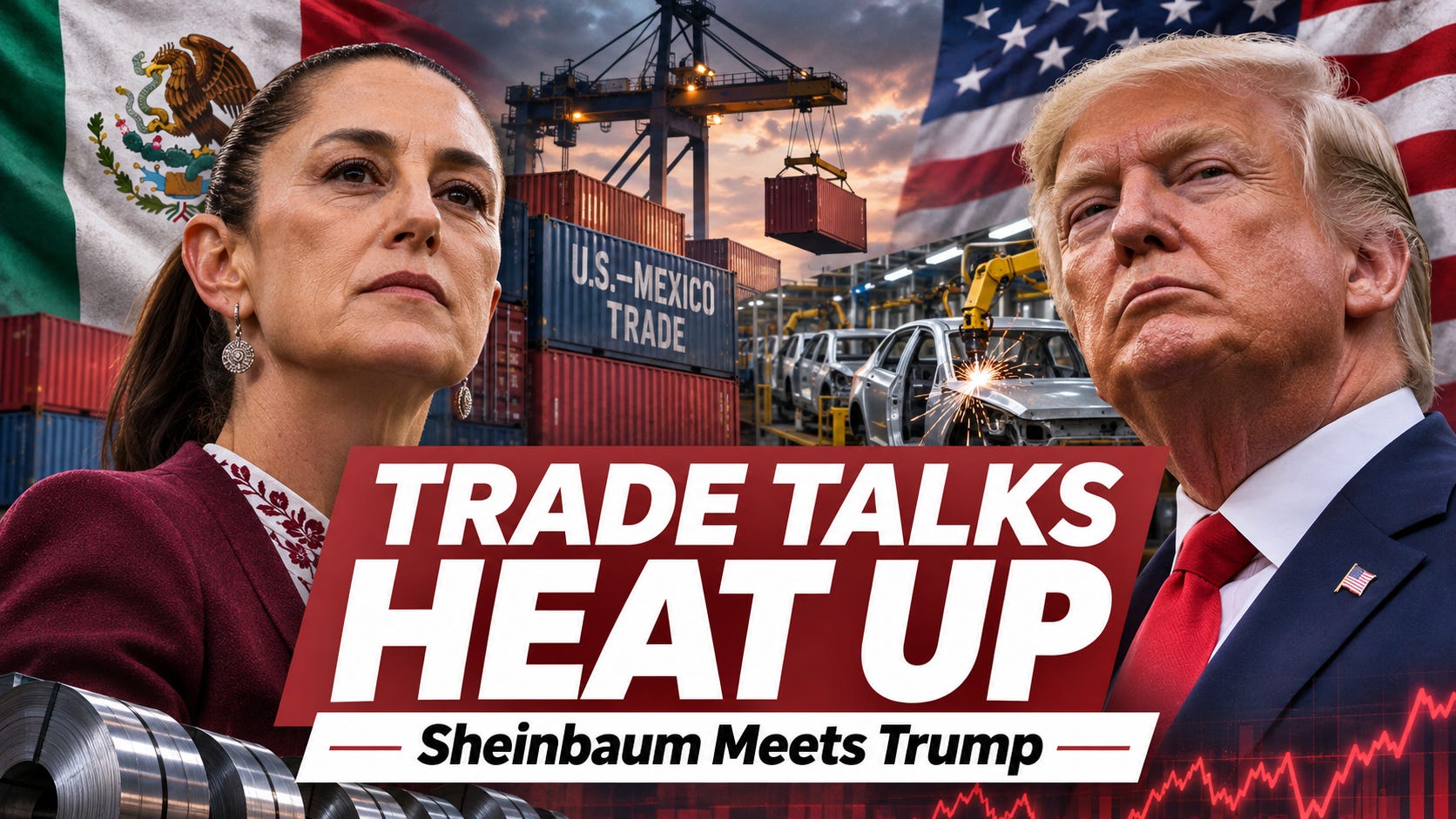
Claudia Sheinbaum and Donald Trump sat down together in China. And apparently, everybody was in a good mood.
Mexico’s president described Wednesday’s meeting with Trump in Shenzhen, China, as a very good one. She also said negotiations between the two countries over trade are now “very far along.”
She even mentioned that Trump was in a very good mood.
Well, that’s encouraging. But forgive me for wanting a little more than a presidential mood report when Mexico’s economic future is sitting on the negotiating table.
Here’s what makes this meeting so important.
Mexico and the United States aren’t simply neighbors who happen to trade a few products across the border. Their economies are practically joined at the hip.
A vehicle assembled in Mexico might contain parts manufactured in the United States, components shipped back and forth across the border, and steel purchased from another supplier. By the time that vehicle reaches a dealership, several communities on both sides of the border may have contributed to building it.
That’s why Washington’s tariffs on Mexican vehicles, steel, and aluminum matter so much.
According to Reuters, the two countries traded approximately $779 billion in goods during the first nine months of 2026.
That’s a staggering amount of economic activity to have hanging on political negotiations.
And while roughly 80% of Mexican exports currently enter the United States tariff-free, the remaining restrictions hit some particularly important industries.
There’s also a little problem called the USMCA.
If you’ve lived in Mexico for a while, you’ve probably heard politicians talk endlessly about the USMCA, or T-MEC as it’s called here. It’s the trade agreement between Mexico, the United States, and Canada that replaced NAFTA in 2020.
Think of it as the rulebook that helps businesses decide where to build factories, hire workers, and invest millions of dollars.
Back in July, Washington declined to extend that agreement for another 16 years under its current terms.
That doesn’t mean the agreement disappeared overnight. It remains in effect, potentially until 2036, but without a new extension agreement, the three countries face annual reviews.
And businesses generally aren’t enthusiastic about making billion-dollar investment decisions when the rules might keep changing.
Imagine deciding whether to build a new factory in Mexico when you can’t confidently predict what tariffs your products might face in the American market.
Would you invest immediately? Or would you hold onto your money until the politicians figured things out?
Multiply that hesitation across hundreds of companies, and you begin to see why these negotiations matter well beyond government offices.
Now, here’s the part I find particularly interesting.
The meeting happened in China.
Yes, China. The very country whose growing economic influence has become one of Washington’s biggest concerns.
Mexico has been trying to expand its international commercial relationships while simultaneously convincing the Trump administration that Chinese goods won’t simply pass through Mexico to avoid American tariffs.
That’s quite a balancing act.
Sheinbaum wants Mexico to attract investment, manufacture products, sell to the United States, and develop opportunities elsewhere in the world.
Trump wants stronger protections for American industries and assurances that Mexico won’t become a convenient back door for Chinese exports.
Neither position is particularly surprising. But satisfying both sides without sacrificing Mexico’s economic interests is another matter entirely.
And remember, trade isn’t the only issue Trump has connected to tariffs. Just last week, he threatened to double tariffs on Mexico over migrant caravans.
That tells me something important about how unpredictable these negotiations can become.
One day, the conversation is about manufacturing and trade agreements. The next, an immigration dispute threatens to change the economic equation.
So what does all of this mean for those of us living in Mexico?
Probably nothing dramatic when we wake up tomorrow morning.
Your grocery bill isn’t suddenly going to change because two presidents shook hands in a hotel in Shenzhen.
But over time, trade uncertainty can affect business investment, employment, manufacturing, and the overall strength of Mexico’s economy.
And whether you’re Mexican, American, Canadian, retired here, or running a small business, a healthy Mexican economy is something we should all care about.
For Americans and Canadians living on foreign pensions or earning money abroad, currency movements can also affect how far those dollars go. That doesn’t mean this meeting will send the peso in any particular direction, but economic confidence is part of the larger picture.
I also think we sometimes underestimate how much Mexico has changed.
This isn’t simply a country dependent on beach vacations, inexpensive retirement, and American tourists. Mexico is an industrial powerhouse with manufacturing operations deeply connected to the global economy.
What happens to those factories, their workers, and future investment matters to the communities where we live, even if we never set foot inside an industrial park.
The good news? They’re talking. The unanswered question? What are they actually agreeing to?
Sheinbaum says negotiations are progressing, and the two presidents expect to meet again at the G20 gathering in Miami in December.
That’s encouraging.
But I wouldn’t confuse diplomatic optimism with an economic breakthrough just yet.
There’s been no announced breakthrough on the tariffs Mexico most wants removed. And until we see the actual terms of an agreement, nobody really knows how much Mexico will gain or what it might have to concede.
Personally, I’d rather see Mexico negotiate carefully and come away with something substantial than rush into an agreement simply to produce a flattering headline.
The country needs investment certainty, competitive industries, and a trade relationship that doesn’t feel like it’s being renegotiated every time another political disagreement erupts.
A friendly meeting is a start.
But here’s the question I’ll be asking when the next round of optimistic headlines arrives:
Did Mexico actually get a better deal, or did everyone just leave the room smiling?
Because those are two very different things.
Source: Reuters, November 18, 2026.