
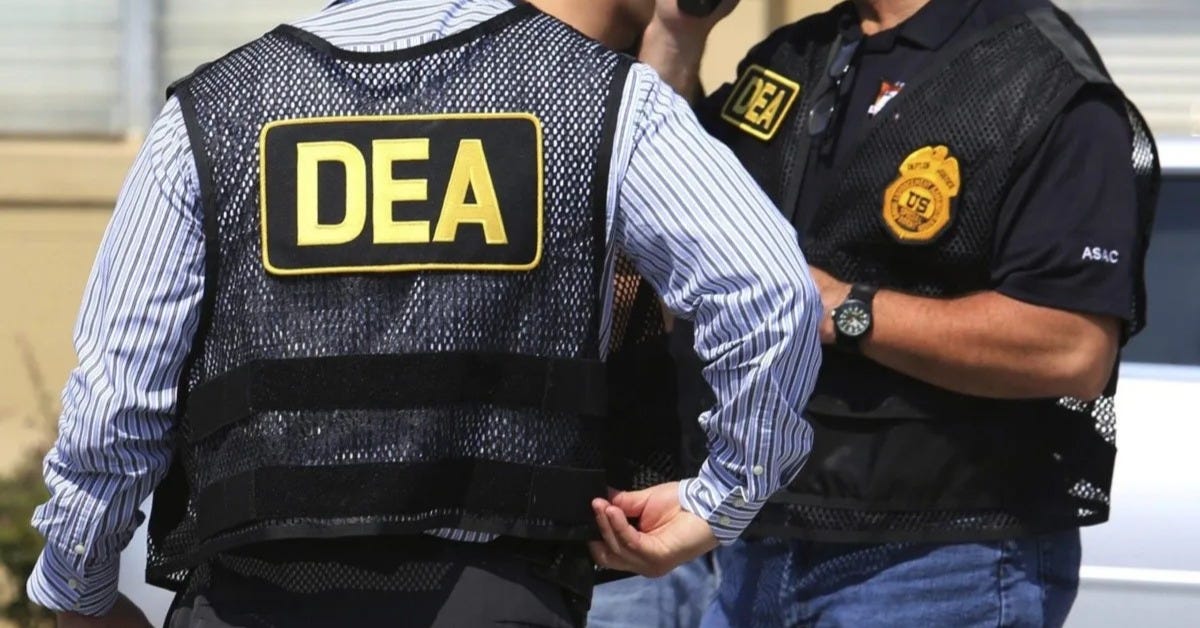
A new U.S. drug strategy is turning fentanyl from a law enforcement issue into a national security fight. The plan describes cartels as a direct threat to the United States and treats fentanyl as part of a “chemical war” against Americans. That shift gives Washington more room to use counterterrorism, financial, intelligence, and military-linked tools. For Mexico, the pressure is no longer just about drug seizures. It is now about measurable results against cartels, labs, chemical suppliers, money laundering, and corruption.
U.S. fentanyl strategy raises pressure on Mexico
The United States has placed fentanyl trafficking at the center of a sharper security strategy that increases pressure on Mexico and Mexican criminal groups.
The 2026 National Drug Control Strategy treats fentanyl not only as a public health crisis but as a threat to U.S. national security. The plan frames the crisis as a “chemical war” carried out by cartels and other criminal networks.
That language matters. It moves the issue beyond traditional drug enforcement. It also opens the door to broader legal, financial, and counterterrorism tools that were designed for national security threats.
Mexico is central to that strategy because U.S. officials identify Mexican cartels as major producers and traffickers of fentanyl and methamphetamine. The United States has also pointed to chemical suppliers, financial networks, ports of entry, and corrupt protection systems as part of the wider problem.
The new approach does not mean one single policy has changed overnight. It is better understood as an escalation. Washington is placing greater emphasis on arrests, extraditions, lab seizures, precursor chemical controls, and financial enforcement.
For Mexico, that means the relationship with the United States is moving into a more demanding phase.
From drug crime to national security threat
For decades, U.S. drug enforcement largely operated through criminal and narcotics laws. Those tools remain in place. But the new strategy layers national security language on top of them.
That is the main change.
The United States has already designated several cartels as foreign terrorist organizations. It has also classified illicit fentanyl and key precursor chemicals as weapons of mass destruction under a presidential order.
Those terms are not just political labels. They can change how agencies investigate, prosecute, sanction, and track criminal groups.
In practice, that could mean more use of intelligence tools, more financial sanctions, more pressure on banks and logistics firms, and stronger criminal cases against people accused of helping cartel networks.
It also increases risk for anyone who knowingly provides material support to a designated group. That can include money, equipment, transportation, safe houses, technology, or other services.
For readers in Mexico, the practical effect is likely to be indirect. The pressure may show up through more enforcement at ports, more extradition requests, more scrutiny of financial institutions, and more joint security demands.
It does not automatically mean U.S. troops will operate in Mexico. Mexico has repeatedly drawn a line in the sand on sovereignty. But it does make the diplomatic space more tense.
Why fentanyl changed the debate
Fentanyl is different from older drug threats because small amounts can be lethal, and production does not require large crop fields. It can be made in clandestine labs using chemical precursors that move through global supply chains.
That makes it harder to stop with traditional anti-drug tools.
A heroin or cocaine route may depend on agricultural production, territory, and long transport corridors. Synthetic drugs depend more on chemicals, lab equipment, logistics, money laundering, and corrupt protection.
That is why the U.S. strategy focuses on the full supply chain. It targets precursor chemicals, production labs, border routes, cartel finances, and digital communications.
U.S. agencies say two Mexico-based groups, the Sinaloa Cartel and the Jalisco New Generation Cartel, are central to the synthetic drug crisis. Both groups have long been tied to fentanyl, methamphetamine, weapons trafficking, and money laundering.
The scale of overdose deaths in the United States explains the political force behind the new strategy. U.S. overdose deaths declined in 2024, but they remain high. Synthetic opioids, mainly illicit fentanyl, continue to drive much of the crisis.
That gives the issue unusual political weight in Washington.
What Washington wants from Mexico
The United States is asking for more than public promises. The new strategy points toward measurable results.
That could include more arrests of cartel leaders, more extraditions, more lab raids, more seizures of fentanyl and precursor chemicals, and stronger action against money laundering.
It also means more pressure on ports, customs systems, shipping companies, and financial institutions.
The United States wants Mexico to show that it can disrupt cartel command structures, not just seize drugs after they are already moving.
This is where the pressure becomes more difficult for Mexico. Cartels do not operate only through gunmen. They also rely on political protection, local police contacts, shell companies, real estate, logistics firms, and cash-heavy businesses.
That means a serious crackdown can quickly become political.
Recent U.S. accusations against Mexican officials have already heightened tensions. Mexico has said accusations must be backed by evidence and handled through legal channels. Washington, meanwhile, is signaling that cartel protection networks are part of the problem.
That disagreement could define the next stage of security relations.
Mexico’s balancing act
Mexico faces a difficult balance.
On one side, the country needs cooperation with the United States. The border, trade, banking system, and security relationship are too connected to ignore. Mexico also has its own interest in weakening criminal groups that control territory, extort businesses, and challenge local authorities.
On the other hand, Mexico does not want U.S. security policy to serve as a license for unilateral action on Mexican soil.
The sovereignty issue is not symbolic. It is central to Mexican politics. Any sign that Washington is directing operations inside Mexico can create backlash, even when the target is organized crime.
That is why Mexico is likely to cooperate in areas framed as Mexican-led. Arrests, extraditions, port inspections, financial investigations, and chemical controls may expand. But overt U.S. operational involvement inside Mexico will remain politically sensitive.
The relationship may become more transactional. Washington will ask for numbers. Mexico will ask for respect, evidence, and limits.
What this means for daily life in Mexico
For most foreign residents in Mexico, this strategy will not immediately change daily life.
The bigger impact may be seen in national security policy, border procedures, banking compliance, and political tensions between Mexico City and Washington.
There could be more visible enforcement in states tied to cartel production or trafficking routes. There may also be more scrutiny of businesses, real estate transactions, and financial flows linked to organized crime.
Travelers and residents should not read the strategy as a sign of sudden nationwide danger. Mexico’s security risks remain highly local. They vary by state, city, and neighborhood.
The more important point is that Mexico’s organized crime problem is being pulled deeper into U.S. national security policy. That raises the stakes for both governments.
If cooperation holds, the pressure may produce more arrests and financial disruption. If cooperation breaks down, the same pressure could create diplomatic conflict.
The fentanyl crisis is now about more than drugs. It is about security, sovereignty, trade, intelligence, and the future of U.S.-Mexico cooperation.