
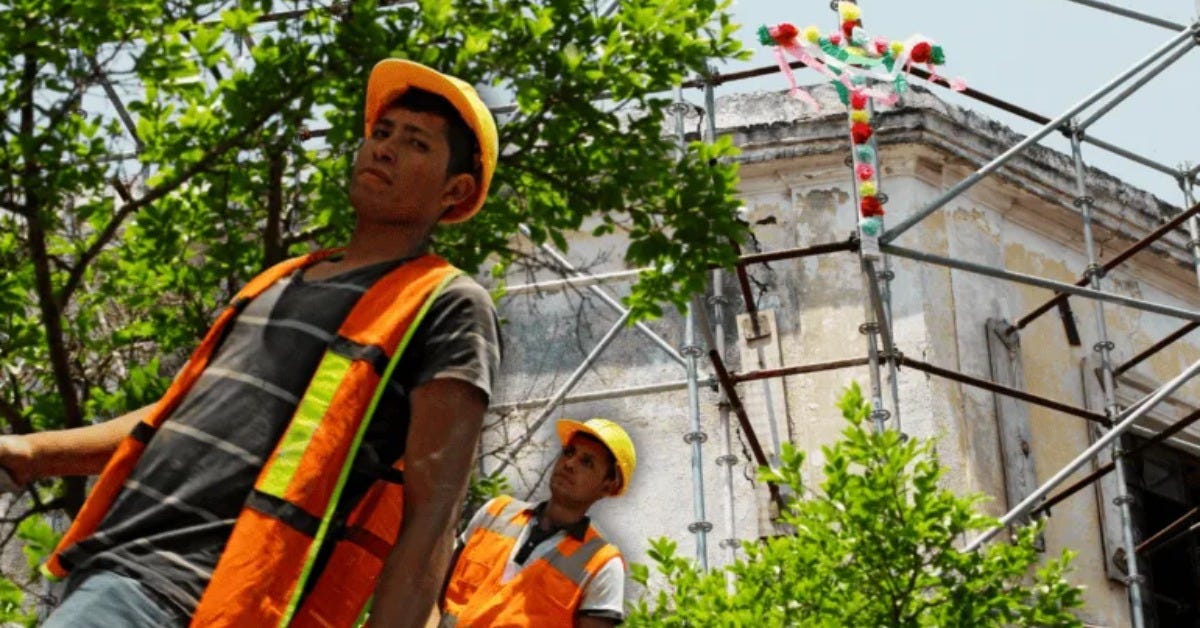
Anyone living in Mexico long enough will eventually notice it: a bright cross above an unfinished building on May 3. The tradition may look simple from the street, but it carries a deeper meaning. For construction workers, the day blends faith, workplace identity, safety, gratitude, and community. It is also one of those Mexican customs that can be easy to miss unless someone explains what is happening above the rooftops.
Mexico prepares for Día de la Santa Cruz tradition
Across Mexico, many construction sites will look different on May 3. On rooftops, scaffolding, and unfinished concrete frames, workers often place a decorated wooden cross covered with flowers, ribbons, paper, or other bright materials.
The custom marks Día de la Santa Cruz, or Day of the Holy Cross. In Mexico, the date is also widely known as Día del Albañil, a day tied closely to construction workers.
For many foreigners living in Mexico, it may be one of those traditions seen from a distance, with little explanation. A cross suddenly appears above a half-built home. Workers gather for food. Firecrackers may be heard near a job site. In some places, a priest may bless the cross before it is taken back to the worksite.
The tradition is not only about religion. It is also about labor, identity, and community.
Why crosses appear on construction sites
The most visible part of the tradition is the cross itself. Workers usually place it at the highest point of the construction site, where it can be seen from the street.
The cross is often decorated with flowers, colored paper, ribbons, or cloth. Some are made quickly from wood at the site. Others are saved and reused each year.
The act has a practical meaning for those who take part. The cross is placed to ask for protection during construction work, which can be dangerous. It is also used to give thanks for work and to ask that the project reach completion.
For construction crews, the day can bring a pause in the normal routine. A blessing may take place. Workers may share a meal. In some communities, the owner, builder, or project manager provides food for the crew.
That meal matters. It is not just a courtesy. It is part of the day’s social meaning. It recognizes the people whose labor turns plans, permits, and materials into homes, shops, hotels, and public buildings.
A religious date with a Mexican working-class meaning
The Catholic tradition behind Día de la Santa Cruz is linked to the veneration of the cross and to the story of Saint Helena, mother of Emperor Constantine, who searched for the cross associated with the crucifixion of Jesus.
In Mexico, the meaning changed over time. During the colonial period, Catholic practices mixed with local customs, seasonal rituals, and community celebrations. May also has importance in many parts of Mexico because it comes near the start of the rainy season.
That timing helped the celebration take root beyond churches. The cross became a symbol used in fields, homes, hills, communities, and later construction sites.
Among builders, the date became especially important. Over time, Día de la Santa Cruz became closely linked with Día del Albañil, honoring masons and other construction workers.
Today, the custom is practiced in different ways across the country. In some places, it remains strongly religious. In others, it is more of a workplace and community tradition. Often, it is both.
What the day looks like in daily life
The celebration can vary by region, town, and job site. Still, the basic pattern is familiar in many parts of Mexico.
Workers prepare or decorate a cross. The cross may be taken to Mass or blessed at the site. It is then placed high on the building under construction.
The workday may include music, food, and a gathering among workers. In some places, firecrackers are used. The meal can be simple or more formal, depending on the crew and the project.
For people new to Mexico, the day may explain why an unfinished building suddenly has a festive look. It may also explain why activity at some construction sites changes at certain times of day.
It is not a national public holiday in the way Independence Day or Christmas is. Banks, schools, and government offices generally continue normal operations. But within construction culture, May 3 carries its own weight.
A tradition tied to risk and recognition
The link between the cross and construction work is easy to understand once the risks are considered. Building sites involve heights, heavy materials, tools, dust, and unstable surfaces. For many workers, the cross is a request for safety.
But the tradition also speaks to recognition. Construction workers are often visible throughout Mexico, yet their labor is often taken for granted. Día del Albañil gives public meaning to that work.
The decorated cross makes the workers’ presence visible in another way. It says that a building is not only a real estate project or a private investment. It is also the product of human labor.
That is why the day has remained relevant. It serves as a public symbol of a trade that shapes Mexico’s cities, towns, and neighborhoods.
Why this matters for expats in Mexico
For foreigners living in Mexico, Día de la Santa Cruz is a reminder that many local traditions are layered. What may look like a small religious custom from the outside can carry social, historical, and workplace meaning.
The day also helps explain the rhythm of local life. Construction is part of the daily sounds and scenery in many Mexican cities. On May 3, those job sites may briefly become places of celebration.
It is also a useful reminder to see the workers behind the buildings. Many expats live in homes, condos, and neighborhoods shaped by construction labor. This tradition places those workers at the center of the story, even if only for one day.
The decorated cross is easy to miss. But once people understand it, May 3 becomes one of those small details that make Mexico easier to read.