
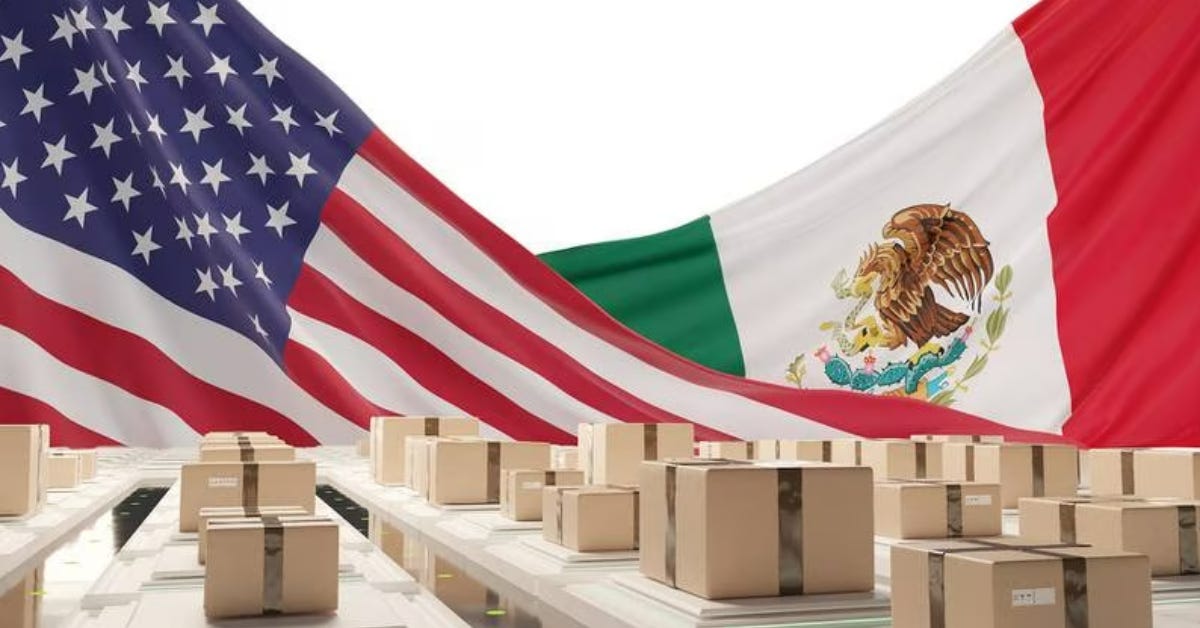
Mexico talks often include the word “diversification,” especially when tensions rise with Washington. But Mexico’s economy remains deeply tied to the United States through exports, manufacturing, supply chains, investment, remittances, and consumer prices. The T-MEC review is a reminder that one trade agreement does not just affect big companies. It helps shape factory jobs, grocery prices, small-business costs, the peso, and investors' confidence in deciding where to build next.
Why This Matters Now
Mexico is entering another sensitive period with the United States as the T-MEC review moves forward. The trade deal, known as USMCA in the United States and CUSMA in Canada, is not just a technical agreement between governments. It is the framework behind a large share of Mexico’s modern economy.
Economy Secretary Marcelo Ebrard has warned that the review may not have a quick conclusion and could lead to ongoing discussions, possibly on an annual basis. U.S. and Mexican officials have also agreed to hold an official bilateral negotiating round for the review in Mexico City during the week of May 25, 2026.
At the same time, Mexico is trying to expand trade with Europe and Asia. The European Union has authorized the signing of updated agreements with Mexico, including an interim trade agreement and a broader modernized partnership. Those agreements are meant to improve market access, remove some remaining trade barriers, and deepen investment ties.
That push matters. But it does not change the central fact: Mexico’s economy is still built around North America.
What T-MEC Actually Does
T-MEC is the trade agreement between Mexico, the United States, and Canada. It replaced NAFTA in 2020 and sets the rules for much of the region’s commerce.
The agreement covers far more than tariffs. It includes rules for autos, agriculture, labor, digital trade, intellectual property, customs procedures, and dispute resolution. For companies, it helps answer basic questions: where parts can come from, how much regional content a product needs, what paperwork is required, and whether a product can cross borders with reduced or no tariffs.
That matters because Mexico does not simply sell finished goods to the United States. Many products cross borders as part of a shared production chain. A car part may be made in Mexico, sent to the United States, combined with other components, and later returned as part of a larger product. The same logic applies to electronics, machinery, medical devices, and other manufactured goods.
The agreement also includes a built-in review process. Under Article 34.7, the deal has a 16-year term unless the three countries confirm that they want to extend it. The first joint review comes on the sixth anniversary of the agreement’s entry into force. If all three countries agree to extend it, the agreement continues for another 16 years. If not, reviews continue every year for the remainder of the term.
That is why the review matters so much. It is not an automatic expiration, but it can create uncertainty.
Exports Are the Clearest Sign of Dependence
The easiest way to understand Mexico’s dependence on the United States is to look at trade.
The U.S. Trade Representative reported that goods trade between the United States and Mexico totaled an estimated $872.8 billion in 2025. U.S. imports from Mexico reached $534.9 billion, while U.S. exports to Mexico totaled $338 billion.
From Mexico’s side, the relationship is even more concentrated. Data México reported that in November 2025 alone, Mexico exported $45.2 billion in goods to the United States and imported $19.9 billion from the United States. That produced a monthly trade balance of $25.3 billion in Mexico’s favor.
This is why Mexico pays close attention to U.S. politics. A tariff decision in Washington can affect factories in Nuevo León, Chihuahua, Coahuila, Guanajuato, Puebla, Baja California, and other states tied to export manufacturing.
It Is Not Just About Cars
Autos are the best-known example of Mexico’s export economy, but they are only part of the picture.
Mexico sells vehicles, auto parts, electronics, machinery, appliances, medical devices, agricultural goods, beer, tequila, and other products into the U.S. market. Data México reported that Mexico’s main export to the United States in 2024 was motor vehicles for the transport of persons, valued at $41.4 billion. It also listed major origins of sales to the U.S. as Ciudad de México, Chihuahua, and Nuevo León.
That shows how broad the relationship has become. This is not only a story of the northern border. The U.S. market influences factory investment, logistics, transport, industrial parks, ports, customs activity, and employment across much of the country.
For some Mexican regions, U.S. trade is the backbone of local growth. For others, it affects prices, jobs, and business confidence indirectly.
Supply Chains Make the Relationship Hard to Untangle
Mexico’s economic dependence on the United States is not only about who buys the final product. It is also about how products are made.
North American supply chains have been built over decades. Companies choose locations based on highways, rail links, ports, suppliers, labor skills, customs rules, and access to the U.S. consumer market. Once those systems are in place, they are not easy to move.
This is one reason “diversification” is easier said than executed.
Mexico can sign more agreements with Europe, strengthen ties with Asia, and look for new buyers in Latin America. But replacing the U.S. market is not simple. The United States is nearby, wealthy, familiar to exporters, and connected by roads, railways, and decades of production planning.
Europe and Asia offer opportunities, but distance adds costs. Different regulations add complexity. Smaller export volumes make shipping and distribution harder. For many companies, selling to the U.S. remains the most practical option.
Nearshoring Has Made the Link Even Stronger
Nearshoring is often presented as a way for Mexico to benefit from global change. In simple terms, it means companies move production closer to their main customers instead of relying on distant factories.
Mexico has a clear advantage here. It borders the United States, has an established manufacturing base, participates in T-MEC, and already has suppliers tied into North American production.
That has made Mexico attractive to companies trying to reduce dependence on China or shorten supply chains. But nearshoring also deepens Mexico’s connection to the U.S. economy. If new factories are built mainly to serve U.S. customers, Mexico’s export base grows, but so does its exposure to U.S. demand and U.S. policy.
That is the trade-off. Nearshoring can bring investment and jobs, but it does not necessarily make Mexico more independent.
Tariffs Are the Pressure Point
Tariffs are taxes on imported goods. When the United States imposes or threatens tariffs, the effects can move quickly through Mexico’s economy.
A tariff can make Mexican exports more expensive in the U.S. market. That can hurt sales, reduce orders, delay investment, or push companies to adjust supply chains. In some cases, companies may absorb part of the cost. In others, the cost may be passed on to buyers.
Tariff pressure also creates uncertainty. Businesses do not need a tariff to be permanent for it to affect decisions. If a company is unsure whether a product will face new costs next year, it may delay hiring, expansion, or investment.
This is why the T-MEC review matters beyond government offices. The longer the uncertainty continues, the more companies may hesitate.
What It Means for Consumers, Retirees and Small Businesses
For everyday residents in Mexico, trade policy can seem distant. But it can affect daily life in several ways.
If tariffs or trade disputes raise costs for imported goods, consumers may see higher prices. This can include food products, appliances, vehicles, building materials, electronics, and other goods that depend on cross-border supply chains.
Retirees and foreign residents may also feel the effects through the exchange rate. Trade uncertainty can influence investor confidence, which can affect the peso. A weaker or stronger peso changes the purchasing power of people living on a dollar, Canadian dollar, or euro income.
Small businesses can be affected through inventory costs, shipping delays, supplier changes, and shifts in consumer spending. A restaurant, hardware store, repair business, real estate office, or tour company may not export anything, but it can still feel the impact of higher costs or weaker household confidence.
Why Diversification Is Still Worth Pursuing
Mexico’s effort to diversify is not meaningless. It makes sense for any country to avoid relying too heavily on a single market.
The updated EU-Mexico agreements are part of that strategy. The European Council said EU-Mexico goods trade was valued at more than €86 billion in 2025, and the EU was Mexico’s third-largest trading partner after the United States and China.
That relationship gives Mexico more options, especially for agriculture, services, investment, and higher-value manufacturing. Trade with Asia also matters, especially because many Asian companies already operate in Mexico to serve North America.
But diversification is a long-term project. It requires infrastructure, export promotion, financing, logistics, regulatory alignment, and companies willing to build new customer relationships. It is not achieved by signing a single agreement or announcing a new strategy.