
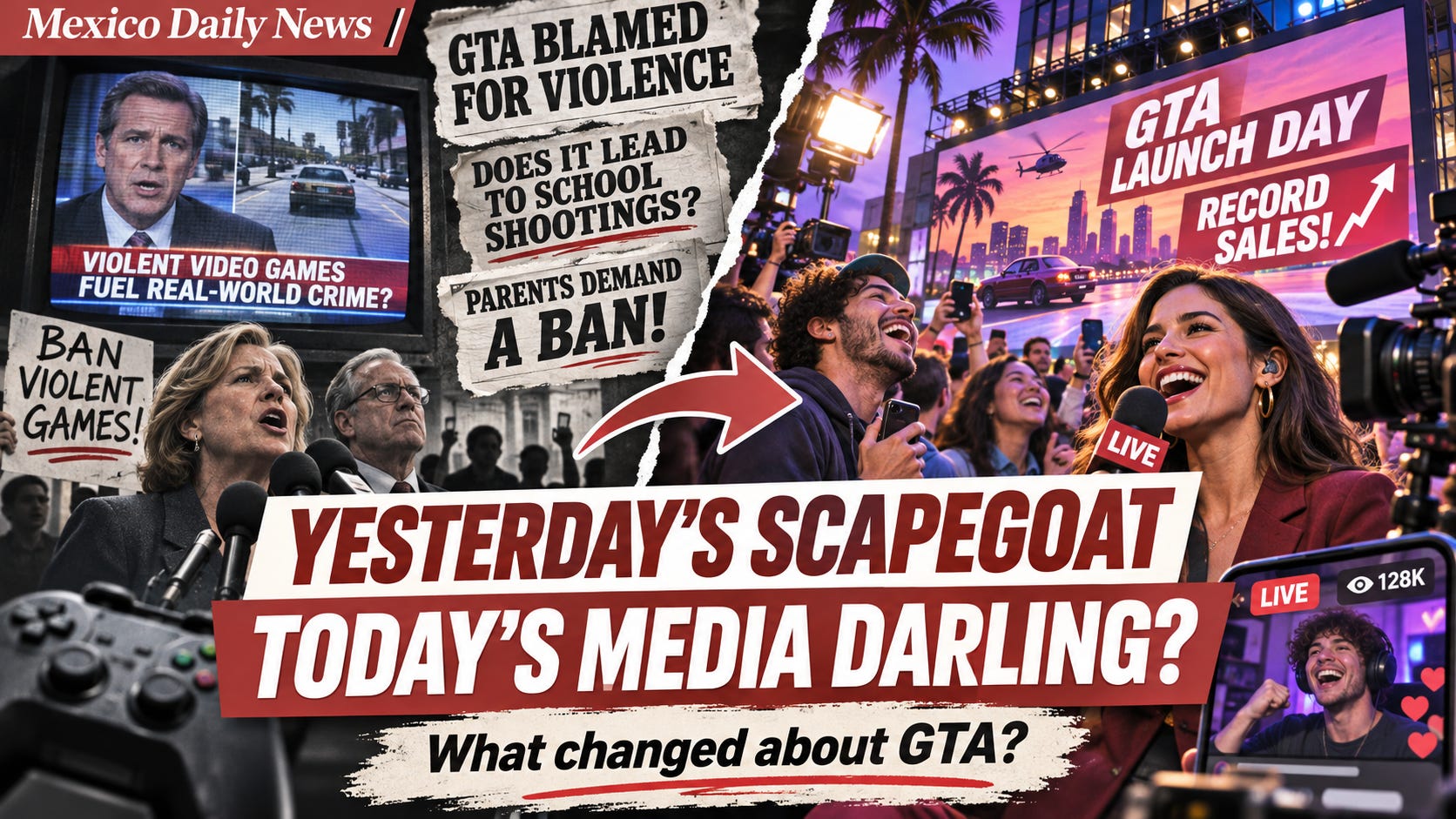
For years, politicians and television commentators warned that Grand Theft Auto was corrupting American children and contributing to real-world violence. Today, the same franchise is being celebrated like a national holiday. Did the game change, or did the media simply forget its own history?
It’s another warm afternoon in Mexico. The ice is melting in your drink, somebody’s phone is playing a video a little too loudly, and American headlines are making their usual appearance between conversations about the weather and what’s happening back home.
Except today’s big American story isn’t another political scandal or Washington showdown. It’s the release of a video game that, not so long ago, was practically accused of destroying civilization.
Welcome to November 19, 2026, the day Grand Theft Auto VI officially arrived.
And apparently, we’re all supposed to celebrate.
Wait, wasn’t this game supposed to be turning kids into killers?
I’m old enough to remember when mentioning Grand Theft Auto on American television meant you were probably about to hear a very serious discussion about violence, troubled teenagers, and the moral collapse of society.
There would be concerned parents, politicians demanding action, and television personalities explaining why letting teenagers steal imaginary cars and shoot imaginary people was somehow connected to real-world crime.
School shootings inevitably entered the conversation.
Fast-forward to today, and the coverage looks remarkably different.
Television networks are reporting on excited fans. Gaming journalists are practically throwing confetti. Reviewers are calling the new installment a masterpiece, while YouTube has turned the launch into a 24-hour celebration of people playing the game.
CBS News is covering the crowds rushing to play it. Reuters is discussing enormous sales expectations. The Washington Post has praised the game as an astonishing American epic.
And I’m sitting here thinking: Are we all just going to pretend the last 25 years never happened?
Let’s revisit the years when GTA was public enemy number one
Back in 2005, Hillary Clinton was a U.S. senator, and Grand Theft Auto was one of the games at the center of a political campaign to restrict what minors could buy.
Clinton joined senators Joseph Lieberman and Evan Bayh in introducing legislation aimed at restricting sales of violent and sexually explicit video games to children.
That year’s controversy also involved hidden sexual content in Grand Theft Auto: San Andreas, which resulted in the game receiving a more restrictive Adults Only rating and being pulled from many store shelves.
It wasn’t just some angry parent complaining at a school board meeting. Washington was getting involved.
California went even further, passing a law restricting sales of certain violent video games to minors. The courts blocked it, and in 2011 the U.S. Supreme Court struck it down on First Amendment grounds.
Think about that for a moment.
We went from trying to restrict violent video games through legislation that reached the highest court in the country to treating the latest GTA release like the entertainment industry’s version of the Super Bowl.
But the most disturbing chapter was still to come.
Then came the school shootings
In December 2012, after the horrific Sandy Hook Elementary School shooting in Connecticut, the National Rifle Association’s Wayne LaPierre held a nationally televised press conference.
Twenty children and six adults had been murdered at the school.
America was devastated and arguing about what could possibly prevent another tragedy.
And there was LaPierre, naming Grand Theft Auto among violent video games he accused of helping spread a culture of violence.
The message was unmistakable: violent entertainment was part of the problem.
The allegations didn’t disappear after Sandy Hook, either.
In 2018, following the Parkland high school shooting in Florida, President Donald Trump brought video game executives and critics to the White House to discuss whether violent games were influencing young people.
Representatives associated with the companies behind Grand Theft Auto were part of that discussion.
The implication was once again that violent games deserved scrutiny in the aftermath of a school massacre.
We’re not talking about ancient history. That White House meeting happened just eight years ago.
And today we’re watching news organizations enthusiastically cover the release of another installment in the same franchise.
Nobody seems particularly worried that a teenager might steal a car after watching a reporter discuss how impressive the graphics are.
Funny how quickly the national conversation can change.
Here’s where things get interesting: The science never supported the panic
Before anyone misunderstands me, I’m not suggesting the old accusations were correct.
Quite the opposite.
In 2020, the American Psychological Association made something important clear: there wasn’t sufficient scientific evidence to establish that violent video games caused violent criminal behavior, including mass shootings.
Researchers had examined possible connections between violent games and some forms of aggression, but that wasn’t the same thing as proving that virtual gunfire leads to actual murder.
It’s a pretty important distinction.
Millions of people have played Grand Theft Auto without ever committing a violent crime.
And American school shootings are far too serious and complicated to explain away by pointing at a PlayStation controller.
Personally, I think the old blame game was a convenient distraction. It’s easier to point at a video game than confront the much messier questions surrounding firearms, mental health, warning signs, and failures to intervene.
But here’s what bothers me about today’s coverage.
If the evidence never justified the panic, where’s the acknowledgment that the public was repeatedly subjected to these accusations?
When did the national conversation change, and why wasn’t that change itself worth explaining?
The game didn’t become family-friendly. The media became fans.
Let’s be clear about something else.
Grand Theft Auto VI hasn’t turned into a wholesome game about volunteering at animal shelters and helping elderly neighbors cross the street.
Rockstar Games still lists intense violence, blood and gore, sexual content, drugs, and strong language among its content warnings.
The franchise still revolves around crime, chaos, and the freedom to behave in ways most of us wouldn’t dream of behaving in real life.
That’s part of its appeal.
So the striking difference isn’t that GTA suddenly stopped being violent.
It’s that violent video games are no longer routinely presented as an unfamiliar threat to America’s children. They’re mainstream adult entertainment, consumed by an enormous audience that includes plenty of people who now work in the news business.
There’s also a rather obvious financial angle.
Grand Theft Auto VI is a massive entertainment event, and enormous entertainment events attract audiences.
Audiences mean clicks, views, advertising revenue, and more opportunities to keep people engaged.
A reporter playing GTA live online today might attract far more attention than another stern discussion about whether imaginary violence corrupts young minds.
Maybe that’s progress. Maybe it’s business. I suspect it’s a little of both.
And to be fair, not everyone has forgotten
There are still critics warning about violent games, and some news outlets are revisiting those concerns.
In fact, longtime GTA critic Jack Thompson was back in the headlines this week, repeating warnings about violent games and mass shootings.
Other reporters are examining the history of the controversy rather than simply joining the launch party.
So it would be unfair to say absolutely nobody is discussing GTA’s past.
But those conversations feel like a sideshow compared with the enormous celebration surrounding this release.
And what I find remarkable isn’t simply that attitudes have changed.
It’s how comfortable much of the news industry seems to be with the new attitude, without revisiting the fears that once commanded so much airtime.
I don’t want GTA banned. I want the media to remember.
I don’t have a problem with adults enjoying Grand Theft Auto.
If someone wants to spend their weekend exploring a fictional version of Florida, stealing virtual sports cars, and escaping from virtual police officers, that’s their business.
I might even join them.
And I certainly don’t think television news needs to return to the days of treating video games as a national emergency.
But I do think there’s something worth examining when an entertainment franchise travels from the center of a national moral panic to the center of a national celebration.
The politicians who raised alarms were real. The legislative efforts were real. The television discussions connecting violent games to school shootings were real.
And the fear those conversations helped spread was real, too.
This doesn’t mean every journalist supported those accusations. Some challenged them at the time, and others simply reported what public officials were saying.
But the news industry helped give those claims a national stage.
Now it has an opportunity to explain what changed.
That’s the conversation I’d actually like to see on television today, somewhere between the glowing reviews and the live gameplay.
Because perhaps Grand Theft Auto was never the greatest danger to young American minds that some people claimed.
Perhaps the bigger lesson is how easily an entire country can be persuaded to fear something, and how quietly that fear can disappear when the cultural mood changes.
Yesterday, GTA was accused of helping create America’s killers. Today, it’s being celebrated as one of America’s greatest entertainment achievements.
And somewhere between those two headlines is a story about the American media that deserves a little more attention.
What do you think? Has America finally grown up about video games, or has the media conveniently forgotten a controversy it once helped fuel?